
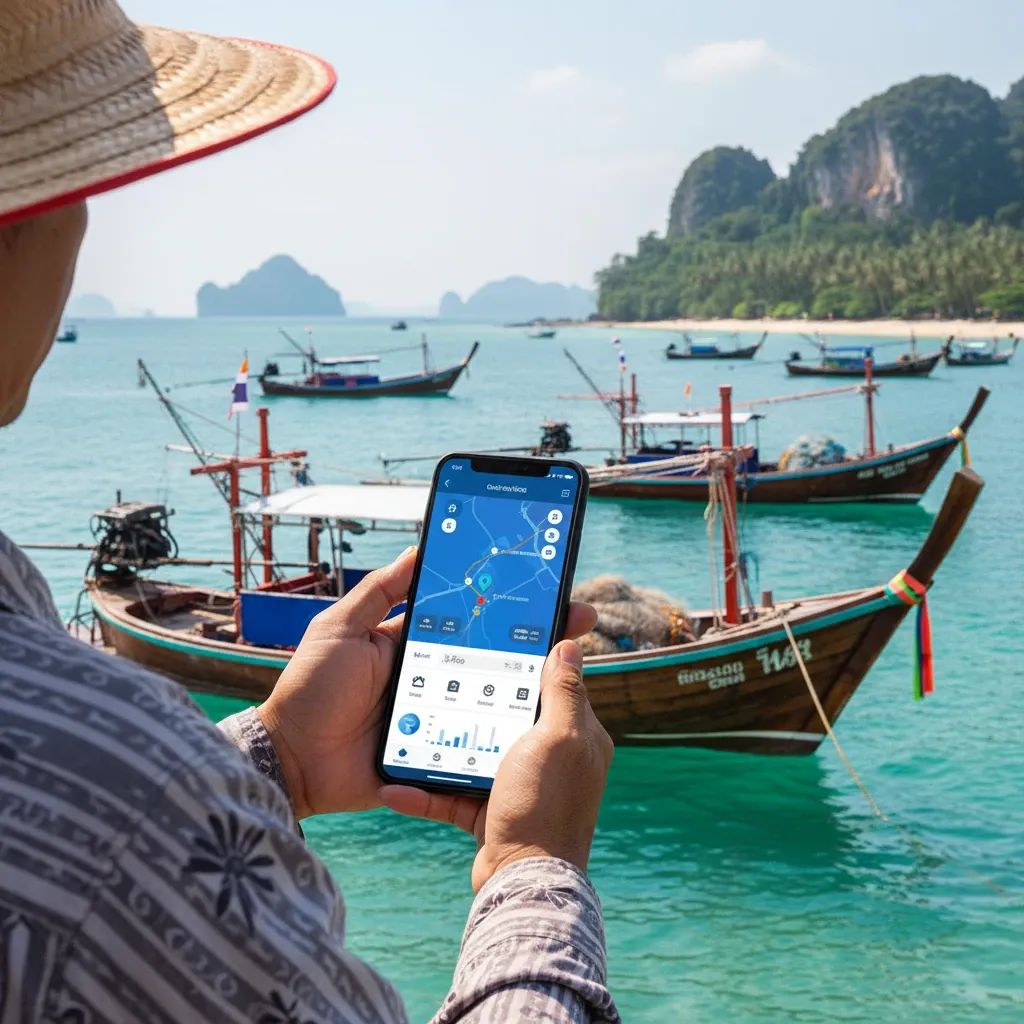
Thailand's Department of Fisheries has found itself in an awkward position: defending a 9-million-baht government app that has become the subject of national ridicule. Launched in early May 2024, the Thailand FishAI application promised to modernize species identification for the fishing industry. Instead, it has stumbled out of the gate, reliably identifying only 50 of its advertised 2,000 species while misidentifying everything from fried dough to shrimp with embarrassing consistency.
Why This Matters
• Fishermen cannot rely on it yet: Commercial fishing operators and aquaculture farmers have access to an unreliable tool when they need dependable field support; most continue consulting printed guides and expert phone calls instead.
• The accuracy gap is massive: The app identifies roughly 2.5% of its catalogued species, while international competitors like Indonesia's FishFace already achieve 95% accuracy on their species sets.
• Opportunity cost for taxpayers: At 9 million baht (approximately $244,000 USD, or roughly 300,000 baht per month for 30 months—comparable to the annual budget of several government vocational training centers), the question emerges whether Thailand would have gained more practical value from licensing existing platforms rather than building a prototype.
• Citizen-science experiment in progress: The department is essentially asking the public to volunteer as data collectors—submitting photos to improve an AI system that currently returns incorrect results.
What This Means for You
For Commercial Fishermen and Aquaculture Operators: If you're downloading Thailand FishAI for professional use, treat it as a reference encyclopedia first, an identification tool second. The digital library functions well: browsable entries across 2,000+ aquatic animals and plants, taxonomic information, habitat details, and regional distribution maps. However, the AI identification feature remains experimental—unsuitable for relying on in professional contexts where accuracy directly impacts your livelihood decisions. The safer option remains traditional expertise: consulting field guides, calling colleagues with decades of experience, or contacting the Department of Fisheries directly.
For Expats and Recreational Anglers: If you're interested in Thai marine life, weekend fishing, or aquarium hobbyists looking to identify catches, Thailand FishAI offers educational value through its reference library. However, if you're seeking immediate, dependable species identification for casual interest, consider proven international alternatives like FishBrain (85–92% accuracy, used globally by recreational anglers) or iNaturalist (70–85% accuracy, free citizen-science platform). These apps excel at identifying commonly encountered species worldwide, though they may have gaps with rare or endemic Thai fish. Thailand FishAI may eventually specialize better in local species—but not yet.
For Students and Educators: The app's digital encyclopedia provides genuine educational value for learning about Thailand's aquatic biodiversity. School groups and teachers exploring freshwater species will find the library function useful. The AI tool works best as a learning exercise: make a guess, check your answer, then discuss why the AI succeeded or failed.
The Cascade of Embarrassment
The backlash started within days of the May 2024 release. Social media users compiled screenshots documenting the app's more spectacular failures: a photograph of fried dough pastry classified as goldfish, a shrimp labeled mackerel, clear fish images dismissed with "unable to identify." The misidentification of a Nile tilapia as a carp became an early symbol of the dysfunction. Each post amplified public doubt. By mid-May, the app had transitioned from a hopeful government initiative into a national punchline.
What made the situation particularly acute was the visible gap between promise and delivery. A 9-million-baht budget is substantial for Thailand. For that investment, citizens expected something functionally mature, not an experimental system that struggled with basic visual recognition.
The timing intensified the embarrassment. Thailand FishAI arrived in an era when fish identification apps with genuine capability already existed globally. FishBrain, the Swedish-based application used by recreational anglers worldwide, claims 85%–92% accuracy across most species and operates on a free-with-premium-tier model. Indonesia's FishFace, developed with a $750,000 Nature Conservancy grant, demonstrated 95% accuracy in preliminary trials. Meanwhile, iNaturalist—a completely free citizen-science platform maintained by the California Academy of Sciences—delivers 70%–85% median accuracy, climbing to 92% for expert-verified observations in specialized categories.
The comparison was inescapable: other countries had solved this problem more comprehensively, often with comparable or lower per-country investment.
Why Officials Say Patience Is Warranted
The Department of Fisheries has mounted a consistent defense: the current version is explicitly a one-year pilot program, not a finished product. Officials emphasize that reliable AI identification demands massive training datasets. Each species requires between 100 and 1,000 field-collected photographs—captured from multiple angles, in varying light conditions, at different sizes, and at different life stages. Without this volume of carefully labeled training data, neural networks default to unreliable pattern-matching.
The department's initial strategic focus targeted freshwater Cyprinidae species—the carp family and related fish that dominate Thailand's inland fisheries and aquaculture industry. This choice reflects practical prioritization: approximately 50,000 aquaculture operators work with these species daily, as do countless subsistence and commercial fishermen. Expanding to saltwater species, rare fish, and ornamental varieties would exponentially increase data collection requirements, which explains why only 50 species function reliably today.
This framing positions the app as a participatory research instrument rather than consumer software. Built-in features enable users to photograph unidentified specimens and submit them to expert ichthyologists at the department. Each submission serves dual purposes: it routes toward expert verification for the user, and it feeds the training database. The department announced partnerships with disaster-relief organizations to deploy drones for systematic large-scale photography across rivers, coastal zones, and aquaculture centers—a strategy designed to accelerate data collection beyond what crowdsourcing alone could provide.
Officials also note that Thailand's aquatic biodiversity presents a distinct challenge. The country hosts hundreds of endemic species—fish found nowhere else on Earth—that rarely appear in international datasets. Global applications trained on worldwide fish populations may misidentify or simply fail to recognize Thai species. A homegrown system, theoretically, has an inherent advantage. The catch: it must complete its training phase efficiently, a threshold Thailand FishAI has not yet reached.
Current Operational Reality
A commercial fishing operation downloading the Thailand FishAI app today receives a functional digital library but an unreliable identification tool. The digital encyclopedia serves well: browsable entries across 2,000+ aquatic animals and plants, taxonomic information, habitat details, and regional distribution maps. Students, educators, and hobbyists find this portion genuinely useful for learning. The AI identification feature, however, remains experimental—suitable for educational guessing or for opening conversations with domain experts, but hazardous for relying on in professional contexts.
The practical reality is stark. A shrimp farmer confronted with an unfamiliar larval specimen cannot confidently depend on AI classification. A small-scale fisher landing an unusual catch risks misidentification leading to improper handling or mislabeling. The safer option remains traditional expertise: consulting field guides, calling colleagues with decades of experience, contacting the Department of Fisheries directly, or using the app's "Survey" function to submit the image to a human expert—essentially reverting to the manual process the app was supposed to automate.
For the estimated 100,000+ commercial fishermen actively working Thai waters, the app's operational value is currently minimal. Early adopters willing to tolerate identification errors and contribute corrected photos are participating in a citizen-science experiment that may yield payoffs over 12–18 months. Those seeking immediate, dependable species identification for livelihood decisions should explore mature international alternatives—accepting that those platforms may not specialize in local Thai species.
A Broader Pattern in Thailand's Digital Spending
The 9-million-baht investment in FishAI reflects a wider governmental impulse toward digitalization. Government agencies increasingly allocate budgets to tech modernization projects, positioning themselves as innovation leaders. The Department of Fisheries, like many ministries, has prioritized digitalization to improve resource management, transparency, and accessibility for stakeholders.
Yet the app's troubled launch raises accountability questions. Did the department conduct adequate pilot testing before public release? Were international benchmarks—such as FishBrain's accuracy rates or FishFace's 95% threshold—used as performance targets during development? Was there evaluation of licensing an established platform rather than building from scratch? Why was the public positioned as a testing ground rather than waiting until alpha stage had resolved fundamental accuracy issues?
These questions don't invalidate the app's theoretical potential. They expose a pattern in Thailand's government digital projects: prioritizing the innovation narrative over launch readiness, deploying early to demonstrate progress, then iterating in public view while users bear the inconvenience and confusion.
The Governance of Crowd-Sourced Data
The department's strategy to treat Thailand FishAI as a live research platform creates an unusual arrangement: the public essentially volunteers as data collectors for a government project, submitting photographs that improve the underlying AI system. This crowdsourcing model has precedent. iNaturalist has amassed millions of observations this way, building both a database and a genuine citizen-science community with transparent governance structures.
The risk for Thailand is perception. If users feel exploited—contributing their smartphone data while receiving poor identification in return—adoption stalls, the training dataset grows slowly, and the timeline to meaningful accuracy extends indefinitely. If the department's drone partnerships and expert-review system genuinely accelerate data collection, the app could reach competence within a year or so. However, officials have not publicly committed to specific benchmarks (e.g., "95% accuracy by year-end"). This ambiguity makes it difficult for potential users to assess whether patience is strategically rational or a waste of time.
Measuring Success Against Alternatives
The global landscape offers instructive contrasts. FishVerify (US-based) delivers comparable accuracy to FishBrain on a subscription model following a 3-day trial. Fishial.AI, a free open-source global project, aims for high-accuracy identification without proprietary costs. Picture Fish identifies over 2,500 species via a freemium model at roughly $19.99 annually. AFID (Australia) specializes in automated detection and measurement from underwater video, serving organizational clients with licensing arrangements.
None of these global alternatives were available as free, government-backed tools tailored specifically to Thailand's endemic fish biodiversity. This theoretical advantage justifies some R&D investment. The question becomes one of execution speed and transparency. Thailand FishAI must demonstrate accelerating accuracy improvements and articulate realistic timelines. Vague promises of "continuous upgrades" without specific milestones erode public confidence faster than honest admission that accuracy will remain limited in the short term.
The Wager Ahead
The Department of Fisheries is making a strategic gamble: early deployment combined with public crowd-sourcing will accelerate learning faster than traditional, delayed development would. If they succeed, Thailand FishAI could become genuinely valuable within 12–18 months—a homegrown platform tailored to local aquatic biodiversity, serving fishermen, students, and conservation workers. If they fail, the 9 million baht becomes a marker of optimistic planning, and the department would have delivered better public value by licensing established technology or partnering with proven platforms.
The outcome hinges on execution: whether promised data-collection partnerships with drone-equipped disaster organizations function as designed, whether expert verification systems process submissions efficiently, and whether Thailand's public retains patience for an experiment requiring time to mature. The defense mounted by officials is reasonable in principle. Whether it translates to a useful tool depends on the department's follow-through, not their rhetoric.


