
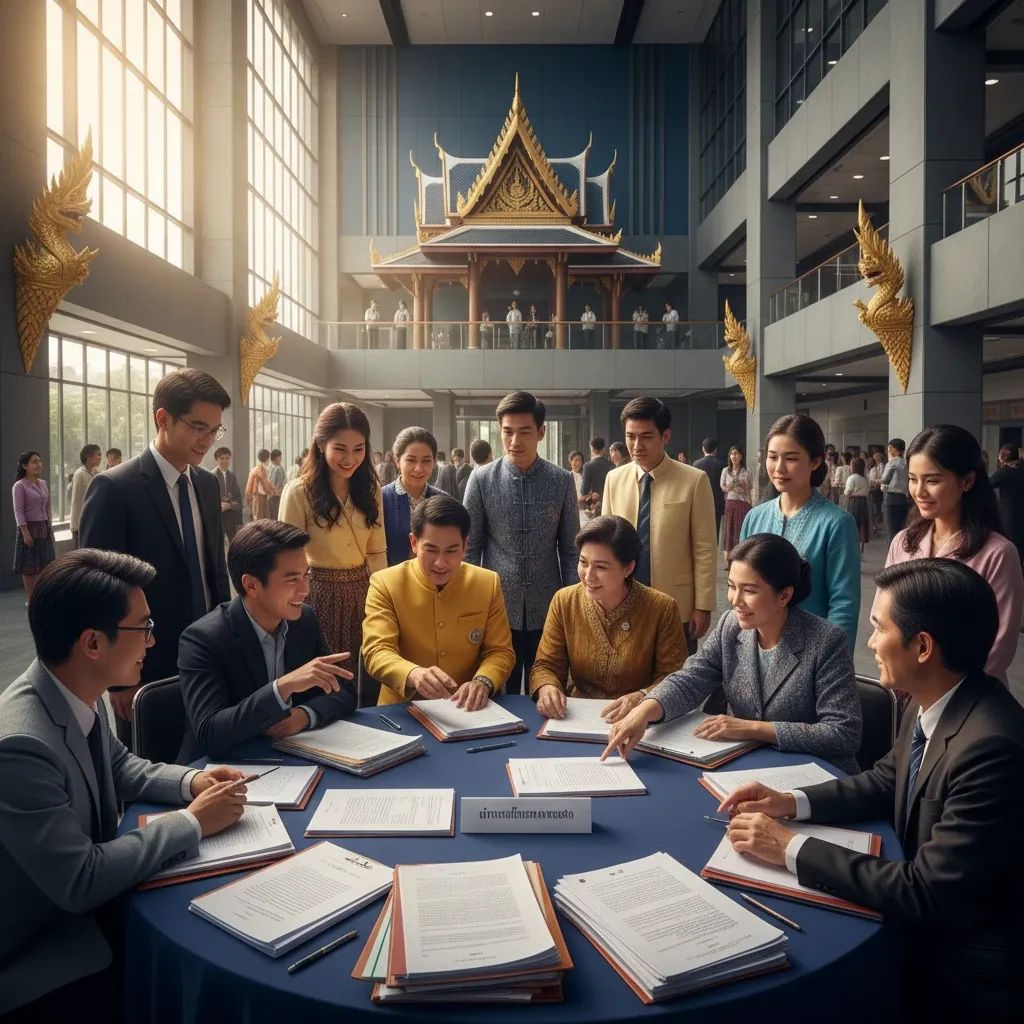
Thailand's People's Party secured a commanding 60% approval in the February 2026 constitutional referendum and is pushing an ambitious reform agenda that directly affects residents' daily lives. The package projects over 100 billion baht in new state revenue from anti-corruption measures, alongside welfare increases, police restructuring, and a shift toward elected provincial governors. For Thailand's residents and expat communities, this moment matters because it will determine whether reform translates into tangible changes—lower utility bills, transparent government spending, elected local leaders, and increased welfare benefits—or remains aspirational amid political resistance.
Direct Impact on Residents and Expats
Welfare increases carry immediate financial implications. The monthly young-child subsidy would climb from 600 baht to 1,200 baht by 2029 (approximately $33-$34 USD). Expectant mothers would receive 5,000 baht at five months pregnant (approximately $140 USD), with new mothers getting a 3,000-baht coupon (approximately $85 USD) for baby products. Elderly pensions would standardize at 1,000 baht monthly starting October 2026 (approximately $28 USD), rising to 1,500 baht by 2030 (approximately $42 USD). People with disabilities would see monthly payments increase to 2,000 baht (approximately $57 USD).
The party pledges to open 1,000 childcare centers for infants aged four months to two years, addressing a critical gap for working mothers. For farmers, debt relief programs would cancel obligations for those over 70 and restructure chronic non-performing loans, with incentives for consistent repayment.
Provincial governance changes would fundamentally alter how local administration functions. Currently, provincial governors are appointed by the central government in Bangkok rather than elected by local residents. The People's Party's proposal would instead have the highest provincial executive elected locally, creating a single, locally accountable leader—potentially streamlining bureaucracy for residents dealing with permits, land issues, or local services.
Electricity sector reform aims to break monopolistic control by introducing competition, potentially lowering costs for households and businesses. Environmental protection measures and education reforms round out the legislative pipeline, with the latter focusing on reducing administrative burdens on teachers and improving school safety standards.
Tax adjustments include raising the personal allowance from 60,000 baht to 100,000 baht (approximately $1,700-$2,800 USD), reducing the burden on lower earners while broadening the overall tax base through streamlined filing. Healthcare reforms target the National Health Security Office (NHSO) fund management and patient data linkage systems, aiming to strengthen service capacity across Bangkok and provincial areas.
What the Reform Package Contains
Thailand's People's Party has tabled a sprawling reform agenda that extends far beyond symbolic gestures. Their 12-month police overhaul plan involves a phased approach: suppression of corrupt networks, structural dismantling, and complete reconstruction of the Royal Thai Police to serve the public rather than function as a revenue-generating apparatus for insiders. The strategy acknowledges that wealth currently influences legal outcomes, with better-resourced defendants securing favorable treatment.
On economic restructuring, the party's 54-policy blueprint centers on what they term a "new economic model." Key pillars include semiconductor and electronics manufacturing, AI-driven industrial upgrades, and infrastructure modernization. The Open Data Economy proposal would centralize fragmented government datasets, enabling freelancers to use platform work histories for loan applications—a direct attempt to democratize access to capital.
Military reform proposals take aim at the Royal Thai Armed Forces' extensive business portfolio—golf courses, hotels, horse racing operations, boxing promotions, lottery sales, and television stations—arguing these commercial ventures distort defense priorities. The party also advocates replacing conscription with voluntary service and reducing the general officer corps while improving conditions for rank-and-file soldiers.
Political Competition and Constitutional Context
The People's Party is recalibrating its message after the Thai Pakdee Party leader grabbed attention on MP benefits reform, forcing progressives to broaden their focus to independent agencies' executive compensation. The party now faces a challenge to remain the leading voice on institutional reform—the very issue that forms the ideological foundation of the progressive movement.
The Bhumjaithai Party, which secured the most seats in the February 2026 election and installed Anutin Charnvirakul as Prime Minister, represents a fundamentally different approach. Considered a guardian of the conservative military-monarchy establishment, Bhumjaithai campaigned on "10+ economic policies" and social welfare programs rather than structural institutional change. Their electoral success demonstrates that many voters prioritize immediate economic relief over systemic reform.
Pheu Thai, another major competitor, revived legacy policies like universal healthcare and agricultural price guarantees—tangible, bread-and-butter issues that resonate with rural constituencies. This economic focus by mainstream parties creates an alternative narrative to the People's Party's emphasis on constitutional architecture and institutional transparency.
The Thai Pakdee Party made its move by spotlighting MPs' perks, expanding the conversation to include the National Anti-Corruption Commission, the Ombudsman's Office, and the National Broadcasting and Telecommunications Commission. These constitutionally protected independent agencies enjoy substantial budgets and privileges with minimal public accountability—precisely the areas the People's Party targets.
Judicial Constraints on Reform
The Constitutional Court has historically served as a brake on progressive reform. It dissolved both the Future Forward and Move Forward parties over their reform agendas, particularly concerning Article 112 (the lèse-majesté statute protecting the monarchy). Ahead of the 2026 elections, the court ruled that no party could campaign on reforming Article 112, effectively constraining the scope of permissible institutional critique.
This judicial oversight explains why the People's Party focuses energy on areas where court intervention is less likely—procurement transparency, police restructuring, provincial governance—rather than the most sensitive constitutional questions. The referendum victory provides some cover, but translating popular mandate into legislative reality requires navigating a political environment where conservative institutions retain significant veto power.
Historical Context
The original Khana Ratsadon (People's Party) engineered the 1932 revolution that ended absolute monarchy and established constitutional rule. The modern iteration—successor to the dissolved Future Forward and Move Worth parties—explicitly channels that legacy, targeting the same fundamental question: who holds power, and how transparently do they wield it? The 2017 constitution, drafted under military oversight, entrenched conservative influence. The People's Party's mission is to replace it with a charter that reflects popular will.
Where the Reform Push Goes Next
Public polling shows strong confidence in the People's Party's proposals across education, anti-corruption, political security, and agriculture. The challenge lies in converting that confidence into legislative momentum within a parliament where Bhumjaithai leads the coalition.
The AI-driven procurement audits could prove particularly consequential if implemented. Government contracting has long been an opacity zone where politically connected firms secure inflated contracts. Algorithmic analysis of bidding patterns and pricing could expose systematic leakage, simultaneously addressing corruption and generating revenue that funds welfare expansion without raising taxes.
Constitutional drafting begins soon, following the February 2026 referendum mandate, with the People's Party pushing to amend Chapters 1 and 2—the most sensitive sections governing state structure and the political system. Nine legislative packages are queued for parliament, covering electricity price reductions, environmental protection, education overhaul, and the election of provincial governors.
For Thailand residents watching this unfold, the practical stakes are clear: will reform translate into tangible improvements in government operations and daily life, or will political resistance dilute reform into symbolic gestures?


