
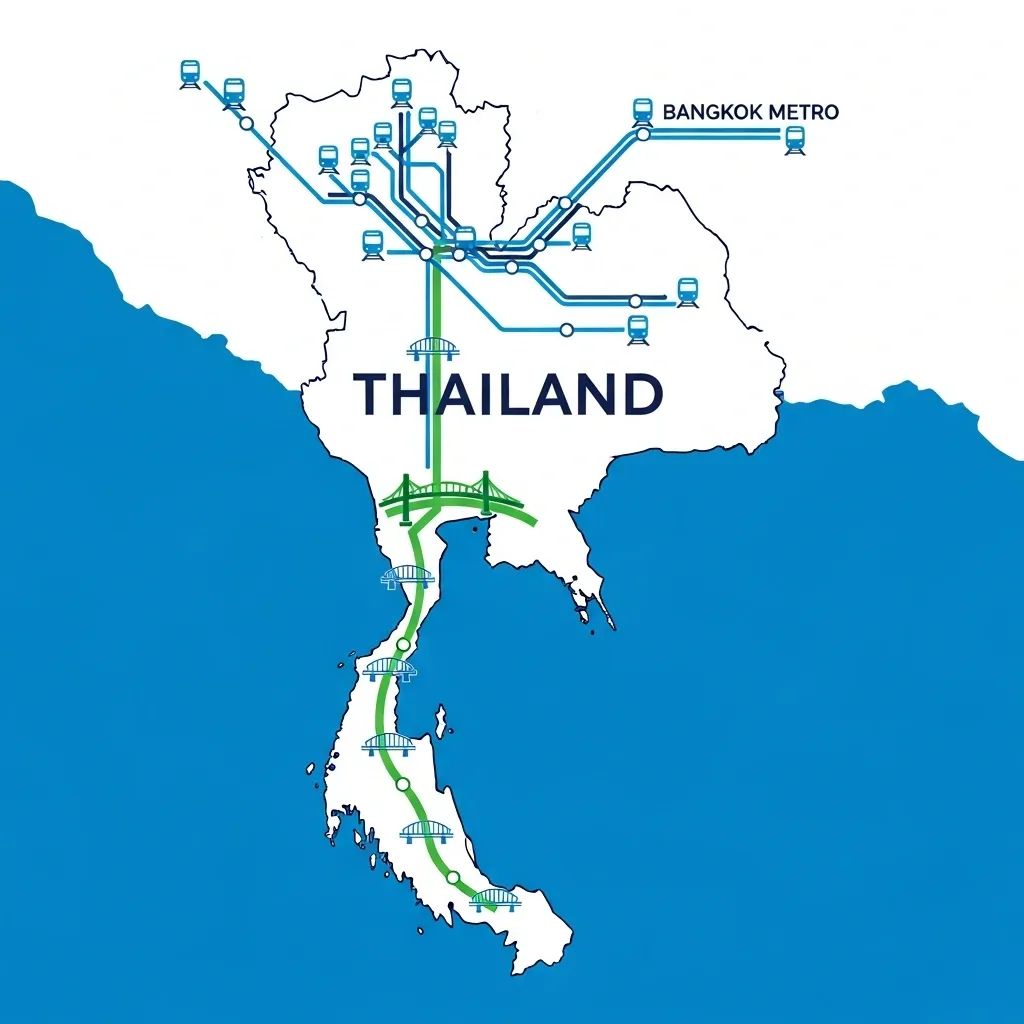
Thailand Opens Regional Gateway as Singapore Signals Strategic Interest in Massive Connectivity Project
The Thailand Government has moved toward concrete implementation of its most ambitious infrastructure gambit in decades, with Singapore's Defence Minister Chan Chun Sing expressing strategic interest in a dual-port transport corridor that fundamentally reshapes how goods flow across Asia. On Monday, Chan Chun Sing met with Prime Minister Anutin Charnvirakul to discuss cooperation spanning military ties, energy markets, and what could become one of the century's defining trade routes.
Why This Matters
• Bidding opens mid-2026: Investors from China, the Middle East, Japan, and Europe are positioning to compete for the ฿1 trillion concession.
• Construction likely by late 2026 if approved: The Thailand Cabinet decision expected by mid-2026 determines whether the project stays on track or slips into 2027.
• Shipping time reduced by approximately 4 days: Cargo bypassing the congested Strait of Malacca sees measurable cost savings of roughly 15%.
• 280,000 jobs projected: Chumphon and Ranong provinces will see multi-year construction activity with permanent port operations afterward.
The Project in Plain Terms
The Land Bridge is not abstract infrastructure policy—it is a 90-kilometer overland route connecting two seaports on opposite sides of the southern isthmus. The Gulf of Thailand (Chumphon) links to the Andaman Sea (Ranong) via purpose-built vessels and cargo handling systems. Think of it as a physical shortcut: instead of sailing around Malaysia for 5-7 days, shipping moves over land in hours.
The complete system includes two deep-water ports capable of handling massive container ships, a six-lane motorway, a dual-track railway, and energy pipelines for oil and gas. Thailand does not pay for construction; rather, a 50-year private concession hands operational rights to winning bidders who fund, build, and manage the entire system.
The investment requirement sits at approximately ฿1 trillion (approximately USD 28.5 billion), making it comparable to Thailand's entire annual national budget. The government estimates it will boost national GDP growth by 1.5-5.5% annually once operational, primarily through logistics savings and new industrial development.
Singapore's Strategic Calculation
Singapore's interest reflects pragmatic economic positioning. The city-state processes 37 million shipping containers annually, a volume that legitimizes its status as Southeast Asia's premier transshipment hub. The Land Bridge offers traders a faster alternative to routes through Singapore's waters.
Yet Chan Chun Sing framed Singapore's interest as recognition of complementary opportunities, not threat mitigation. According to discussions held during the visit, Singapore views the project as:
Risk diversification through alternative routing. The Strait of Malacca is a chokepoint—piracy, congestion, and geopolitical tension create genuine shipping delays. A functioning Land Bridge distributes that risk across Southeast Asian shipping routes, benefiting regional stability.
Premium services over bulk transit. Rather than compete on volume, Singapore is positioning itself for high-margin logistics services: digital trade platforms, marine insurance, supply-chain financing, and specialized port operations. The Tuas Mega Port, now under construction, incorporates artificial intelligence and automated cargo handling—capabilities that complement rather than compete with Thailand's transshipment function.
Regional infrastructure development as mutual benefit. Singapore's government understands that a successful Land Bridge enhances economic connectivity across the Indo-Pacific. Better to explore partnership opportunities than remain distant from a project addressing genuine infrastructure needs.
What Expats, Business Owners, and Residents Should Track
For anyone living or working in Thailand, the Land Bridge represents tangible economic shifts:
Southern provinces entering a construction boom. Chumphon and Ranong will experience property speculation, wage inflation, and infrastructure upgrades over the next 3-5 years if the project receives Cabinet approval. Real estate agents are quietly acquiring land near proposed port sites, though the government has not yet released final zoning maps. Caution is warranted: the project requires final Cabinet approval and environmental clearance before construction begins.
Job creation weighted toward skilled trades and logistics. The 280,000 projected positions include temporary construction work, permanent port operations, and emerging industries around containerization and supply-chain management. Wages in southern logistics hubs may rise faster than Bangkok averages, assuming bidding and financing proceed on schedule.
Import costs may decline modestly over time. If the Land Bridge functions as planned, imported goods moving through Thailand experience lower shipping costs, potentially reducing consumer prices for imported electronics, machinery, and raw materials. This benefit materializes gradually—not immediately upon opening, but as volume grows and carrier competition intensifies.
Environmental scrutiny remains unresolved. The Ranong area contains mangrove forests critical to fish breeding and carbon sequestration. Local fishing communities worry about dredging and port traffic impacts on marine ecosystems. The government has committed to impact assessments but faces skepticism from environmental groups. Monitoring those assessments is prudent for residents concerned with coastal sustainability.
Defense Cooperation and Military Continuity
The Chan-Anutin meeting reaffirmed what has been consistent between Thailand and Singapore for decades: a stable military partnership anchored by annual Exercise Cobra Gold drills. Prime Minister Anutin confirmed that Thailand will continue providing training areas for Singapore's Armed Forces, a critical arrangement given Singapore's physical constraints.
Both nations discussed expanding crisis response coordination and disaster management protocols, reflecting recognition that regional stability requires military trust. Neither country views the other as a competitor in traditional security terms; rather, they operate within a framework where credible defense ties underpin economic cooperation.
Energy and Utilities Agreements
Singapore imports nearly all its energy and remains vulnerable to supply disruptions. Thailand, conversely, is developing renewable capacity—solar, wind, and hydroelectric projects—while managing natural gas infrastructure. The two sides discussed:
Regional electricity grid connectivity to allow power trade, reducing both nations' reliance on single suppliers. This is long-term infrastructure requiring years of planning, but the principle is straightforward: shared grids lower costs and improve resilience.
Liquefied natural gas (LNG) transit acceleration. The Land Bridge's planned pipeline infrastructure could facilitate faster LNG movement from Middle Eastern suppliers to East Asian markets. This benefits both countries and opens future investment opportunities in energy logistics.
Renewable energy partnerships, particularly Thailand's expanding solar capacity. Singapore has expressed interest in purchasing Thai-generated power or investing in solar farms in Thailand, diversifying its energy portfolio.
Aviation Maintenance as a Tractable Near-Term Win
Among the topics discussed, the aircraft maintenance hub emerged as most concrete. Singapore brings technological expertise, global certification standards, and quality control protocols. Thailand offers lower labor costs, geographic centrality, and underutilized airport capacity—particularly U-Tapao Airport in the Eastern Economic Corridor and Don Mueang in Bangkok.
A joint MRO (Maintenance, Repair, and Overhaul) facility could service commercial aircraft, regional jets, military helicopters, and eventually ships and defense equipment. The two governments committed to joint public-private investment exploration, with feasibility studies likely underway by mid-2026.
This project is meaningful because it is achievable within 3-4 years, whereas the Land Bridge requires 7-10 years to operational maturity. For investors and operators in Thailand, an MRO hub represents genuine job creation and skills transfer.
Food Security as Strategic Asset
Singapore imports over 90% of its food supply—a structural vulnerability. Thailand ranks among the world's top exporters of rice, seafood, processed food, and tropical fruits. The two nations discussed long-term supply agreements and cold-chain logistics improvements to ensure food reliability for Singapore while maintaining markets for Thai producers.
This dynamic is not new; it reflects decades of trade. But formalized agreements reduce price volatility and create predictability for both food security (Singapore's concern) and export stability (Thailand's interest).
Why This Matters Geopolitically
The Land Bridge is not merely engineering. It is a geopolitical statement: Thailand positions itself as the vital link between Indian Ocean and Pacific trade, directly challenging the dominance of existing chokepoints. China views the route as complementary to its Belt and Road Initiative, reducing reliance on vulnerable Malacca transit for Middle Eastern oil. India sees efficiency gains for its Act East Policy. Western investors recognize commercial logic while remaining wary of Chinese dominance.
Singapore's interest in exploring partnerships signals regional recognition that the project addresses genuine infrastructure needs. When established regional powers publicly engage with Thai development initiatives, it enhances investor confidence in project legitimacy.
Timeline and Reality Check
These government projections assume no major obstacles and are contingent on Cabinet approval:
June-July 2026: Cabinet decision on final project structure, bidding rules, and environmental frameworks (or later if delays occur).
Q3 2026: Investor shortlisting begins; detailed submissions from competing consortia expected, pending Cabinet approval.
Late 2026: Government aims to sign concession agreements with winning bidders, contingent on financing clarity and regulatory approval.
2027 onward: Construction commences pending environmental permits and final land acquisition.
2032-2035: Core port and rail infrastructure completion estimated, assuming project timelines remain on schedule.
Environmental lawsuits, financing gaps, or political shifts could easily delay commencement. Residents should not assume construction certainty until Cabinet approval occurs and funding sources are formally announced.
What Residents and Investors Watch Next
The Land Bridge has transitioned from concept to active negotiation. Singapore's willingness to explore partnerships publicly signals that major regional players view the project as addressing real infrastructure needs. That matters for investor confidence; when established powers acknowledge the commercial logic of Thai infrastructure projects, it supports investor interest.
For those living in Thailand, the next 6-12 months will clarify whether this becomes a multi-decade development saga or another announced-but-delayed megaproject. Cabinet approval remains the critical threshold. After that, watch for environmental assessments, final zoning announcements, and investor consortium declarations. These milestones determine whether southern Thailand undergoes genuine transformation or merely absorbs speculation and false starts.


