
Senate Scrutiny Looms Over Thailand's 1 Trillion Baht Land Bridge This Week
The Senate prepares to scrutinize a transformative infrastructure proposal this week: a land corridor slicing through southern Thailand to shave four days off shipping routes between the Indian Ocean and East Asia. The Thai government is banking on one of Southeast Asia's most audacious megaprojects to deliver national prosperity, but independent economic studies and environmental concerns are raising harder questions about whether the project justifies its scale.
Why This Matters
• Scale and urgency: Nearly 1 trillion baht committed; construction bidding targeted for mid-2026; first phase completion projected by 2030.
• Local paradox: Southern residents largely support the project, yet surveys show over half grasp little about what it entails or costs them personally.
• Environmental collision course: Seabed reclamation affecting 12,000 hectares of sensitive marine habitat; mangrove destruction; climate and sustainability questions remain largely unresolved.
• Financial skepticism: A study commissioned by the National Economic and Social Development Council (NESDC) and executed by Chulalongkorn University reached a sobering conclusion: the project's Net Present Value turns negative if revenue depends primarily on transshipment traffic alone.
What Residents Should Watch
For people living in Thailand—particularly in the south—the immediate implications cluster around three domains: land acquisition fairness, employment and wage dynamics, and environmental degradation.
Compensation structures for displaced farmers and fishermen require scrutiny. Job-creation projections of 280,000 positions need clarity: how many positions target locals versus imported labor? What wage floors apply? Will cost-of-living increases offset nominal income gains?
Environmental due diligence demands independent verification. The current Environmental and Health Impact Assessment (EHIA) should undergo peer review by local marine biologists and international conservation consultants. Climate-adaptation implications—particularly around coastal erosion and freshwater availability—deserve scenario modeling.
For foreign residents and international investors, the calculus centers on regional real estate dynamics and ESG risk. Approval of the Land Bridge would likely trigger speculative land-price inflation in the project zone, creating short-term gains for early movers but also bubbles vulnerable to correction. Foreign data-center operators and logistics firms might benefit from Southern Economic Corridor (SEC) tax holidays, yet simultaneously face intensifying wage competition and potential regulatory shifts if public frustration with the project grows.
Environmental degradation could harm Thailand's international reputation among eco-conscious tourists and ESG-focused capital allocators—a cost not easily quantified but increasingly material for a nation positioning itself as a sustainable tourism destination.
The Project at a Glance
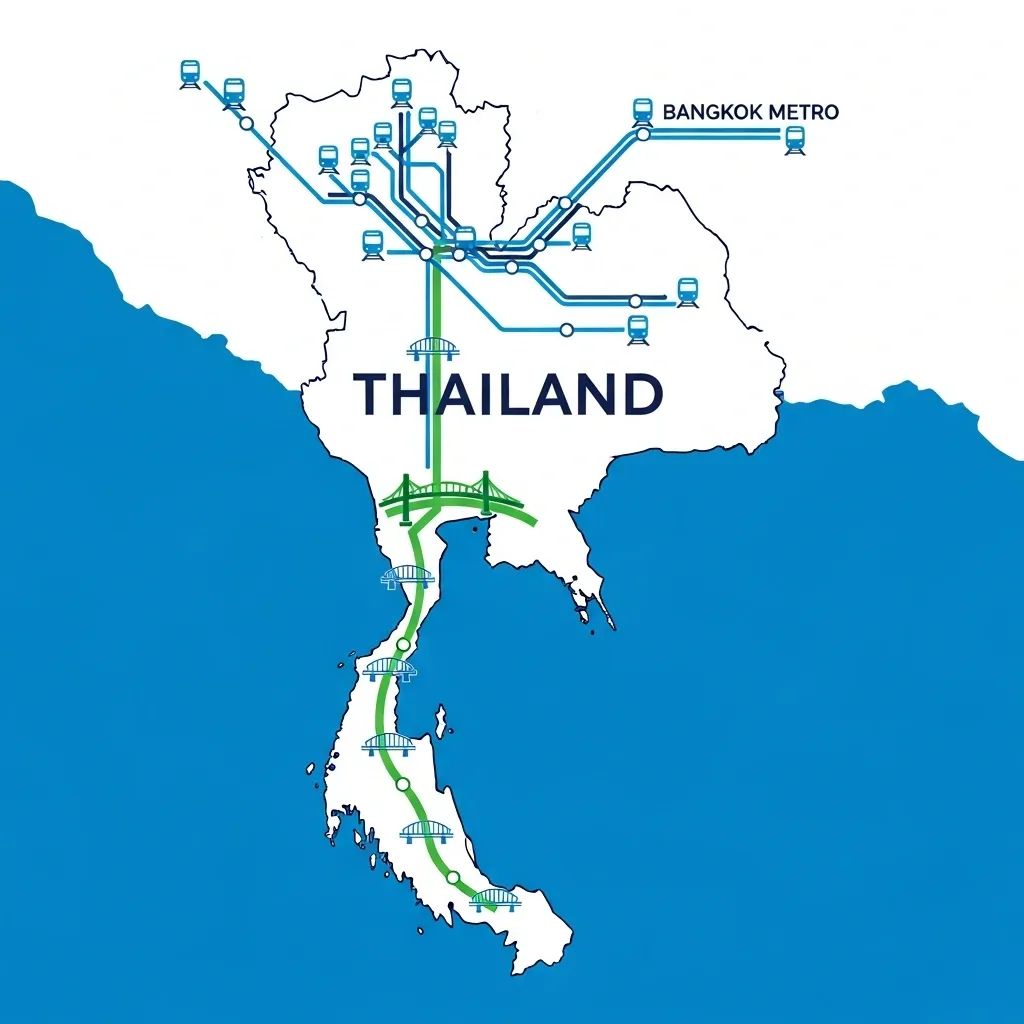
The project would create an 89-kilometer corridor stretching from Laem Ao Ang in Ranong Province (Andaman Sea) to Laem Riew in Chumphon Province (Gulf of Thailand). Two deep-water ports anchor the ends. Between them: a six-lane expressway, dual-track railway, and pipelines for oil and natural gas. Total investment: approximately 1.001 trillion baht, with the first phase alone budgeted at 522.8 billion baht.
The corridor would theoretically allow cargo vessels to bypass the Strait of Malacca, cutting transit time from nine days to five and trimming shipping costs by an estimated 15%. For a country dependent on sea trade—and concerned about chokepoint vulnerability—the appeal is intuitive.
Yet shipping remains a profoundly pragmatic industry. Every operator has performed the calculation. Few, so far, have committed.
The Double-Handling Dilemma
Cargo doesn't float between oceans. It unloads on one side, crosses by truck or rail, reloads on the other. This double-handling introduces inefficiencies that many maritime operators argue offset any distance savings. A study commissioned by the National Economic and Social Development Council (NESDC) and executed by Chulalongkorn University reached a sobering conclusion: the project's Net Present Value turns negative if revenue depends primarily on transshipment traffic alone.
Industry veterans are blunt. Existing routes through Malacca have been refined over decades. Infrastructure investment, port facilities, and bunkering services are already optimized. A new corridor, however innovative, competes against entrenched advantage—not abstract geography.
The United Nations Conference on Trade and Development (UNCTAD) compounds the skepticism with a longer view: seaborne trade in oil, coal, and natural gas—historically the bulk cargo that justifies such projects—could contract by 40% by mid-century due to decarbonization policies. If true, the Land Bridge's foundational revenue assumptions erode before completion.
The Government's Counter-Narrative
Officials project an Economic Internal Rate of Return of 17.38% for ports and infrastructure alone, rising to 14.77% when paired with the broader Southern Economic Corridor (SEC), a planned special economic zone designed to attract data centers, logistics hubs, and petrochemical facilities. The argument hinges on secondary value: industry agglomeration, supply-chain integration, and spillover growth in the region.
The Thai government, particularly Prime Minister Anutin Charnvirakul and Deputy Prime Minister Pirapan Salirathavibhaga, has made the project a political priority. Both have committed to visiting Chumphon and Ranong in May 2026 to conduct public consultations—though critics note previous engagement efforts have excluded non-landowners and limited space for dissenting voices.
A Population Supports What It Doesn't Fully Understand
A Nida Poll released recently found majority support for the project among southern residents. Yet it also revealed a telling gap: over 50% of supporters admitted limited comprehension of the scheme's mechanics, costs, or personal implications. This disconnect matters. Informed consent, particularly when land acquisition and environmental damage are at stake, requires more than passive assent.
Local stakeholders face concrete stakes. Durian farmers and artisanal fishermen in the project zone have livelihoods tied to specific waterways and soils. One-time land compensation rarely matches the capitalized value of future income from agriculture or marine extraction. The government estimates land expropriation costs at 6.2 billion baht for Phase One—yet market rates in rapidly developing zones often climb sharply after disclosure of megaproject plans, raising acquisition costs and complicating equitable settlement.
Environmental Costs Written in Seabed
Construction requires reclaiming 6,975 rai of seabed in Ranong and 5,808 rai in Chumphon—totaling roughly 12,000 hectares of marine habitat. This is not blank ocean. These waters host mangrove nurseries, coral assemblages, and seagrass meadows that support fisheries producing Thai mackerel and other species central to regional food security and livelihoods.
The Ranong coastline overlaps with sites proposed for UNESCO World Heritage Marine status—a designation still pending. Construction would foreclose that possibility and trigger international criticism from conservation bodies.
The Environmental and Health Impact Assessment (EHIA) has drawn criticism from marine biologists for relying on dated baseline data and underestimating cascading ecological harm. Altered ocean currents could trigger severe coastal erosion in populated areas. Pollution from anticipated petrochemical industries would introduce PM2.5 and water contamination to regions previously insulated from heavy industrialization.
Freshwater scarcity looms as a second-order crisis. Heavy industry competes fiercely for groundwater and surface reserves in the region—a competition agriculture will likely lose.
What Neighbors Learned
Regional precedent offers mixed lessons. Malaysia's Johor-Singapore Causeway, operational since 1919 and approaching its centennial, handles 350,000 people and 100,000 vehicles daily—sometimes peaking at 530,000 during holidays. It catalyzed genuine cross-border commerce, investment, and cultural exchange. That success, however, rested on enormous pre-existing demand: two massive population centers separated by minimal distance, with complementary economies.
Thailand's situation differs. Chumphon and Ranong lack comparable metropolitan heft. Existing demand for inter-sea transshipment remains speculative.
Indonesia's Semarang-Demak Expressway—a 27-kilometer coastal highway relying on 10 million bamboo poles as foundational stabilizers—demonstrates innovative engineering and cost efficiency (cutting conventional construction expenses to one-fifth). Yet it addresses a different challenge: local land transport in a fragile coastal zone, not international maritime redirection.
Malaysia's planned second causeway at Sungai Kolok, Narathiwat, scheduled for 2028 completion, targets congestion relief on the existing crossing and cross-border tourism, not megaport development.
None of these precedents involve the capital scale or speculative revenue model underpinning the Land Bridge.
Governance Questions Sharpen the Debate
Academics and transparency advocates have raised structural concerns transcending engineering. The SEC Bill—supporting legislation intended to grant the project special regulatory status and tax incentives—has been flagged for favoring foreign investors and weakening public oversight mechanisms. Procurement processes remain opaque. Civil society participation in project design has been limited.
These governance deficits carry a familiar risk: well-intentioned megaprojects sometimes devolve into vehicles for elite enrichment rather than distributed development. Thailand's history includes cautionary tales of infrastructure that failed to generate promised returns or that concentrated gains while dispersing costs to vulnerable populations.
The Senate session this week represents a pressure point. If lawmakers demand transparent financial audits, comprehensive environmental reassessment, and genuine community consultation before proceeding, they signal that democratic institutions retain teeth. If the motion passes without material impact, the opposite message emerges.
The Timeline and Next Moves
The Office of Transport and Traffic Policy and Planning (OTP) is finalizing tender documents—a process expected to consume five to six months. The SEC Bill faces Cabinet submission by June 2026. International investors from China, France, Germany, Singapore, and India have expressed preliminary interest in the Public-Private Partnership (PPP) structure, which would grant 50-year operational concessions.
Private sector bidding is targeted for late 2026, with groundbreaking potentially following in 2027 or 2028. Phase One port and corridor completion is pegged at 2030.
Yet Senate skepticism, mounting environmental concerns, and unresolved financial assumptions could force redesign or delay. The government's political will appears firm, but technical and institutional headwinds are substantial.
The Underlying Stakes
This is ultimately a test of institutional maturity. Does a nation subject transformative national projects to rigorous, independent scrutiny? Or does political momentum override technocratic caution and democratic deliberation?
The Senate's role is pivotal. Lawmakers who demand binding financial reassessment, transparent procurement, and genuine community voice over skeptical executives signal that governance restraint remains operational. Those who acquiesce to expedited timelines and minimal revision signal the opposite.
For residents across the south, the Land Bridge has ceased being an abstract policy document. It is now a live test of whether public institutions can mediate between visionary ambition and grounded accountability—a question far larger than one megaproject, with consequences extending well beyond infrastructure.


