
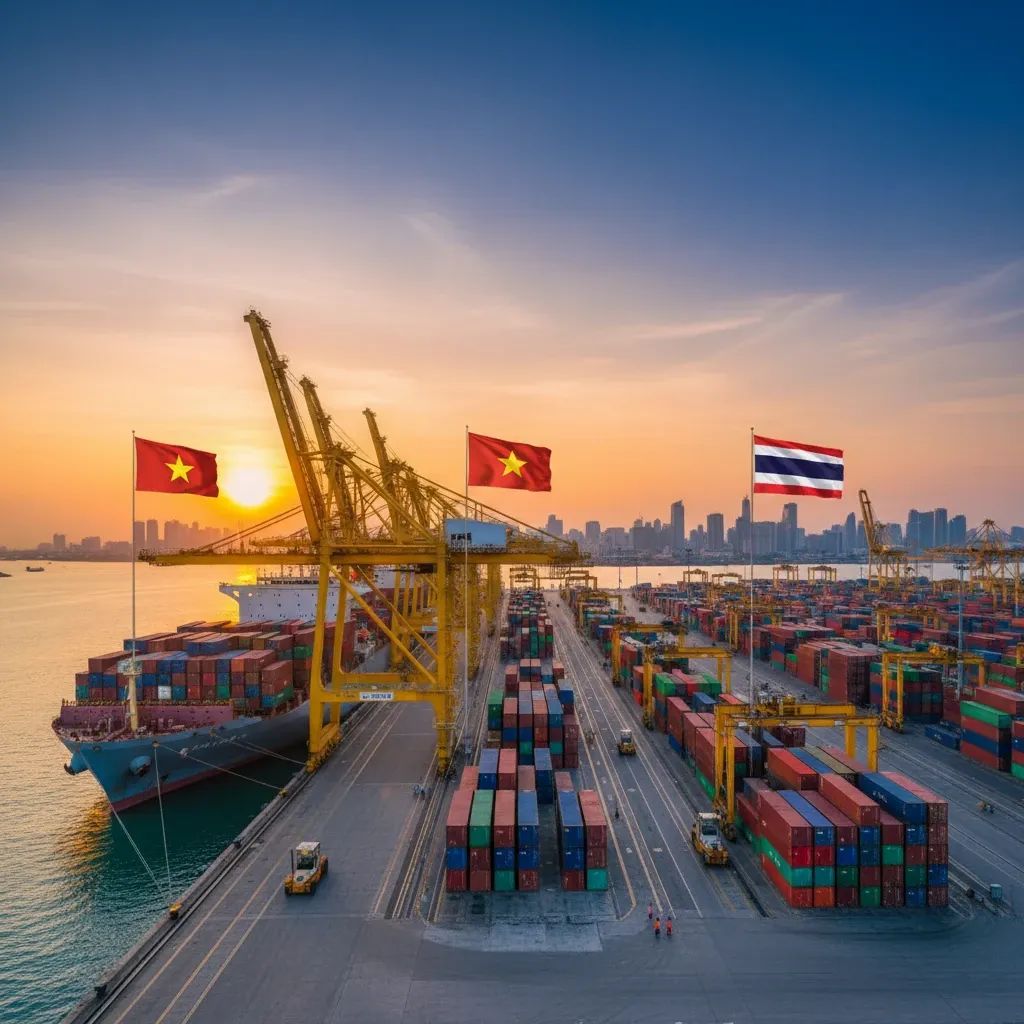
The Thailand government has hosted Vietnamese General Secretary and President To Lam for a landmark three-day state visit this week, a diplomatic milestone that carries direct implications for investors, manufacturers, and residents navigating Southeast Asia's evolving economic landscape. This is Lam's first official visit to an ASEAN nation since assuming the presidency, and the timing—aligned with the 50th anniversary of Vietnam-Thailand diplomatic relations—underscores a strategic recalibration of regional supply chains, trade corridors, and security protocols.
Why This Matters:
• Bilateral trade target: Both nations are racing toward a $25 billion trade goal by year-end, up from $22.1 billion in 2025.
• Electronics integration: Vietnam's electronics exports to Thailand hit $1 billion in just the first four months of 2026, signaling tighter supply chain interdependence.
• Energy investment: Thai firms have poured $3 billion into Vietnam's renewable energy sector, with more projects in the pipeline.
• Security protocols: Joint naval patrols and transnational crime units now address call-center scams, human trafficking, and precursor chemical smuggling across the border.
What This Means for Residents and Investors
For manufacturers and investors based in Thailand, this visit translates into tangible shifts in how regional supply chains are configured. The so-called "Three Connections" strategy—linking supply chains, business networks, and sustainable development—aims to move beyond traditional trade into integrated production ecosystems. This is particularly relevant for electronics, where Vietnamese assembly lines now feed directly into Thai upstream suppliers, reducing lead times and logistics costs for companies operating warehouses or distribution hubs in Thailand.
Energy security is another critical angle. Vietnam's accelerating demand for power—and its vulnerability to shortages—creates opportunities for Thai energy developers while simultaneously posing risks for manufacturers considering cross-border expansion. Thai conglomerates have already committed to solar, wind, and thermal power projects in Vietnam, but the question remains whether infrastructure can keep pace with industrial growth. For residents working in energy, tech, or logistics, this dynamic opens pathways for cross-border project roles and consultancy engagements.
On the regulatory front, both governments are pushing for streamlined customs procedures and digital financial services, including cross-border e-commerce platforms. If executed, these reforms could ease bureaucratic friction for small and medium enterprises (SMEs) in Thailand that source components or finished goods from Vietnam. However, challenges remain: Vietnamese administrative procedures and frequent regulatory changes still frustrate Thai businesses, despite government promises to reform taxation and licensing systems.
Strategic Partnership in Practice
Thailand Prime Minister Anutin Charnvirakul and President Lam formalized a 2026-2031 Plan of Action during the visit, structured around three pillars: sustainable peace, sustainable growth, and a sustainable future. This is more than diplomatic boilerplate. The plan codifies joint efforts in maritime security, freedom of navigation under UNCLOS 1982, and the maintenance of ASEAN centrality amid intensifying great-power competition in the Indo-Pacific.
For Thailand residents concerned about regional stability, this matters because both nations are explicitly working to keep ASEAN a "safe zone" from geopolitical conflict. The bilateral defense mechanisms—including the High-Level Dialogue on Crime Prevention and the Defence Policy Dialogue—now coordinate responses to transnational threats that directly affect daily life, from drug trafficking networks to sophisticated call-center scam operations that target Thai and Vietnamese citizens alike.
Naval cooperation has also intensified. A Royal Thai Navy vessel visited Ho Chi Minh City this week to commemorate the diplomatic anniversary, while joint patrols now monitor illegal fishing and smuggling routes in the Gulf of Thailand. These measures aim to protect both marine resources and the integrity of coastal trade routes critical to Thailand's seafood and logistics industries.
The Electronics and Technology Push
Vietnam's electronics sector is undergoing a high-tech evolution, with government incentives for semiconductor manufacturing, AI development, and fintech. For Thailand-based tech firms, this creates both partnership opportunities and competitive pressure. Vietnamese exports of computers, electronic products, and components to Thailand exceeded $1 billion in the first four months of 2026 alone, a figure that reflects Vietnam's growing role as a regional manufacturing and technology hub.
The strategic opportunity lies in complementary strengths: Thailand retains advantages in upstream supply chains and logistics infrastructure, while Vietnam offers a younger workforce and cost-competitive manufacturing. Thai companies are increasingly investing in PCB circuit boards, semiconductor components, and advanced electronics assembly in Vietnam, aiming to capture value at both ends of the production chain.
However, competition for investment in advanced chips and data centers remains fierce. Vietnam is accelerating clean energy development specifically to attract global semiconductor firms that require reliable, low-carbon power sources. Thailand must respond by enhancing its own energy security and infrastructure if it hopes to remain competitive in the race for high-value tech manufacturing.
Energy Cooperation and Green Economy
Thai conglomerates are betting heavily on Vietnam's renewable energy transition. With approximately $3 billion already committed to solar, wind, and thermal power projects, Thai investors are positioning themselves to supply Vietnam's growing industrial base. Vietnam's Power Development Plan (PDP8) emphasizes offshore wind potential and renewable targets, creating a pipeline of opportunities for Thai energy developers, equipment suppliers, and project financiers.
For residents in Thailand working in the energy sector, this cross-border expansion means job mobility and project opportunities in Vietnam, particularly for engineers, project managers, and sustainability consultants. The push toward a circular economy and green technologies—including bio-packaging, renewable components, and waste management systems—also opens avenues for Thai SMEs specializing in eco-friendly solutions.
Yet the energy security challenge cuts both ways. Vietnam's potential for power shortages remains a barrier to deeper industrial integration, and any prolonged supply disruptions could ripple back into Thailand's supply chains. Thai firms with operations or sourcing relationships in Vietnam need contingency planning to mitigate this risk.
Navigating the Challenges
Despite the optimistic rhetoric, practical hurdles remain. Regulatory complexity in Vietnam—vague rules, frequent changes, and multi-agency licensing processes—continues to frustrate Thai investors. Taxation and administrative procedures are oft-cited pain points, though the Vietnamese government has pledged reforms.
Market entry also requires cultural localization. Thai businesses expanding into Vietnam must invest in market research and local partnerships, while Vietnamese firms entering Thailand face a competitive, discerning consumer base that demands quality and brand credibility.
On the logistics front, both nations are racing to upgrade infrastructure. Vietnam is expanding its expressway network and pursuing high-speed railway projects, while Thailand is enhancing coastal and overland transport routes to reduce delivery times. These improvements will be critical for realizing the $25 billion trade target by year-end.
Looking Ahead
President To Lam's visit to Thailand is a signal moment in Southeast Asian economic integration. The focus on semiconductors, renewable energy, and digital finance reflects a broader regional strategy to reduce dependency on external supply chains and build resilient, interconnected production networks.
For people living in Thailand—whether local professionals, entrepreneurs, or business owners—this visit represents a recalibration of regional economic geography. The opportunities are real: expanded supply chain roles, cross-border energy projects, and streamlined e-commerce platforms. But so are the challenges: regulatory friction, energy security risks, and intensifying competition for advanced manufacturing investment.
The takeaway is clear: Thailand's economic future is increasingly tied to Vietnam's trajectory, and those who understand this dynamic—and act on it—will be best positioned to benefit from the next phase of ASEAN integration.


