
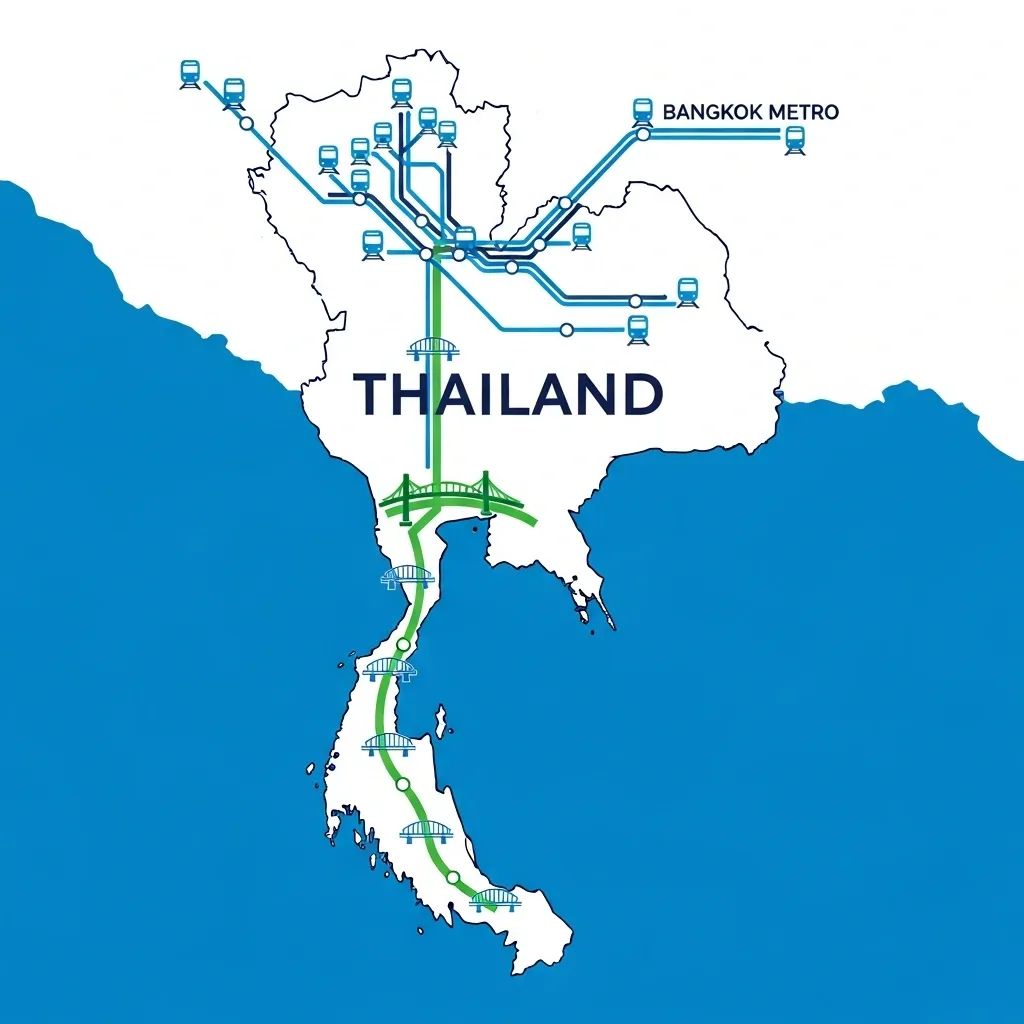
The Thailand Cabinet, after a comprehensive government study, has suspended the ambitious Land Bridge mega-project—a ฿1 trillion (US$29.7B) plan to link the Gulf of Thailand and the Andaman Sea—citing sharp declines in projected returns, weak shipping industry interest, and significant environmental risks. The decision marks a strategic pivot toward smaller-scale, higher-return infrastructure investments that officials say will move faster and deliver more certain economic benefits.
Why This Matters
• No sunk costs: Land acquisition and construction never began, meaning Thailand avoided direct investment losses from the suspension.
• New focus: The government is redirecting resources to upgrade Ranong Port and build a freight rail link connecting the Andaman coast to the existing national network.
• Not entirely dead: Prime Minister Anutin Charnvirakul clarified July 27 that the project has been "adjusted," not abandoned, and could be revived if geopolitical conditions shift.
• Regional race: Neighboring countries including Vietnam, Malaysia, and Singapore are accelerating their own infrastructure plans, positioning themselves as alternative logistics hubs.
Viability Concerns Behind the Project Suspension
The Land Bridge concept promised an alternative shipping route bypassing the Malacca Strait, using a 100km network of seaports, highways, and railways across southern Thailand. Early projections painted a rosy picture: an 8% financial return and a net present value (NPV) of ฿637.7B.
A revised government study released in July 2026 shattered that optimism. The anticipated financial return collapsed to 4.8%, and the NPV swung from positive ฿637.7B to negative ฿10.3B. Expected container volumes dropped 15-16% below initial estimates, slashing anticipated returns by 38%.
The commercial viability took another hit when analysts discovered that 9 of the 10 largest global shipping lines had already committed capital to competing projects elsewhere, effectively eliminating the customer base Thailand needed to justify the investment. Operational complexities and slow cargo transfer speeds—inherent to any land-based transshipment system—further dimmed the project's appeal compared to established maritime routes.
Environmental assessments flagged serious risks to Ranong's biosphere reserve, wetlands, and key marine tourism sites. Public opinion remained divided, and coastal communities voiced concerns about the project's impact on their livelihoods and ecosystems.
The Government's New Strategy
Rather than pouring resources into a questionable mega-project, the Thailand Ministry of Finance and planning agencies are now concentrating on incremental upgrades with clearer returns. The centerpiece of this revised strategy is the expansion and modernization of Ranong Port, a facility strategically positioned on the Andaman coast.
Complementing the port upgrade is a planned freight rail connection that will link Ranong to Thailand's existing rail network. This network already extends north toward China and east toward the industrial seaboard, meaning the new rail spur could open southern ports to continental trade routes without the massive investment and environmental disruption of the Land Bridge.
Transport Ministry officials have emphasized that these smaller projects can be completed faster, attract private investment more easily, and deliver measurable cost reductions for exporters and importers within a few years rather than decades.
The government also noted that because land acquisition for the Land Bridge never commenced, no direct financial losses were incurred—a silver lining that distinguishes this suspension from other high-profile project failures in the region.
What This Means for Residents and Investors
For foreign investors and businesses operating in Thailand, the shift represents both relief and recalibration. The Land Bridge had generated cautious enthusiasm among some logistics firms and real estate developers betting on port-adjacent opportunities. That specific driver is now absent, though the government's pragmatic pivot may actually strengthen long-term confidence.
China, Thailand's largest source of foreign direct investment, remains a key partner. The revised infrastructure strategy explicitly includes strengthening rail links with China, suggesting that capital flows into Thai infrastructure projects will continue, just redirected toward projects with lower risk and faster timelines.
For residents in southern Thailand, particularly in Ranong and nearby provinces, the suspension removes the threat of large-scale environmental disruption and coastal displacement. At the same time, the promised economic boom from mega-project construction jobs and port activity will not materialize in the form originally envisioned. Instead, locals can expect more modest employment from port upgrades and rail construction, along with improved freight logistics that could benefit existing fishing and tourism industries.
Exporters and manufacturers in Thailand's industrial heartland—particularly the Eastern Economic Corridor—will see little immediate change. The government's focus on connecting existing networks means incremental efficiency gains rather than transformative shifts in logistics costs or transit times.
How Neighbors Are Reacting
The Land Bridge suspension has been quietly welcomed by Singapore and Malaysia, whose established transhipment hubs in the Malacca Strait faced potential competition from the Thai project. Singapore's Minister for Transport, Chee Hong Tat, has consistently emphasized that the city-state's competitive advantage lies in connectivity and reliability, not just geography. Singapore continues investing heavily in the automation and expansion of Tuas Port, aiming to cement its status as the region's premier maritime hub.
Malaysia is pressing ahead with its own Pan-Asia rail ambitions. The East Coast Rail Link (ECRL) is being extended to the Thai border, with plans to integrate with Thailand's rail network and eventually connect to Laos and China. Malaysian officials have explicitly urged Thailand to prioritize these rail connections over maritime mega-projects, seeing an opportunity to position Malaysia as a critical land bridge within the Trans-Asian Railway network.
Vietnam is pursuing perhaps the region's most ambitious infrastructure bet: a US$67B North-South high-speed railway connecting Hanoi and Ho Chi Minh City. Vietnamese planners view the project as essential to reducing logistics costs and positioning Vietnam as a key logistics hub within the Greater Mekong Subregion. The rapid pace of Vietnam's infrastructure development—including new airports and expressways—has led some analysts to suggest Vietnam could soon outpace Thailand in attracting foreign investment.
Indonesia remains focused on its National Strategic Projects (PSN), including the Jakarta-Surabaya high-speed rail and the development of Nusantara, the new administrative capital. These projects aim to reduce regional disparities and attract both public and private investment.
A Separate Challenge: The Three-Airport Rail Link
While the Land Bridge suspension has been resolved—at least for now—Thailand faces a separate infrastructure headache with the Three-Airport High-Speed Rail link. This project, intended to connect Don Mueang, Suvarnabhumi, and U-Tapao airports as part of the Eastern Economic Corridor, has encountered serious delays and financial viability questions.
The concessionaire, Asia Era One Co Ltd (led by CP Group), has reportedly sought to terminate the agreement, citing difficulties securing bank loans. The government denies that a final decision to scrap the project has been made, noting that large contracts require mutual agreement to cancel.
Alternatives under consideration include a scaled-down medium-speed railway or utilizing the existing Red Line to connect the airports—a far cry from the original high-speed vision but potentially more financially realistic.
The Bigger Picture
Thailand's infrastructure recalibration reflects a broader trend toward pragmatism in regional megaproject planning. After a decade of ambitious proposals—many inspired by China's Belt and Road Initiative—Southeast Asian governments are increasingly scrutinizing the financial viability and environmental costs of transformative infrastructure.
The Land Bridge suspension is not a retreat from infrastructure investment; it is a recognition that smaller, faster, lower-risk projects may deliver better returns in a region where shipping lines have already committed to established routes and environmental sensitivities are rising.
For residents and investors in Thailand, the message is clear: expect incremental improvements to existing systems rather than revolutionary mega-projects. Whether that strategy proves sufficient to keep pace with Vietnam's high-speed ambitions and Malaysia's rail expansion remains to be seen.


