
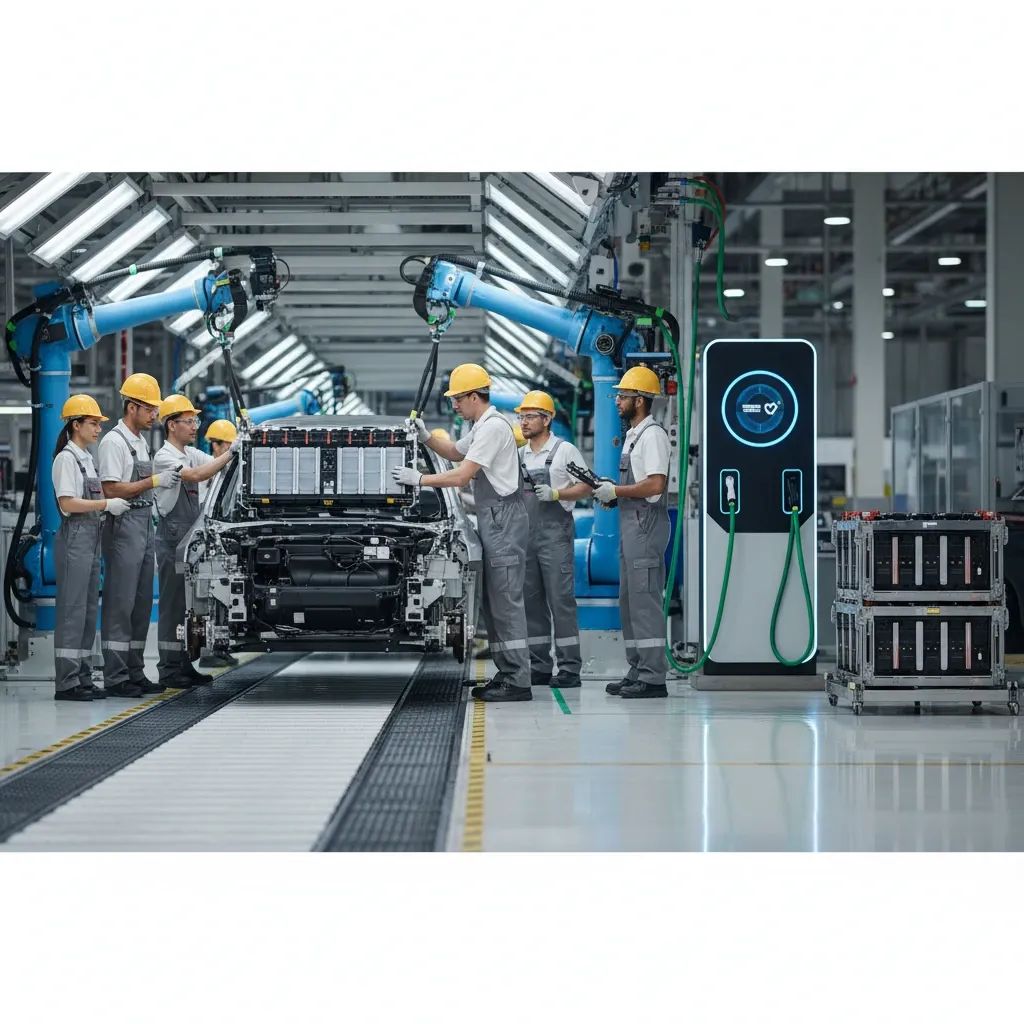
The Thailand Excise Department is pushing a graduated battery tax system that rewards manufacturers producing long-life, high-density power cells—a strategic pivot designed to cement the Kingdom's position as a regional energy storage hub while accelerating the shift away from cheap, low-performance imports.
Why This Matters
• Cabinet approval pending: The framework awaits final approval following government transition—timeline for implementation remains uncertain. Residents should verify current policy status before making major EV or battery purchases.
• Tax breaks for quality: Batteries with higher energy capacity and longer lifespans will qualify for lower excise rates (if approved), tilting the economic playing field toward advanced technology.
• Local production mandate: From January 1, 2026, plug-in hybrid batteries must be made in Thailand to access preferential tax treatment—a hard line on localization.
• Import squeeze: Imported battery cells can now contribute only 10% of an EV's factory price toward local content requirements, down from much higher thresholds.
• Clean energy alignment: The proposal ties directly to Thailand's broader clean energy transition goals and targeted industry development plans.
The New Rate Structure
Unlike the existing flat 8% excise tax applied uniformly to all battery types, the proposed framework introduces a performance-based tiered system. Energy storage capacity, energy density per kilogram, and life cycle duration become the determining factors. Cells engineered for maximum efficiency and longevity will enjoy reduced tax burdens, while older, less efficient technology faces steeper costs.
Current vs. Proposed Rates (if approved):
• Current system: 8% flat rate for all batteries
• Proposed system: 2% for locally-made BEV batteries (75% reduction), 5% for long-range PHEV batteries with 80+ km range (37.5% reduction), 10% for short-range PHEVs below 80 km (25% increase)
The Thailand Excise Department completed its draft legislation months ago, but cabinet approval has stalled during the government transition. Once ratified, the framework will be embedded in the medium-term fiscal framework for 2027–2030, signaling a multi-year commitment to reshaping the battery manufacturing landscape.
Deputy Finance Minister Paopoom Rojanasakul confirmed that consultations with industry stakeholders yielded broad consensus. "All relevant parties agree with the proposed revision because this industry is an emerging one that needs to prioritize environmental concerns," he stated.
What This Means for Residents
For households and businesses installing battery energy storage systems (BESS) or buying electric vehicles, the new tax structure could translate to potentially lower costs for premium products—once approved and implemented. High-capacity lithium-ion packs built to last a decade or more would become comparatively cheaper than disposable, short-cycle alternatives. Consumers purchasing plug-in hybrids with electric ranges exceeding 80 kilometers would benefit from a 5% excise rate, while shorter-range models would incur 10%.
The policy also nudges the market toward local sourcing. If you're buying a battery electric vehicle (BEV) assembled in Thailand, the excise rate could drop to 2%—a significant advantage over the 10% levy now slapped on imports under the EV3.5 framework. For expats and long-term residents considering solar installations paired with home battery systems, the government has also approved tax deductions for rooftop solar and a 1.5x deduction for businesses investing in energy-efficient equipment.
Purchasing Strategy Guidance:Given the uncertain timeline for cabinet approval and implementation, residents facing EV or battery purchase decisions should: (1) Verify the latest cabinet approval status through official Thailand Excise Department announcements before committing to major purchases; (2) Request written confirmation from dealers about battery specifications (energy capacity, lifespan ratings, manufacturing origin) to ensure products would qualify for lower rates once the policy takes effect; (3) Consider that purchases made before official implementation will likely not retroactively benefit from lower rates, so timing your purchase closer to confirmed implementation dates may yield better value.
Regional Competitiveness and ASEAN Context
Thailand's performance-linked approach distinguishes it from neighboring strategies. Vietnam recently became the first major ASEAN economy to implement a two-part tariff structure for BESS, compensating batteries for both availability and actual delivery. Indonesia leverages its mineral wealth to offer 10-year income tax exemptions for battery and energy storage projects. Singapore aims to become a regional energy storage hub with plans to ban fuel-powered vehicle sales by 2030.
What sets Thailand apart is the direct linkage between tax rates and battery specifications—a regulatory lever that other ASEAN nations have not yet deployed at this granularity. Bangkok's approach aims to engineer market behavior at the product design level, not just incentivize deployment.
Impact on Manufacturers and Investment
The Thailand Board of Investment (BOI) already provides powerful magnets for battery producers: eight-year corporate income tax exemptions for A1-level cell manufacturing projects, zero import duty on machinery and raw materials used for export, and 90% duty reductions for domestic-market inputs. Companies committing over THB 5 billion (approximately $140 million) to battery EV manufacturing qualify for the full eight-year tax holiday.
The new excise structure layers additional pressure on producers to invest in R&D and upgrade production lines. Manufacturers capable of hitting the high-density, long-cycle benchmarks will enjoy a double advantage: lower tax costs and alignment with consumer demand for quality. Conversely, plants churning out short-lifespan, low-density cells face a shrinking margin and potential obsolescence.
Chinese automakers and battery firms—already major players in Thailand's EV ecosystem—are recalibrating strategies to navigate these rules. Understanding the excise tax thresholds and local content requirements has become a critical input for market entry and expansion planning.
The PHEV Equation
The plug-in hybrid segment faces the most immediate disruption. Starting January 1, 2026, excise rates hinge exclusively on electric-only driving range: vehicles achieving 80 kilometers or more on battery power alone pay 5%, while those below that threshold face 10%. Critically, the batteries powering these vehicles must be manufactured in Thailand, and models must include at least two advanced driver assistance systems (ADAS).
This dual requirement—local battery sourcing plus ADAS integration—effectively closes the door on low-cost, low-tech imports and pressures automakers to commit capital to Thai production facilities. The temporary allowance permitting imported battery cells to count toward local content was extended to June 30, 2026, but the 10% cap on imported cell value from January 1 leaves little room for half-measures.
Strategic Ambitions and Clean Energy Transition
Thailand's battery tax proposal is not a standalone measure but part of a coordinated industrial strategy to build a vertically integrated EV and energy storage supply chain. The government views battery manufacturing as a cornerstone of its clean energy transition, targeting both the electrified mobility market and the grid-scale storage needed to support renewable energy expansion.
By structuring tax policy to favor high-performance, long-life batteries, Thailand Royal Government officials aim to leapfrog the low-margin, commodity battery trap and position the country as a premium manufacturing base. The policy also addresses environmental concerns—longer-lasting batteries reduce waste, lower lifecycle carbon emissions, and align with global sustainability standards.
The excise framework dovetails with the EV3.5 policy, which slashed subsidies for imported EVs and reserved incentives exclusively for locally assembled models. That shift, combined with the battery tax, creates a powerful localization incentive: automakers and battery producers must either invest in Thai facilities or accept significantly higher costs.
Risks and Open Questions
While the policy's objectives are clear, execution risks remain. Cabinet approval is pending, and the specific percentage thresholds defining "high-capacity" and "long-life" batteries have not been publicly finalized. Industry insiders caution that overly stringent benchmarks could inadvertently exclude mid-tier technologies still viable for certain applications, such as utility-scale storage where cost per kilowatt-hour often trumps energy density.
There is also the question of enforcement and verification. The Thailand Excise Department will need robust testing and certification protocols to prevent gaming of the system—such as inflated life-cycle claims—and ensure that only genuinely efficient batteries qualify for reduced rates.
Finally, the timeline for cabinet approval and implementation will determine whether manufacturers can adjust supply chains smoothly or face disruptive bottlenecks. With the PHEV battery localization requirement already in force and the 10% import cap biting from January 1, the clock is ticking for producers yet to establish or expand Thai operations.
The Bottom Line
Thailand's proposed graduated battery tax represents a calculated bet that quality standards can drive competitiveness. By rewarding efficiency and penalizing obsolescence, the policy aims to attract cutting-edge manufacturers, reduce reliance on imports, and establish Bangkok as a regional energy storage powerhouse. For residents, the potential payoff is access to better, longer-lasting batteries at lower effective costs—and a cleaner, more resilient energy grid to support the Kingdom's electric future. However, until cabinet approval is finalized and implementation timelines are confirmed, prospective buyers should exercise due diligence before committing to major purchases.


