
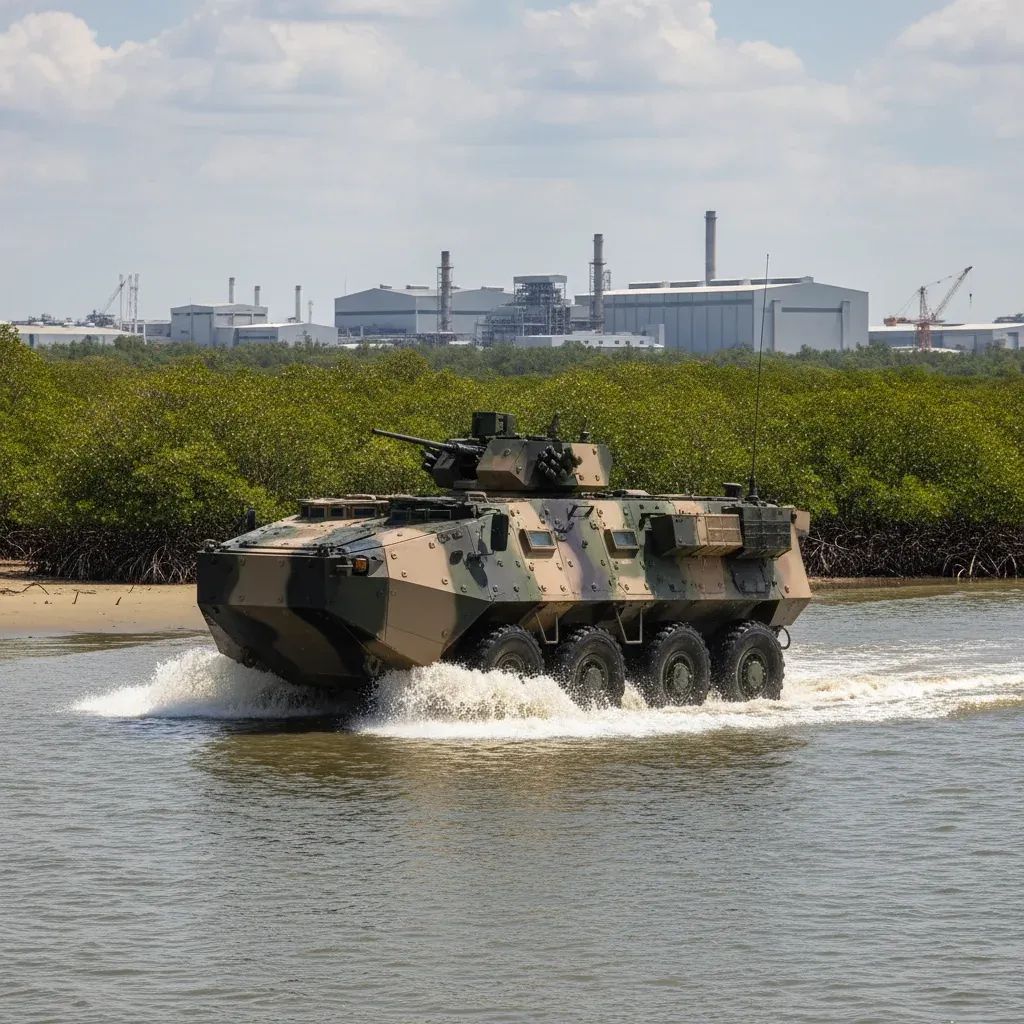
Thailand's navy has greenlit ฿434.6 million for a new fuel vessel from Thai International Dockyard Co., Ltd. (Tindy), signaling a deliberate bet that the country can build—not merely buy—the maritime assets it needs. The decision to replace the HTMS Chula through domestic construction rather than a foreign shipyard represents the navy's most significant test yet of whether Thai industry can deliver modern naval vessels on schedule and within budget.
Why This Matters
• Domestic spending stays domestic: Instead of exporting funds abroad, ฿434.6 million will flow through Thai engineering, fabrication, and skilled trades within the kingdom's borders.
• A tangible 2028 deadline: The new tanker's delivery will either validate Thai shipbuilding ambitions or expose the gaps that foreign skeptics have long pointed out.
• Technology transfer potential: International naval relationships increasingly come with offset requirements—meaning foreign firms bidding on Thai contracts must invest in local suppliers and expertise.
The Aging Workhorse and Why It Must Go
The HTMS Chula entered service on December 30, 1980—making it nearly 46 years old. Naval vessels of that age approach the end of their operational lifespan, with increasing maintenance costs and declining capability. The ship is scheduled for decommissioning in 2027, making replacement a practical necessity. The navy needs a modern tanker to sustain extended logistics operations and maintain its aging but still-active fleet.
For a navy that operates across the Indian Ocean and Southeast Asian waters, maintaining current operational standards is essential. A replacement vessel with modern systems will support the naval fleet's efficiency and interoperability with regional partners.
The Economic Layer Beneath Fleet Modernization
Thailand's defense spending does not exist in isolation. Each procurement decision has ripple effects through the country's industrial base and employment. A ฿434.6 million contract awarded to Tindy funds engineers, welders, electricians, and procurement staff—jobs that directly support households in shipbuilding regions. Parallel subcontracting extends to steel mills, electrical suppliers, and component manufacturers across the kingdom.
By contrast, purchasing the same vessel from a foreign yard would have moved those wages, profits, and supply chain relationships offshore. Retaining this work domestically keeps economic benefits within Thailand's economy.
The Royal Thai Navy enforces this calculus through offset policies on major contracts. Any international shipbuilder competing for Thai work must establish joint ventures with local yards, train Thai engineers, source components domestically when feasible, and transfer proprietary knowledge. Six international firms—ASFAT and TAIS from Turkey, Hanwha Ocean and Hyundai Heavy Industries from South Korea, ST Engineering from Singapore, and Navantia from Spain—recently submitted bids for the navy's planned two 4,000-tonne frigates. None can win without committing to Thai industrial participation.
For foreign investors and companies considering Thailand, the message is clear: defense contracts increasingly require local partnerships. Thai firms capable of supporting naval construction will find growing demand.
A Measured Confidence in Domestic Capacity
Thailand's shipbuilding trajectory has been incremental by design. The country began with small inshore patrol vessels, then progressed to offshore patrol craft. In March 2026—just two months before this tanker contract—Asian Marine Services delivered the HTMS Suriya, a 60-meter hydrographic vessel displacing 1,545 tonnes with a 2,400-nautical-mile range. That delivery demonstrates Thailand's growing capability in precision engineering and sophisticated vessel systems.
The tanker sits at the next rung of complexity. It is more technically demanding than patrol craft but less intricate than a frigate armed with combat systems. If Tindy delivers on schedule and within budget, naval leadership gains credibility to award more sophisticated contracts domestically. Delays or cost overruns could strengthen arguments for relying on foreign sources.
Success here would accelerate Thailand's transition from a purchaser to a builder of major naval assets.
The Frigate Ambition and Its Constraints
Thailand's stated goal is to construct two 4,000-tonne frigates domestically by the early 2030s—a significant step forward in capability. A frigate demands integrated combat systems, advanced propulsion engineering, and electronics architecture that requires international collaboration to achieve.
The solution: partnership. A memorandum of understanding signed by Marsun Public Company Limited, the Thai Shipbuilding and Repairing Association, and local yards formalizes a coalition aimed at pooling expertise and capacity. Foreign partners—the six bidders mentioned above—will co-produce frigates alongside Thai teams, transferring knowledge and establishing supply chains that Thailand can eventually operate independently.
South Korea followed this exact pathway decades ago. It began building ships under foreign license, gradually absorbed the technical knowledge, and eventually exported indigenous frigates and submarines. Thailand's roadmap mirrors that model: build confidence and institutional knowledge with each completed project before graduating to fully independent production.
The Strategic Independence Calculation
By cultivating domestic shipbuilding capacity, Thailand strengthens its naval logistics independence. The Royal Thai Navy operates roughly 70 vessels across multiple age groups and capabilities. Combat ships dominate headlines, but logistics vessels—tankers, replenishment ships, support craft—are the operational foundation. Without them, a modern navy cannot sustain extended missions or humanitarian deployments.
A domestically constructed tanker also demonstrates Thailand's commitment to building indigenous capability rather than remaining solely a consumer of military hardware.
What Comes Next
The HTMS Chula's replacement will perform critical logistics support for the next several decades. The next 24 months will be significant in determining whether Thailand's industrial ambitions are credible. Tindy must deliver the tanker on schedule and within budget, meeting international maritime standards.
Simultaneously, the frigate program must progress from proposals to contracts to construction. Private sector confidence in domestic shipyard capacity will hinge on visible progress on this tanker project.
Success demonstrates that Thailand's industrial ambition translates into operational reality. The ฿434.6 million tanker contract signed in 2026, with delivery scheduled for 2028, represents an important step in this direction.


