
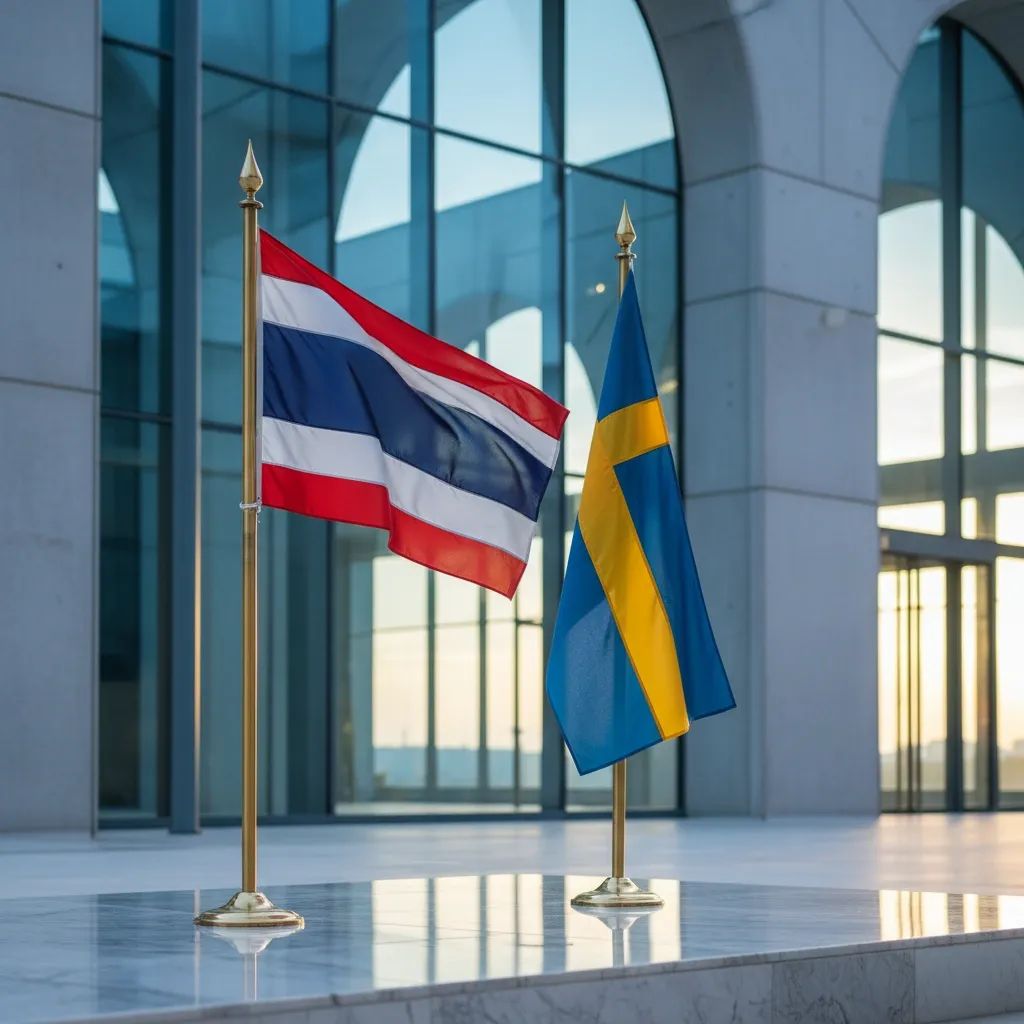
Thailand's monarch stood as the only Asian royal among European counterparts at Sweden's King Carl XVI Gustaf's 80th birthday celebrations on April 30, a distinction that underscores the depth of a relationship stretching back nearly 160 years. The exclusive invitation reflects a 157-year diplomatic connection that was formalized into a comprehensive strategic partnership last August, transforming ceremonial friendship into a relationship with measurable economic and strategic consequences.
Why This Matters
• Thailand was the only Asian royal house invited to the Stockholm celebrations, a rare honor that signals Sweden's strategic priorities in Southeast Asia.
• The visit builds on the August 2025 bilateral strategic partnership agreement covering defense procurement, green energy transitions, and OECD membership backing for Thailand.
• Over 100 Swedish firms operate in Thailand, with defense and technology transfers tied to Thailand's purchase of JAS 39 Gripen fighter jets forming a cornerstone of economic ties.
• Roughly 70,000 Thai nationals live in Sweden, while 200,000+ Swedish tourists visit Thailand annually, making visa liberalization talks a practical priority.
Strategic Partnership Behind the Pageantry
When His Majesty King Maha Vajiralongkorn and Queen Suthida stepped out of their motorcade at the Royal Palace in Stockholm on April 30, they were not simply attending a state banquet. They were representing the culmination of a relationship that Sweden now views as central to its entire Southeast Asia policy.
The Thailand Ministry of Foreign Affairs formalized the bilateral strategic partnership on August 26, 2025, in Stockholm, transforming what had been a cordial royal friendship into a multi-sector alliance. The agreement spans defense technology, sustainable forestry, startup ecosystems, and the green energy transition. For residents and businesses in Thailand, this translates into tangible opportunities: Swedish investment in renewable infrastructure, technology transfer linked to defense contracts, and Sweden's vocal support for Thailand's OECD accession.
Sweden views Thailand as its primary gateway into ASEAN markets, a region it considers increasingly vital to European economic growth and security. More than 100 Swedish companies already maintain operations in Thailand, concentrated in advanced manufacturing, green infrastructure, and renewable energy solutions. The partnership also includes ongoing negotiations for Thailand to secure Schengen visa exemptions for ordinary passport holders, a move that would ease travel for the 70,000 Thai residents in Sweden and benefit business mobility.
The Only Asian Monarchy at the Table
The guest list for King Carl XVI Gustaf's 80th birthday was a roll call of European royalty: Belgium, Denmark, Finland, Luxembourg, the Netherlands, Norway, Spain, and several non-reigning houses from Serbia, Romania, and Bavaria. Thailand stood alone as the sole representative from Asia.
This exclusivity is no accident. Thailand's royal ties with Sweden stretch back to 1884, when Prince Oscar Bernadotte sailed into Bangkok aboard the Swedish warship Vanadis. The relationship deepened in 1897 when King Chulalongkorn (Rama V) visited Stockholm during his first European tour, becoming the first Asian monarch to do so. A street in Ragunda Municipality still bears his name—Kung Chulalongkorns väg—and a Thai-style pavilion was erected there in 1997 to mark the centenary of that visit.
King Bhumibol Adulyadej (Rama IX) and Queen Sirikit visited in 1960, and King Carl XVI Gustaf has reciprocated with multiple trips to Thailand, including attendance at King Bhumibol's royal cremation in 2017. The Swedish Royal Court also bestowed the rare Garuda emblem in honor of the late monarch, one of the highest distinctions granted to a foreign head of state.
What This Means for Residents
For expatriates, investors, and professionals in Thailand, the strategic partnership offers concrete benefits beyond ceremonial diplomacy.
Defense and Technology Transfer: Thailand's procurement of JAS 39 Gripen fighters from Sweden has unlocked pathways for aerospace and cybersecurity investment. Swedish defense contractors are exploring joint ventures in Thailand's aviation and digital security sectors, creating specialized employment opportunities and technical training programs.
Green Energy and Sustainable Infrastructure: Sweden is positioning itself as a partner in Thailand's transition to renewable energy. Expect increased Swedish involvement in solar, wind, and biomass projects, as well as sustainable forestry management—areas where Swedish firms hold global expertise.
OECD Membership Support: Sweden is actively backing Thailand's bid to join the Organisation for Economic Co-operation and Development, a move that would integrate Thailand more deeply into global economic governance frameworks and potentially ease regulatory barriers for trade and investment.
Visa Liberalization: Talks are underway to grant Schengen visa exemptions to Thai ordinary passport holders. If successful, this would eliminate a significant friction point for business travel, family visits, and tourism between Thailand and the 26-nation Schengen zone.
Trade and Investment Expansion: The partnership aims to accelerate Thailand-EU Free Trade Agreement negotiations, which have stalled intermittently over the past decade. Swedish diplomatic support could help break the deadlock, opening preferential access to European markets for Thai goods.
Cultural Soft Power in Play
While defense and trade dominate the strategic calculus, cultural diplomacy is also at work. Thai traditional medicine, particularly herbal compress therapy (known as luk pra kob), has gained traction in Sweden's wellness and spa industry. Multiple Thai massage centers across Stockholm and other Swedish cities offer authentic treatments using Thai herbal compresses, and online retailers in Sweden now stock Thai-produced wellness products.
This cultural footprint, combined with the 200,000+ Swedish tourists who visit Thailand each year, creates a constituency in Sweden with direct economic and personal stakes in the bilateral relationship. It also provides a soft-power foundation for more formal diplomatic initiatives.
Military and Geopolitical Context
Sweden's recent accession to NATO adds a new layer to its partnership with Thailand. While Thailand maintains a non-aligned foreign policy and balances relationships with China, the United States, and regional powers, its defense procurement choices signal strategic preferences.
The Gripen deal is more than an arms sale; it is a technology transfer agreement that embeds Swedish expertise in Thailand's military-industrial complex. For Sweden, and by extension NATO, this represents a foothold in Southeast Asia's defense ecosystem, facilitating intelligence sharing and interoperability without formal alliance structures.
Thailand's participation in the Stockholm celebrations—at a moment when European security is under strain and transatlantic ties are being recalibrated—sends a message about Thailand's interest in maintaining diversified partnerships beyond its immediate region.
Historical Ties as Strategic Asset
The longevity of the Thailand-Sweden relationship is itself a strategic asset. Few bilateral ties can claim unbroken diplomatic relations since 1868, and even fewer have been continuously reinforced by royal exchanges. This historical depth provides political stability that commercial and defense contracts require.
For Thailand, the relationship offers leverage in European policy debates, access to advanced technology, and a reliable partner in multilateral forums. For Sweden, Thailand is a stable, middle-income economy with regional influence and a pragmatic approach to international relations.
The State Banquet and Military Parade
At the state banquet on April 30, King Maha Vajiralongkorn appeared in White Tie formal attire, the highest level of diplomatic dress code, while Queen Suthida wore a floor-length gown complemented by a royal tiara and the sash of the Order of Chakri, Thailand's highest royal decoration.
Earlier that day, the Thai royal couple attended a military parade at the Royal Palace, observing the Royal Guard's ceremonial display following a thanksgiving service and performance by the Royal Choir in the palace chapel. The precision of the protocol and the exclusivity of the guest list underscored the diplomatic weight of the occasion.
Looking Ahead
The strategic partnership is still in its early phase. Implementation will depend on follow-through in specific sectors: whether Swedish firms make promised investments, whether Thailand's OECD accession gains traction, and whether visa liberalization becomes reality.
For residents of Thailand, the partnership represents an opportunity to access European markets, technology, and mobility on more favorable terms. For Swedish expatriates and businesses in Thailand, it offers a more formalized framework for operations and government support.
The royal presence in Stockholm demonstrates how ceremonial diplomacy and strategic interests now reinforce each other, with measurable stakes in trade, defense, and mobility. What is clear is that the relationship between Thailand and Sweden has evolved from historical curiosity into a partnership with genuine significance for residents and businesses in both countries.


