
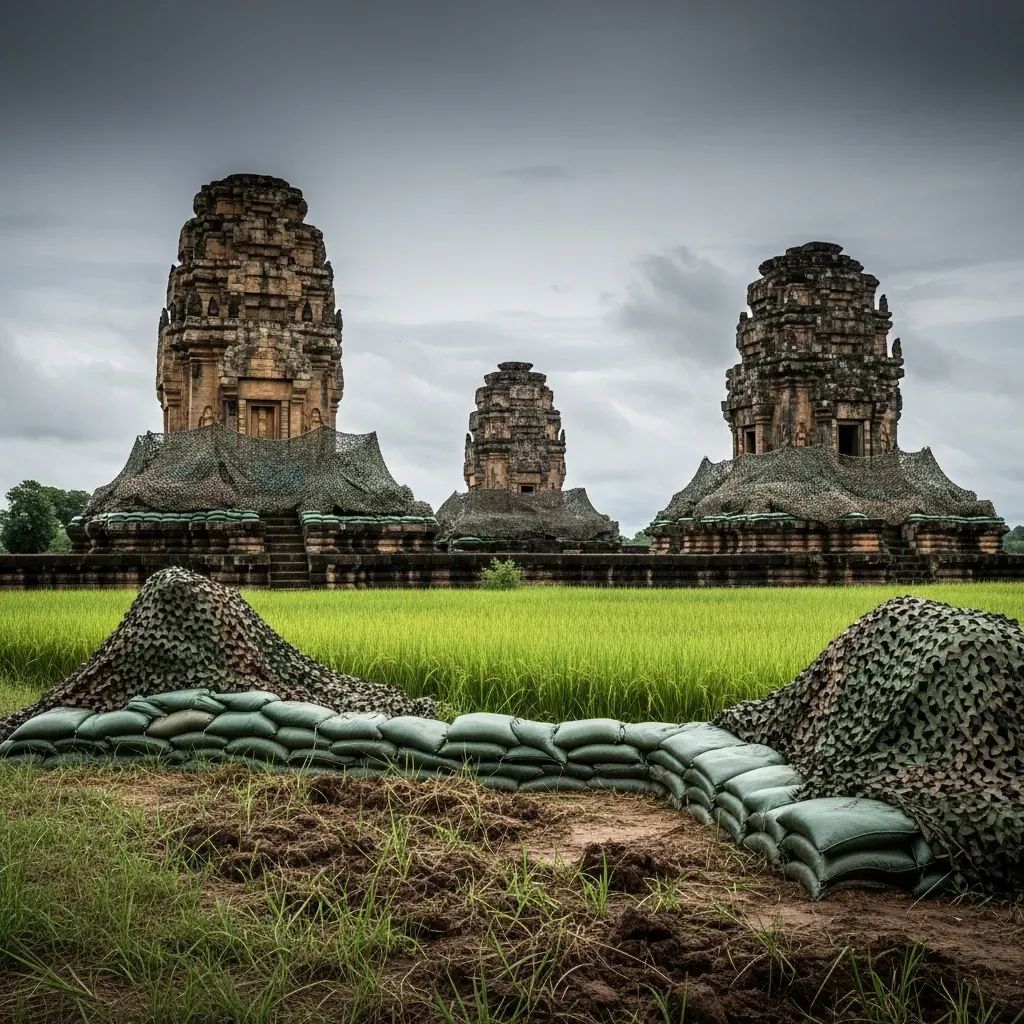
Tension is flaring again on Thailand’s northeastern frontier, where artillery whistles across the rice fields of Surin and ancient Khmer towers now bristle with sandbags instead of saffron robes. What began as a dispute over crumbling laterite walls has snowballed into a humanitarian headache: temples doubling as gun-pits, cross-border salvos, and more than 1,000 schools shuttered to keep children out of the firing line.
Flash Points in One Glance
• Prasat Ta Kwai in Surin allegedly converted into a weapons hub, with Cambodian troops firing from inside UNESCO-listed stonework.
• Thai commanders cite breaches of the 1954 Hague Convention on cultural property; Phnom Penh accuses Bangkok of "over-reaction".
• A cascade of school closures (1,168 campuses) stretches across seven border provinces, displacing tens of thousands of students.
• Vocational-college volunteers install electricity, repair shelters, and man field kitchens at more than 100 temporary evacuation centres.
• Heritage officials on both sides lobby UNESCO and ASEAN for intervention while drones and rocket artillery continue to trade blows.
An Ancient Sanctuary Turned Battlefield
For locals in Phanom Dong Rak district, the laterite spires of Prasat Ta Kwai once hosted loy krathong lanterns and rowdy merit-making festivals. Today, Thai reconnaissance photos show bunkers, mortar tubes, and camouflaged netting draped over lintels carved eight centuries ago. Army Region 2 officers say BM-21 rockets thundered out of the shrine complex on 9 December, prompting Thai counter-battery fire that left the southern wing of the monument pocked and blackened.
Cambodian units, according to Thai intelligence, have also moved family members into the combat zone to serve as cooks and porters — a practice Thai commanders brand "reckless" and "contrary to international humanitarian law". Phnom Penh denies endangering civilians, calling the site its "sovereign territory" and insisting Thai forces fired first.
What the Treaties Actually Say
Under the Hague Convention (1954), any belligerent that stations troops or stores ammunition in a recognised cultural site loses protective status for that site. "But it does not give the opposing army a blank cheque to raze the monument," warns Prof. Kriangsak Kiatfuangfoo, a heritage-law specialist at Chulalongkorn University. UNESCO headquarters in Paris has started analysing satellite imagery and quietly dispatched a liaison team to Bangkok, though officials admit on background that on-the-ground verification is impossible while shells still land.
The Cambodian Ministry of Culture counters that Thai loitering-munitions (FPV drones) have already gouged holes in Ta Kwai’s gopura and collapsed a library outbuilding. The ministry’s communiqué urges the world body to "condemn Thailand’s intentional destruction of Khmer patrimony" — a charge the Thai Foreign Ministry calls "baseless and ironic" given Phnom Penh’s own use of the site as a barracks.
Life in the Fire Zone: Classrooms Go Dark
Parents in Surin, Buri Ram, Sisaket, and Ubon Ratchathani woke to push alerts from the Education Ministry this week: "All classes suspended until further notice." By nightfall the count had reached 1,168 closed schools. Teachers hastily posted LINE group links for online assignments, while pickup trucks ferried villagers to 102 repurposed campuses turned into evacuation shelters.
"The roar of rockets is terrifying, but the bigger worry is lost learning," says Sornchai Miseth, principal of Ban Nong Mak Ok school, now serving as a dormitory for 340 evacuees. Electricity intermittency and patchy mobile data make remote lessons a luxury. The ministry’s mental-health unit has dispatched counsellors to run stress-relief art workshops for children bedding down on classroom floors.
Students in Overalls, Soldiers in Spirit
Amid the din, vocational-college trainees have emerged as unsung heroes. Under the "Fix It Center" programme, mechanics from Surin Polytechnic rig emergency solar panels, re–wire faulty shelter lighting, and tune generators keeping the royal mobile kitchen humming at Chang International Circuit. Welding students fabricate improvised blast-deflecting shields for army trucks, while culinary majors dish out 12,000 meals a day.
"It’s the first time my blueprint classwork saved real lives," beams Thamonwan Phumsawat, clutching a soldering iron still warm from field repairs. Military logisticians say the volunteers slash response times and let professional engineers focus on front-line infrastructure.
Bangkok vs. Phnom Penh: The War of Words
Thai government spokespeople highlight "clear video evidence" of rocket tubes inside heritage walls and accuse Cambodia of "human shield tactics". Phnom Penh’s defence ministry retorts that Thai artillery shells landed first, forcing Cambodian soldiers to seek "the nearest available cover". Each side has launched duelling hashtags — #SaveTaKwai from Bangkok, #DefendKhmerHeritage from Phnom Penh — amplifying nationalist fervour on social media.
Regional analysts warn that heated rhetoric risks eclipsing pragmatic diplomacy. "Both capitals know the International Court of Justice could become the ultimate referee, as it did over Preah Vihear in 2013," notes Dr. Patchara Chantavong of Thammasat’s ASEAN Studies Center. "But neither wants to appear weak heading into election cycles." She adds that a joint archaeological survey, once proposed under the 2000 Memorandum of Understanding, remains stalled.
Can Heritage Diplomacy Cool the Guns?
Past border flare-ups, from Khao Phra Wihan to Ta Muen Thom, eventually subsided when cultural-heritage liaisons stepped in. UNESCO is now floating a ceasefire corridor around Ta Kwai, monitored by drone overflights and Thai–Cambodian rangers wearing the Blue Shield emblem reserved for protected sites. Bangkok says it is "open to discussion" once rockets stop; Phnom Penh says cessation must be "simultaneous".
Behind the scenes, ASEAN’s Secretariat is pressing for a virtual "troika dialogue" that would include Indonesia as current chair. Whether that gains traction before holiday troop rotations arrive is uncertain.
What to Watch in the Days Ahead
Any sign of a localized ceasefire or third-party monitoring team.
Decisions from UNESCO’s World Heritage Committee on emergency funding for damage assessments.
Expansion — or rollback — of school closures as artillery range calculations shift.
Thai cabinet deliberations on additional evacuation budgets and possible curfews in high-risk tambons.
Evidence of heavy-weapon withdrawals from inside the temple perimeter captured by new satellite passes.
For families along the frontier, the priority remains simple: keep children safe and fields unscorched until cooler heads prevail. Yet each fresh burst of gunfire that echoes through the sandstone galleries of Prasat Ta Kwai chips away at more than stone — it erodes the shared cultural story that once bound the two kingdoms together.


