
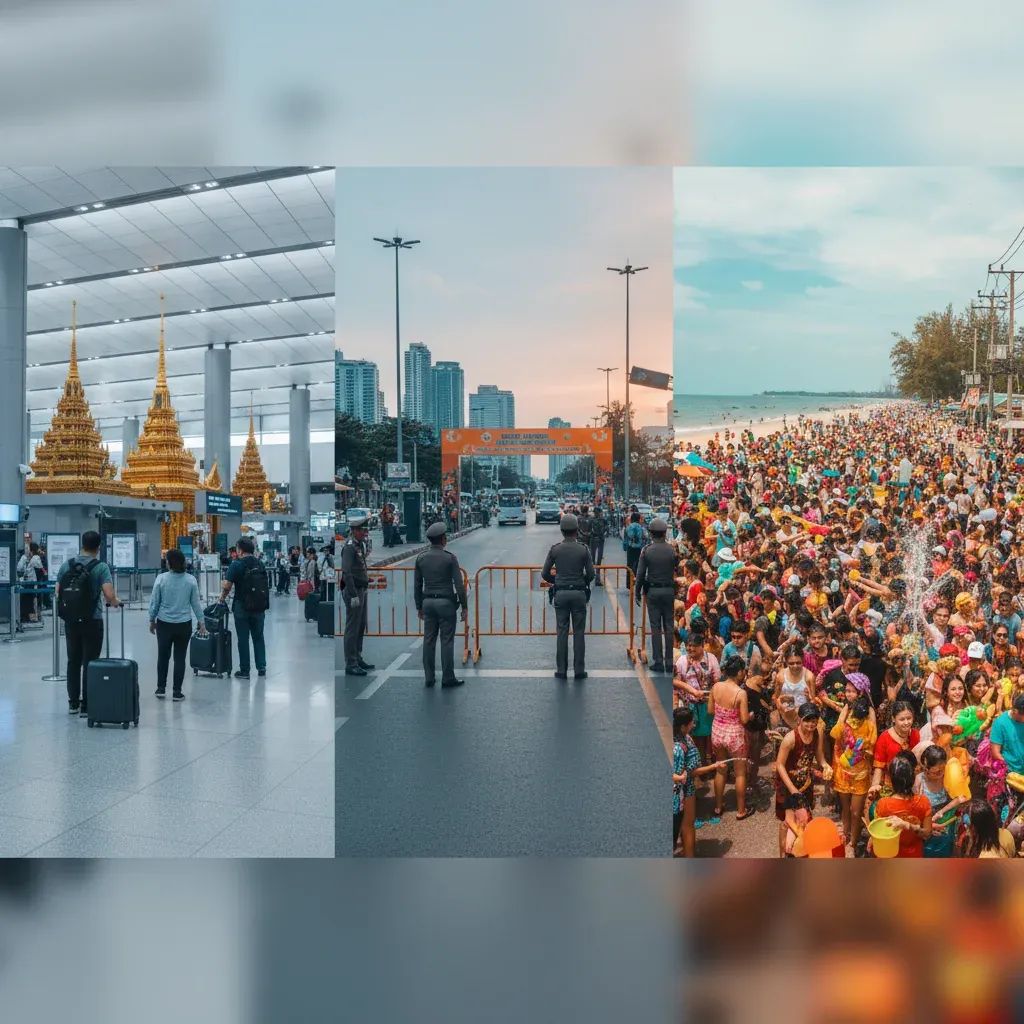
Thailand's tourism sector braces for a challenging Songkran festival as economic pressures converge with extreme heat and hazardous air quality, forcing both the industry and travelers to navigate a holiday period that's become more about survival than celebration.
Timeline: When to Plan Around
Songkran 2026 spans April 13-15 as the official celebration dates, with Pattaya's extended "Wan Lai" festivities continuing through April 19. Heat and air quality warnings are expected to persist through April 14, making late-stage planning critical for residents. Peak dangerous conditions are forecast for April 11-16 across most regions.
Why This Matters:
• Revenue projections are down 3.7% from last year — the first negative growth since the Russia-Ukraine conflict — with total spending expected at 129.6B baht
• Air quality warnings have been issued for 41 provinces, with PM2.5 levels exceeding safety standards and temperatures forecast to hit 42-43°C
• International arrivals are falling short, prompting tourism officials to slash visitor targets by 18% to 30-34M people
• Hotel occupancy rates lag previous years, with some destinations like Chiang Mai expecting revenue drops of 30%
Heat and Haze Compound Tourism Woes
The Thailand Meteorological Department has issued warnings for dangerous heat conditions across the country as the traditional water festival approaches. Temperatures in northern and central regions are expected to reach 40-43°C, with some provinces like Tak potentially hitting 42°C during the April 13-15 celebration period and the days surrounding it.
Pattaya, a key coastal destination hosting its extended "Wan Lai" festivities through April 19, faces not only sweltering conditions but also unexpected haze. While the most severe air pollution concentrates in the north — where Chiang Mai has repeatedly ranked among the world's most polluted cities due to agricultural burning — coastal cities are experiencing degraded air quality when wind conditions stall.
As of April 6, 41 Thai provinces recorded PM2.5 levels exceeding safety standards, with 32 provinces experiencing dangerous conditions for more than three consecutive days. Bangkok's Air Quality Index peaked at 103 (moderate level) on the same date. Health authorities have urged residents and tourists to limit outdoor exposure during peak afternoon hours, stay hydrated, and monitor air quality readings before planning activities.
For residents making Songkran decisions: Major expat hubs face these specific conditions — Bangkok expects moderate AQI levels (75-150 range), Chiang Mai faces severe air quality (unhealthy: 150-200+), Phuket remains relatively cleaner (30-100 range), and Pattaya sees moderate conditions (75-150 range). Use Thailand's official AirID app or aqicn.org for real-time readings. Limit outdoor activities when AQI exceeds 150; evacuate temporarily if readings exceed 200.
For an event built around outdoor water fights and street celebrations, the combination of extreme heat and poor air quality creates a fundamental challenge: how do you enjoy a festival when the environment itself poses health risks?
What This Means for Expats and Long-Term Residents Living in Thailand
For people living in Thailand, this year's Songkran presents practical considerations that go beyond typical festival planning and affect your daily life throughout April:
Health precautions become essential rather than optional. With temperatures potentially exceeding 42°C and hazardous air quality persisting in many regions, outdoor activities require careful timing and preparation. Those with respiratory conditions should monitor AQI readings closely and consider limiting exposure or temporarily relocating if possible. The northern region (Chiang Mai, Tak, Lampang) faces the highest risk and may warrant postponed celebrations.
Travel logistics will be more complex. While domestic flights see increased capacity, popular routes and accommodations face earlier booking pressures as both Thais and tourists compete for limited inventory. Last-minute travel will be prohibitively expensive or simply unavailable in key destinations. Book flights and hotels by mid-April at the latest if you're considering destination changes.
Cost sensitivity affects everyone. The 3.7% decline in overall spending reflects broader economic pressures that impact resident purchasing power as well. Businesses dependent on festival revenue may face difficult months ahead if Songkran fails to deliver expected returns, potentially affecting employment and service availability.
The festival atmosphere itself may feel different this year — less exuberant celebration, more cautious participation shaped by health warnings, economic anxiety, and a general sense that the traditional Songkran experience is being reshaped by forces beyond anyone's control. Community celebrations may see reduced participation due to air quality concerns.
Economic Reality Behind the Water Fights
The University of the Thai Chamber of Commerce's Center for Economic and Business Forecasting projects 129.6B baht in total spending during this year's Songkran — a 3.7% decline from 2025 and the lowest figure in four years. The downturn marks the first negative growth in the festival's economic contribution since geopolitical tensions disrupted global travel patterns.
Only 67% of surveyed Thais plan to travel this year, down from 72.1% in 2025. Rising fuel costs, Middle East conflicts driving up airfares, and general cost-of-living pressures have fundamentally altered travel behavior. Even among those who do travel, many are opting for shorter trips, lower budgets, and destinations closer to home.
The Tourism Authority of Thailand (TAT) has responded by cutting its 2026 foreign visitor target by 18%, from 40M to 30-34M arrivals. The revision reflects not just temporary setbacks but structural challenges: route limitations, volatile fuel prices, and weakening demand from traditionally strong markets in Europe, the Middle East, and the Americas.
Despite the reduced visitor numbers, TAT projects Thailand's overall tourism revenue will reach approximately 2.58 trillion baht in 2026. This apparent contradiction reveals the agency's strategic shift from "volume to value" — focusing on attracting higher-spending travelers who stay longer and spend more per trip, rather than simply maximizing arrivals.
What This Means for Hotels and Airlines
Accommodation Sector Struggles
The Thai Hotels Association anticipates a "quiet" Songkran compared to previous years, particularly noting the absence of long-haul European travelers deterred by airfares that have doubled on some routes due to Middle East airspace restrictions.
Regional breakdowns tell a sobering story:
Phuket expects average occupancy of 77.64% during April 11-15, generating approximately 7.05B baht — respectable numbers that nonetheless fall short of the near-100% occupancy rates typical of pre-pandemic Songkran periods.
Chiang Mai faces the steepest decline, with revenue projected to drop 30% from 1.35B baht in 2025 to just 936M baht this year. Visitor numbers are expected to fall from 150,000 to 120,000, with per-person spending declining significantly. The severe PM2.5 crisis in the northern region compounds these challenges, actively discouraging travel to what would normally be a marquee destination.
Hat Yai-Songkhla in the south reports hotel bookings at only 60-70%, dramatically lower than the typical 100% occupancy. Part of this decline stems from a Malaysian consulate advisory recommending postponed travel to the area.
Many hotels have responded by pivoting marketing efforts toward domestic travelers with aggressive promotions, attempting to compensate for international market weakness with local demand.
Aviation Sector Sees Mixed Results
Airports of Thailand (AOT) forecasts approximately 3.7M passengers during the April 10-19 period, representing a modest 2.3% increase year-over-year. However, this aggregate figure masks divergent trends: domestic passenger traffic is expected to surge 9.3% to 1.44M travelers, while international passenger volumes decline 2.2% to 2.26M.
Six major carriers — Thai Airways, Bangkok Airways, Thai AirAsia, Nok Air, Thai Lion Air, and Thai VietJet — have added 191 flights (nearly 30,000 seats) on 11 key domestic routes connecting Bangkok with Chiang Mai, Phuket, Hat Yai, and Koh Samui. Airlines are offering 15-30% discounts on select routes to stimulate demand.
Major airports including Suvarnabhumi and Don Mueang have prepared enhanced infrastructure including automated check-in kiosks (CUSS), baggage systems (CUBD), and biometric identity verification to reduce congestion, along with free parking zones to ease ground transportation pressures.
Regional Competition Intensifies
As Thailand faces headwinds, neighboring destinations are aggressively courting the same tourist demographics with competitive pricing and packages. Tour operators are offering Vietnam's Phu Quoc packages starting at 11,800 baht for 3 days/2 nights, Indonesia's Bali at 19,999 baht for 4 days/3 nights, and various China destinations from 13,888-20,888 baht for 4-5 day trips.
These alternatives often provide better perceived value, particularly for price-conscious travelers comparing total trip costs. While Thailand remains culturally unique for Songkran celebrations, the economic calculus for many travelers now weighs festival atmosphere against destination affordability and convenience.
Domestic Thai hotels have responded by slashing rates 20-40%, particularly among 3-star properties and below, in an effort to remain competitive with both international alternatives and changing consumer expectations.
The Vulnerability Beneath the Festival
The structural challenges exposed by this year's Songkran extend beyond a single holiday. Thailand's tourism model — built on high-volume arrivals generating predictable revenue streams — confronts a fundamentally altered landscape where visitors are more selective, budget-conscious, and unpredictable.
Rising operational costs, strained infrastructure in major tourism hubs, and ongoing debates about pricing transparency have eroded Thailand's competitive positioning. The strong baht has further diminished purchasing power for international visitors, making everything from hotels to street food more expensive in foreign currency terms.
Government intervention attempts — toll road waivers, fuel price controls, enhanced transport services, and airport incentives — provide temporary relief but don't address underlying competitiveness issues. These measures essentially subsidize movement and spending during peak periods without solving the profitability challenges businesses face during the remaining 50 weeks of the year.
The irony is stark: Thailand's most important cultural festival, traditionally a time of renewal and joy, arrives this year as a test of the tourism sector's resilience and adaptability. The country will celebrate, tourists will come, water will fly through the air as it has for centuries. But beneath the surface, Songkran 2026 reveals an industry at an inflection point, where the old formulas no longer guarantee success and the path forward remains unclear.
Whether this becomes a moment of necessary recalibration or the beginning of more prolonged challenges will depend on factors far beyond the festival itself — from global energy markets to regional competition to Thailand's ability to articulate and deliver unique value in an increasingly crowded tourism landscape.


