
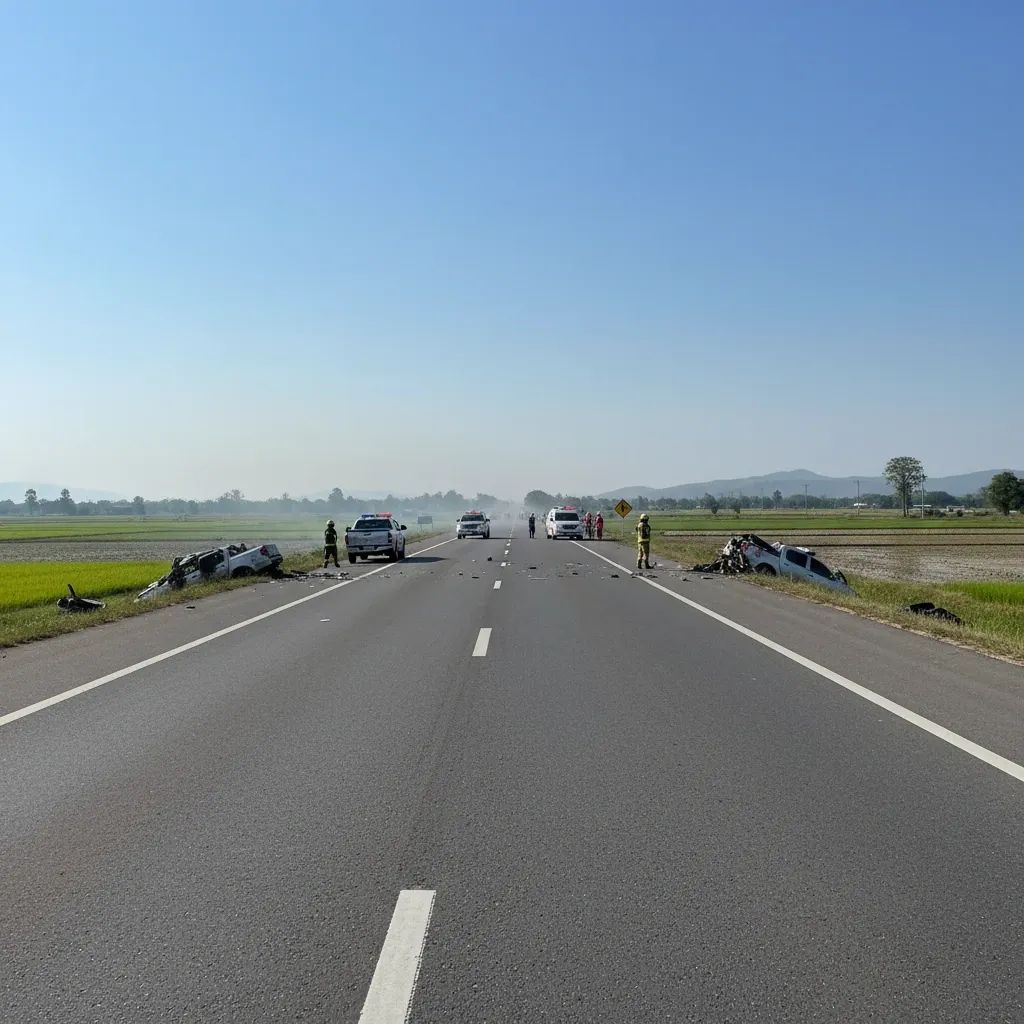
When a 66-year-old retired naval officer's grey sedan struck a motorcyclist pulling into traffic from a side road near Sattahip on April 30, the collision highlighted ongoing concerns about Thailand's road safety challenges: the gap between individual accountability and systemic infrastructure failure. The elderly rider, still unidentified, remained in critical condition at hospital, while the BMW driver cooperated with police investigators tasked with determining fault in a case that hinges not just on witness accounts and vehicle damage, but on the adequacy of the road itself.
Why This Matters
• Investigation outcome will set precedent: How the Thailand Royal Police assigns liability between the motorcycle rider and BMW driver—whether by U-turn violation or driver negligence—could influence how similar crashes are prosecuted and how liability is apportioned when vulnerable road users collide with larger vehicles.
• Highway 332's condition is under scrutiny: Police findings may pressure the Sattahip Municipal Authority to accelerate infrastructure repairs on a stretch already notorious for poor lighting and surface defects that officers acknowledge have contributed to prior accidents.
• Medical outcome determines legal severity: If the elderly rider does not survive, charges against Lt.JG. Prapian Kuemit could potentially escalate to more serious classifications under Thailand's road traffic statutes, which can include enhanced penalties depending on injury severity and investigation findings.
The Collision: Sequence and Immediate Response
At 2:10 p.m. on a Wednesday afternoon, dispatch received a report of a two-vehicle crash on Highway 332. Police officers, rescue workers from Sattahip Hospital, and volunteer disaster relief units arrived to find an elderly man sprawled on asphalt, unconscious and bleeding heavily. A blue Honda Wave motorcycle lay crumpled beneath the front bumper of a grey BMW bearing Bangkok license plates. The sedan's front end bore the signature damage of a high-impact collision—windshield shattered, hood accordion-folded, bumper crushed inward.
Rescue personnel initiated cardiopulmonary resuscitation at the roadside while loading the victim onto a stretcher. The motorcyclist was transported to hospital in critical condition, his identity unknown to responders. Nearby, the BMW driver—identified as Lieutenant Junior Grade Prapian Kuemit—remained at the scene, visibly shaken but cooperative. Officers documented his statement: the motorcyclist had emerged from a side road and attempted a U-turn directly into oncoming traffic; Kuemit stated he could not stop the vehicle in time.
The wreckage told a partial story. Skid marks on the asphalt indicated that the BMW's driver had attempted braking. The final resting positions of both vehicles suggested a high-speed impact. But the investigation was incomplete. Police needed witness testimony, forensic analysis of vehicle damage, and a clearer picture of road conditions at the moment of collision.
Why U-Turns on Secondary Highways Become Fatal
Executing a U-turn requires motorcyclists to perform simultaneous calculations of oncoming vehicle speed, distance, and required turning radius—judgments made in the span of seconds. For riders aged 60 and older, the physiological toll accumulates. Diminished depth perception makes it harder to judge how fast a vehicle approaches. Slower reaction times delay corrective steering. Weaker neck and shoulder strength limits the quick, forceful maneuvers needed if an incoming vehicle suddenly looms larger than anticipated.
Researchers studying motorcycle accidents in Thailand identify perceptual failure—the inability to accurately assess speeds and distances—as the leading cause of fatal crashes. Elderly motorcyclists encounter this hazard acutely during U-turns, when they are momentarily vulnerable, committed to a maneuver with minimal escape options. When a larger vehicle traveling at highway speed meets a motorcyclist mid-turn, the collision forces become immediately catastrophic.
Thailand has experimented with redesigned U-turn infrastructure, including the installation of S-Guard steel barriers that physically prevent wrong-way riding and separate motor-cycle and automobile traffic streams. However, deployment across secondary highways remains patchy. Highway 332 has not benefited from these upgrades. Many riders on such roads receive no formal training; licensing standards are inconsistently enforced. This gap—between what newer safety standards demand and what older infrastructure provides—defines the risk environment for older motorcyclists daily.
The Highway 332 Infrastructure Concerns
Local residents and regular commuters report that sections of Highway 332 between the J Intersection and Kasem Phon experience visibility and maintenance challenges. According to commonly reported concerns, streetlights remain inoperative or absent in certain stretches, road surfaces are uneven with ad hoc patching rather than comprehensive resurfacing, and warning signage is sparse in critical zones. Local residents have lodged complaints asserting that maintenance efforts have not adequately addressed fundamental safety systems—functional illumination, proper drainage, safety barriers.
The documented hazards include sharp curves that require heightened attention, and the J-Kasemphon intersection has earned a reputation as an area where motorcycle accidents cluster. Reports have surfaced of informal motorcycle racing and dangerous driving behavior in the area.
On January 18, 2026, a motorcyclist collided with an abandoned car parked on a section of Highway 331 in Phlu Ta Luang, an accident attributed by local authorities to inadequate lighting. Such incidents demonstrate how visibility and maintenance conditions on secondary highways can contribute to accident patterns across the region.
National Context: Motorcycles and Road Death in Thailand
During the "7 Dangerous Days" spanning New Year 2025 (December 30, 2024, through January 5, 2025), Thailand recorded 1,511 traffic accidents nationwide, resulting in 1,464 injuries and 272 deaths. Motorcycles featured in the vast majority of collisions; speeding was the leading cause of accidents. The Songkran holiday period in 2025 proved similarly concerning, with 1,242 accidents and 242 fatalities over seven days. Motorcycles accounted for more than 70% of vehicles involved in fatal or severe crashes during those periods.
These national statistics underscore a persistent reality: Thailand's motorcycle accident rate ranks among the highest globally. Secondary highways like Highway 332, which lack the enforcement and infrastructure investment of major urban routes, may experience accident rates that exceed national averages. The April 30 crash on Highway 332 reflects systemic patterns in road safety across Thailand.
The Thailand Ministry of Transport acknowledges this reality. The draft Road Safety Master Plan 2022–2027 elevates motorized two-wheeler safety to a central priority, with a target of reducing the national road death rate. Achieving that benchmark requires not merely stricter law enforcement and licensing reforms, but sustained investment in functional infrastructure—streetlights that operate, barrier systems that function, road surfaces that drain properly.
Legal Framework and Investigation Status
The Thailand Road Traffic Act establishes a liability framework for determining fault in traffic collisions. The Sattahip Police Station is currently collecting witness testimony, forensic analysis of vehicle damage, and photographic evidence of the crash site to establish the sequence of events.
As of mid-May 2026, no formal charges have been filed. The investigation's findings will determine whether criminal charges are pursued and their classification. The outcome will hinge critically on whether bystanders witnessed the collision and can provide corroborating accounts.
What Commuters on Highway 332 Should Know Now
For the thousands of residents and workers who navigate Highway 332 daily—whether by motorcycle, car, or commercial vehicle—the April 30 crash serves as a reminder that defensive measures should be prioritized. Motorcyclists should avoid U-turns in high-speed zones, ensure brake lights and turn signals function reliably, and maintain their machines in good mechanical condition. Reflective clothing and defensive riding during dawn and dusk, when visibility is poorest, measurably reduce collision risk.
Larger vehicle operators must anticipate erratic maneuvers from two-wheelers, particularly near side roads where motorcyclists may enter traffic abruptly. The Thailand Royal Police periodically intensify enforcement operations targeting speeding, mobile phone use while riding, and wrong-way driving on Sattahip roads, but these campaigns remain intermittent and concentrated around major holiday periods. Outside those windows, enforcement gaps widen. Commuters cannot rely on consistent systemic protection; individual vigilance remains important for safety.
Infrastructure Investment as Prevention
Until Highway 332 receives comprehensive infrastructure improvements—functional streetlights installed and maintained, physical barriers segregating traffic streams, resurfaced pavement with proper drainage, adequate warning signage at hazard zones—the road will likely continue presenting elevated hazard compared to well-maintained alternatives. The April 30 collision demonstrates how quickly routine maneuvers can become dangerous on roads with infrastructure limitations.
Residents and regular commuters should assume that the road presents elevated hazard and plan travel accordingly. The investigation into the crash will produce findings about driver behavior and liability, but those findings will not address the underlying infrastructure concerns. Only sustained political pressure on contractors and local administrators—and budgetary commitments from regional authorities—can remedy that condition. Until then, Highway 332 requires heightened caution from all users.


