
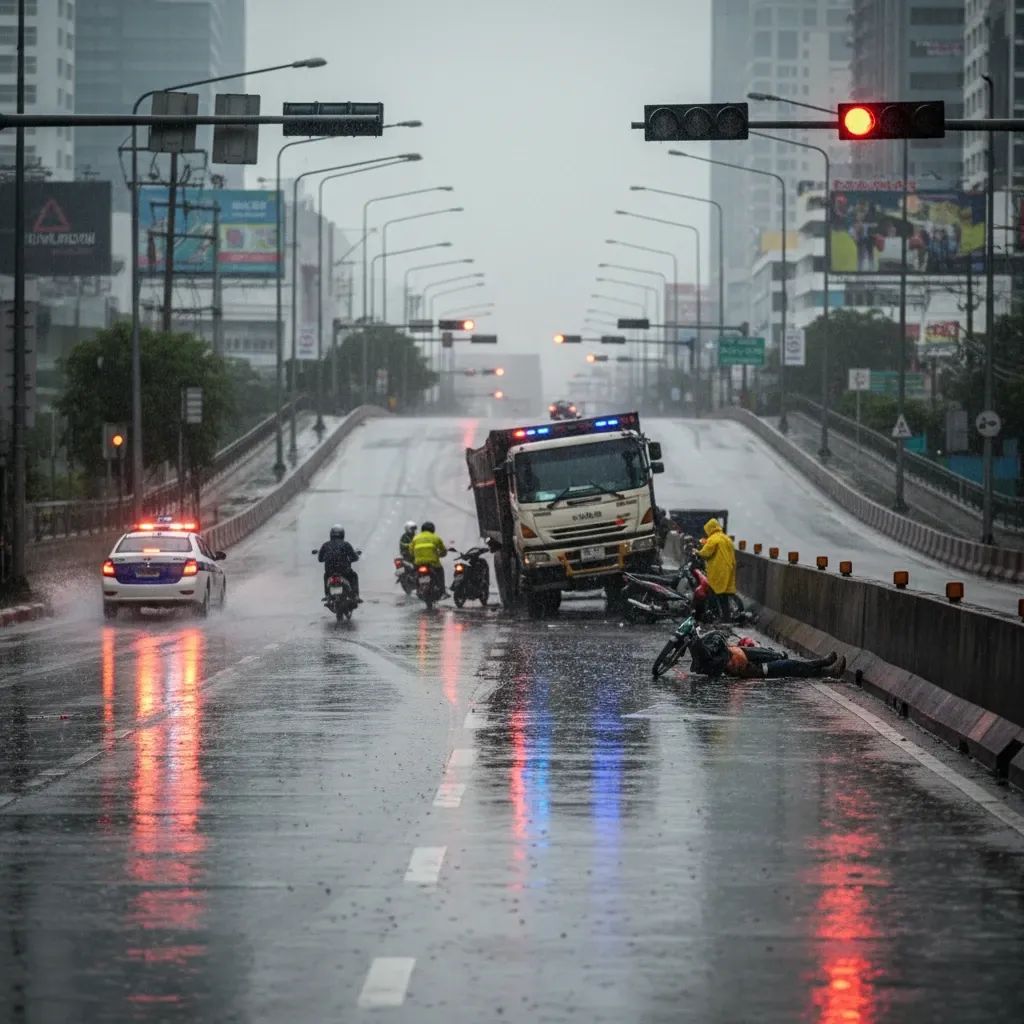
A Thailand freight truck loaded with eucalyptus logs plowed through seven vehicles on Ratchaphruek Road in Bangkok on April 24, 2025, killing one person and injuring multiple others after the driver reported complete brake failure on a rain-slicked downhill stretch near BTS Bang Wa station. The collision has reignited scrutiny over Thailand's enforcement of truck weight limits and brake safety standards, which remain a persistent vulnerability despite regulatory efforts.
Why This Matters:
• Fatal crash zone: The accident occurred on a steep decline in Phasi Charoen district, a high-traffic corridor where heavy vehicles frequently navigate inclines.
• Brake failure claim: The 67-year-old driver told Royal Thai Police the truck's brakes failed after rainfall, raising questions about pre-trip vehicle inspections.
• Legal consequences: Authorities are investigating charges of negligent homicide and injury, which can carry up to 10 years imprisonment under Thai law depending on circumstances and prior record.
• Weight regulations: 10-wheel trucks in Thailand are capped at 25 tons gross weight, but enforcement gaps persist despite heightened controls implemented in 2025.
The Collision Sequence
The 10-wheel Isuzu freight truck, hauling eucalyptus timber, lost control while descending the grade near the Bang Wa BTS station around midday on April 24. Witnesses reported the truck accelerating uncontrollably through the intersection, first striking three motorcycles that became pinned beneath the chassis. Two motorcycle taxi drivers, including a 50-year-old, sustained severe injuries in the initial impact.
The runaway vehicle then crushed a black MG sedan between itself and a cement mixer truck ahead, trapping three occupants inside. A 55-year-old man died at the scene before rescue teams could extract him. Two other passengers required hydraulic extrication equipment and were transported to Bangpakok 9 International Hospital and Siriraj Hospital with critical injuries.
A taxi caught in the chain reaction careened into a roadside barrier, injuring both driver and passenger. In total, seven vehicles sustained damage across multiple lanes, shutting down the southbound corridor for hours as Poh Teck Tung Foundation rescue units cleared the wreckage.
Driver's Account and Police Response
The truck operator, 67, emerged with minor injuries and told investigators that his brakes failed as he descended the bridge approach following rain showers. He claimed the heavy load of eucalyptus logs made it impossible to halt the vehicle once the braking system ceased functioning.
Royal Thai Police have launched a formal inquiry into negligent driving causing death and bodily harm, a charge that can result in imprisonment of up to a decade if gross negligence or mechanical defects are proven. Authorities have impounded the truck for technical inspection to determine whether brake maintenance was neglected or if overloading contributed to the system failure. Additional charges may follow depending on the forensic findings.
Thailand's Truck Safety Gap
Brake failure remains a recurring hazard on Thai roads, particularly for heavy freight vehicles navigating steep terrain or operating in wet conditions. Despite established safety standards, enforcement challenges and maintenance lapses continue to produce deadly outcomes.
Current regulations for 10-wheel trucks mandate a maximum gross weight of 25 tons, encompassing the vehicle, cargo, fuel, and driver. Violations can trigger fines up to 100,000 baht (approximately $2,800 USD), license suspension, vehicle impoundment, and imprisonment for up to six years. Thailand's Department of Land Transport has implemented stricter enforcement targeting ten primary crash causes, including overloading and defective braking systems.
Technical requirements introduced in 2024 now require ABS braking systems, driver airbags, and front and rear cameras on 6- to 10-wheel trucks. However, older vehicles grandfathered under previous standards still circulate, and mobile weigh station inspections face persistent gaps in coverage and occasional corruption issues.
What This Means for Residents
For anyone navigating Bangkok's arterial roads, the crash underscores the elevated risk posed by heavy commercial vehicles, especially during the rainy season (typically May through October) when braking distances extend and road surfaces become treacherous. Ratchaphruek Road, a major north-south thoroughfare connecting suburban districts to central Bangkok, sees substantial truck traffic due to its proximity to industrial zones.
Motorcycle riders, who account for 36% of vehicles in Bangkok and face the world's highest per-capita motorcycle fatality rate, are particularly vulnerable in multi-vehicle pileups. The three motorcycles crushed under the freight truck in this incident illustrate the lopsided consequences when heavy and light vehicles collide.
Defensive driving practices become critical during rain: maintain extended following distances, reduce speed on descents, and avoid positioning alongside or directly in front of large trucks on grades. The sudden downpour that preceded this crash is a recurring pattern—studies link high precipitation levels to significant spikes in traffic accidents across Thailand.
Infrastructure and Weather Vulnerabilities
The accident site near BTS Bang Wa sits on a known downhill section where heavy vehicles must manage both gravity and traffic signals at the base of the slope. When rain compounds the challenge, even properly functioning brakes face increased thermal stress from continuous application.
Bangkok Metropolitan Administration (BMA) has identified excessive speed as a primary crash factor and is petitioning to reduce speed limits on 40 inner-city and residential roads from 80 km/h to 50 km/h. While freight trucks already face limits of 80 km/h on expressways and 90 km/h on general roads, enforcement relies heavily on fixed cameras and patrol units that cannot monitor every descent.
The eucalyptus logs being transported are a common cargo in Thailand, where the timber is processed for paper, plywood, and export as wood chips. While no separate regulations govern eucalyptus transport, the general weight and dimension laws apply universally. Overloading not only increases stopping distance but also accelerates brake wear, a factor investigators will examine closely in the impounded truck.
Looking Ahead: Regulatory Pressure and Accountability
This fatal crash arrives amid intensified government focus on commercial vehicle safety. Metropolitan Police Bureau expanded authority to pull overloaded trucks off Bangkok roads, and mobile weigh stations have increased inspections. Yet mechanical defects—particularly brake system failures—require proactive maintenance that regulations can mandate but not always guarantee.
For freight operators, the legal and financial stakes are rising. Beyond criminal penalties for drivers, cargo owners and transport companies can face liability if inspections reveal negligence. The outcome of this case will test whether Thailand's enforcement push translates into accountability or remains largely symbolic.
Residents and commuters, meanwhile, are left to navigate roads where aging commercial fleets, inconsistent maintenance, and infrastructure stress converge during every rainstorm. Until inspection regimes close the gap between regulation and reality, the hazard remains systemic rather than isolated. Bangkok residents can monitor real-time traffic conditions via BTS and BMA alerts during rainy season conditions, and consider using alternative routes to Ratchaphruek Road during heavy rainfall when truck accidents risk is elevated.


