
Why This Matters
• Timing: A potential 18-day walkout begins May 21, affecting the world's second-largest memory chip manufacturer.
• Scale: Over 40,000 workers—the largest labor action in Samsung's 57-year history—are mobilized for this action.
• Your Impact: Thailand's smartphone and electronics prices could increase, and IT infrastructure timelines may slip if production halts extend through June.
• Market Ripple: Rivals like SK Hynix and TSMC will likely capture Samsung's diverted orders, potentially reducing Samsung's future business opportunities.
The Central Dispute: Money, Not Ideology
What's happening at Samsung Electronics' Pyeongtaek complex centers on economic distribution. The National Samsung Electronics Union (NSEU), which represents more than 70% of Samsung's South Korean workforce, is demanding changes to how company profits are distributed to workers—and the financial stakes are substantial.
The union has identified an issue with Samsung's compensation structure: the performance-based bonus cap, which has historically limited individual payouts to 50% of annual salary or 1,000% of base pay, regardless of company profitability. In profit-strong years, this ceiling prevents workers from receiving larger bonuses, even as the company's bonus pool increases significantly.
The union's core demand is straightforward: eliminate the cap entirely. In its place, allocate 15% of Samsung's annual operating profit directly as employee bonuses, with no ceiling. Samsung has reported forecasts of ₩300 trillion in operating profit for 2026—which would translate to approximately ₩45 trillion in potential bonus payouts under the union's proposal. For comparison, that would equal roughly 260,000 baht per worker annually (assuming distribution across 40,000 employees), equivalent to approximately one month's salary for many Thai households. (Currency conversion based on 2026 rates: 1,000 KRW ≈ 29 THB)
Samsung has offered 13% or 10% profit-share alternatives. Both proposals were rejected. Management argues that committing to 15% of annual profit during a peak industry cycle creates financial risk; when semiconductor demand eventually weakens, the company would face unsustainable obligations. The union counters that Samsung's own financial guidance demonstrates the company can absorb higher payouts while remaining competitive. The core disagreement is whether a bonus constitutes discretionary compensation or a contractual obligation.
The SK Hynix Precedent
The union's confidence is partly based on a recent development. In September 2025, rival SK Hynix agreed to remove the bonus cap and committed to distributing 10% of annual operating profit as bonuses for the next decade. SK Hynix workers saw average bonuses reach approximately ₩100 million (roughly 2.9 million baht) in the current year, with higher projections as demand for specialized AI-optimized high-bandwidth memory (HBM) increases.
Samsung employees have noted this outcome. According to Samsung union representatives, more than 200 Samsung union members have transferred to SK Hynix in recent months, a departure that indicates competitive disadvantage in recruitment. The message to remaining workers is clear: competing employers are offering better compensation.
However, the comparison involves important context. SK Hynix operates with higher operating profit margins than Samsung, driven partly by its greater exposure to the premium AI memory market, where HBM commands higher prices. Samsung manages a more diversified portfolio including foundry services, consumer electronics, and commodity memory chips. A 15% profit-share at Samsung represents a steeper cost burden in absolute terms than SK Hynix's 10%, even though the percentage appears modest. According to industry analysis, the annual cost difference could exceed ₩5 trillion, which would compress Samsung's earnings-per-share.
Production Impact: How Significant Is 18 Days?
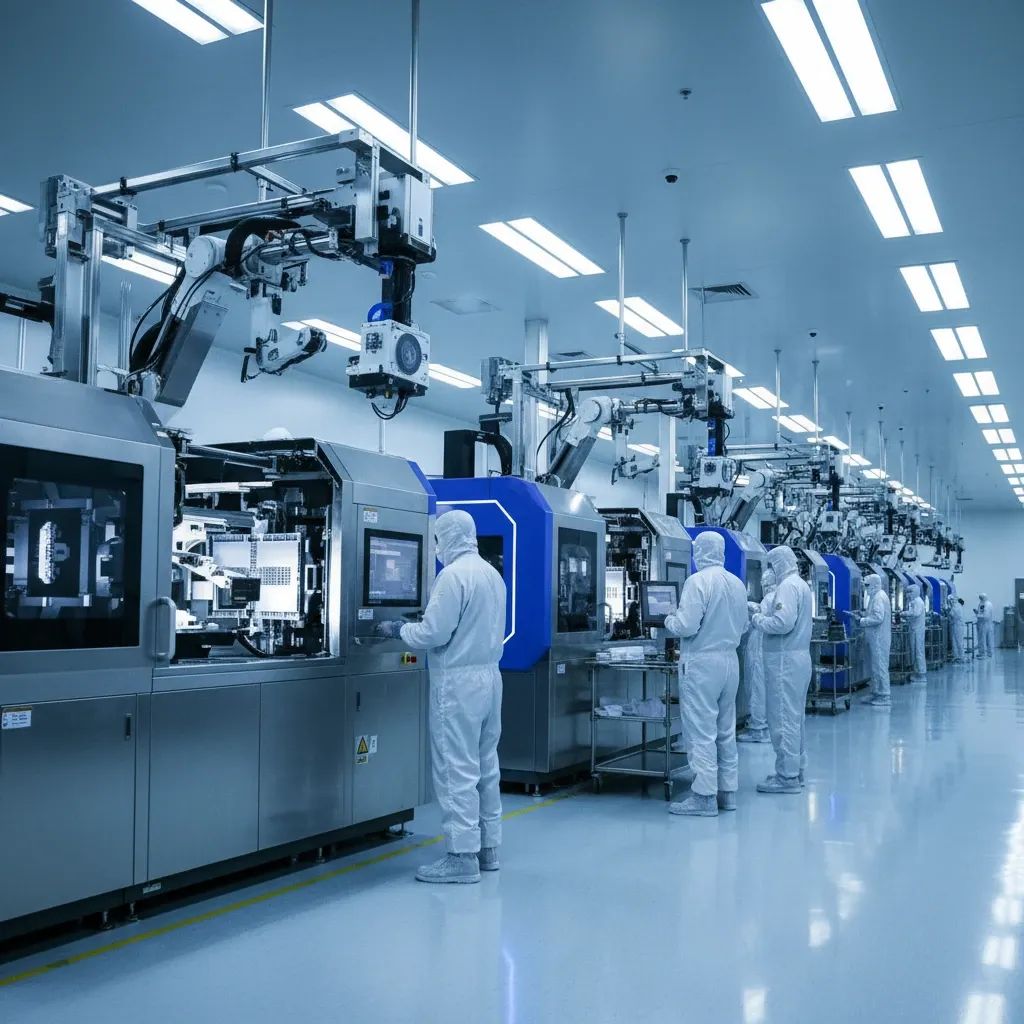
Pyeongtaek remains partially labor-dependent despite automation investments. Advanced chipmaking still requires human expertise for equipment calibration, cleanroom management, and quality assurance in sub-5nm lithography and 3D NAND stacking—processes where small variations in process control significantly affect yields.
During a three-day work action in July 2024, Samsung experienced measurable output losses: foundry production dropped 58%, and memory chip output fell 18%, with reduced crews and limited automation. An 18-day walkout spanning May 21 through June 7 would increase these impacts proportionally. Industry sources suggest production could decline 50-70% across memory fabrication, translating to roughly 30 trillion won (approximately 870 billion baht) in lost output.
Recovery follows a complex timeline. Semiconductor fabrication cannot simply resume after a pause. Wafers mid-production require scrapping; cleanrooms need recalibration; and yield rates typically remain below normal for weeks after resumption due to equipment recalibration and operator retraining. Industry observers suggest that recovery to normalized output could consume significantly longer than the strike duration—meaning a June 7 restart might not achieve full efficiency until late July or August. For annual output targets, this represents a permanent setback within 2026.
Global Competitive Effects
Samsung controls 43% of the global DRAM market and approximately 33% of NAND flash memory—the chips powering smartphones, laptops, data centers, and AI infrastructure. Any production interruption creates supply gaps that competitors can fill.
SK Hynix and Micron, both operating at high capacity utilization, can accept orders diverted from Samsung. Lead times will increase, and customers requiring inventory will accept higher pricing. TSMC, similarly stretched across advanced logic and foundry work, will benefit as clients diversify suppliers to hedge supply-chain risk. Once customers qualify alternative suppliers and establish production routines, reversing course requires expensive re-certification and yield testing.
Samsung management has emphasized the long-term stakes. An extended production halt would not only suppress revenue during the strike period; it would damage customer confidence for years, potentially causing permanent market share loss. This concern explains Samsung's legal filing for a court injunction characterizing the strike as unlawful, signaling that management views settlement as less costly than extended labor action.
What This Means for Thailand Residents
For people living in Thailand, the effects would be direct and measurable.
Consumer Electronics Pricing
Thai retailers selling Android smartphones—particularly Samsung Galaxy models, which represent a significant share of premium phone sales in Thailand—depend on Samsung memory chips for competitive positioning. A production halt would reduce supply availability, potentially causing price increases of 5-12% during Q2-Q3 2026. Thai consumers planning smartphone upgrades before May 21 should consider accelerating purchases if possible, particularly for Galaxy flagship models. Alternative brands widely available in Thailand—including OPPO, Vivo, Xiaomi, and Realme—may experience better availability during a Samsung supply shortage.
Corporate IT Infrastructure
Thai financial institutions, logistics companies, and data centers planning IT upgrades or server expansions face potential timeline delays and cost pressures. Enterprise DRAM and SSD prices could increase 8-15% if Samsung supplies become constrained; procurement teams should place orders immediately. Companies with multi-month IT projects should activate contingency plans for delayed chip delivery and evaluate TSMC or Micron alternatives now. Thai banks and financial technology companies, which typically depend on stable server memory supplies, should confirm Samsung dependency in their supply chains by early May.
Supply Chain and Retail Operations
Electronics retailers across Thailand—including major Bangkok electronics markets in Pantip Plaza and Mah Boon Krong (MBK Center)—should prepare for extended lead times on Samsung memory products (SSDs, RAM modules) beginning in late May. Retailers should increase safety inventory starting immediately, before logistics channels become congested. Distributors supplying regional branches outside Bangkok should prioritize stock levels by mid-May.
Alternative memory suppliers with established Thai distribution include Micron (Crucial brand), SK Hynix, and Kioxia—companies with strong availability in Thailand's retail channel.
Employment in Logistics and Distribution
Electronics supply-chain workers, warehousing staff, and distribution providers servicing Samsung's regional operations could face reduced work hours or temporary layoffs if Samsung's production schedule slips significantly. This impact would primarily affect workers in Bangkok-area distribution centers and provincial logistics hubs supporting electronics retail networks.
Practical Steps for Thailand Consumers and Businesses
Immediate Actions (By May 15):
• Consumers: If you need a smartphone before July, purchase before May 21 to avoid potential price increases or stock-outs
• Businesses: Submit IT equipment purchase orders immediately for server memory and storage; confirm delivery dates with suppliers
• Retailers: Increase inventory of Samsung memory products (SSDs in particular) by 25-30% above normal stock levels
Alternative Brands to Monitor:
• Smartphones: OPPO (strong Thai market presence), Vivo, Xiaomi, Realme offer competitive alternatives during shortages
• Server Memory: Micron (Crucial brand), SK Hynix, and Kioxia have established distribution in Thailand and represent reliable alternatives
• Personal Computing: Check availability from Thai retailers for ASUS, Acer, and Lenovo models using alternative memory suppliers
Supply-Chain Risk Management:
• Thai businesses should audit current Samsung chip dependency by May 10
• Confirm alternative supplier contacts (Micron, SK Hynix Thai representatives) before supply pressures intensify
• Budget contingency funds for potential 8-15% memory price increases if Samsung supplies become constrained
The Negotiation Path Forward
Both Samsung and the union occupy defensible positions, though neither can sustain indefinite stalemate.
Samsung's Position: Accepting the 15% demand would establish a precedent the union could leverage indefinitely, potentially hardening into additional wage commitments that extend industry-wide. Yet resisting outright risks the strike materializing, imposing costs that far exceed any salary savings. The company faces a difficult choice between financial principle and operational continuity.
The Union's Position: A successful 18-day walkout would validate labor movement strength and could trigger similar actions among SK Hynix and Hyundai workers—expanding the strike wave beyond Samsung. However, a negotiating defeat would reduce union credibility. The union must demonstrate willingness to execute the threatened action.
Negotiations remain formally ongoing, though both sides have publicly committed to positions that complicate compromise. The gap between Samsung's 13% offer and the union's 15% demand—less than 1 trillion won annually—appears arithmetically modest. However, the psychological difference between discretionary compensation and a structural entitlement explains the impasse. Compromise mechanisms that might bridge this gap remain to be identified.
Possible Outcomes
Negotiated Settlement (Estimated probability: 60%): Samsung agrees to 14% profit-share with structural adjustments around bonus flexibility. The strike is averted. Output normalizes by early June. Impact on Thailand: minimal. Smartphone prices remain stable. IT projects proceed as scheduled.
Brief Strike Action (Estimated probability: 25%): Workers execute a 3-5 day action to demonstrate commitment. Samsung concedes 13-14% terms. Production disruption is contained to Q2; recovery by mid-June. Impact on Thailand: modest, approximately 2-3% price increase on memory-intensive devices, 3-week delivery delays.
Extended 18-Day Strike (Estimated probability: 15%): Both sides maintain positions. The walkout proceeds through June 7. Samsung loses ₩25-30 trillion in output. Customers diversify suppliers. Market share consequences extend into 2027. Impact on Thailand: pronounced—price increases of 10-15%, lead times extending 6-8 weeks, IT project delays extending through Q3, potential employment reductions in electronics distribution sectors.
Strategic Implications for Southeast Asia
Samsung's operational vulnerability reflects the structure of semiconductor manufacturing: production continuity is non-negotiable because customers cannot simply wait extended periods for chips. Any work stoppage immediately converts into customer defection and lasting competitive damage.
The union understands this structural leverage and has calculated that Samsung's need to avoid a strike might finally produce movement on the 15% demand. Whether that calculation proves correct depends on whether Samsung's financial discipline ultimately outweighs its operational concerns—a dynamic that will likely determine the outcome by mid-May.
For Thailand residents and businesses, the practical response is clear: monitor developments weekly, accelerate technology purchases if warning signs intensify by mid-May, and confirm alternative suppliers by May 15. Samsung's internal labor negotiations may seem distant from Southeast Asia, but their resolution will affect electronics retail availability, data-center construction schedules, and smartphone pricing from Bangkok to Chiang Mai throughout 2026.


