
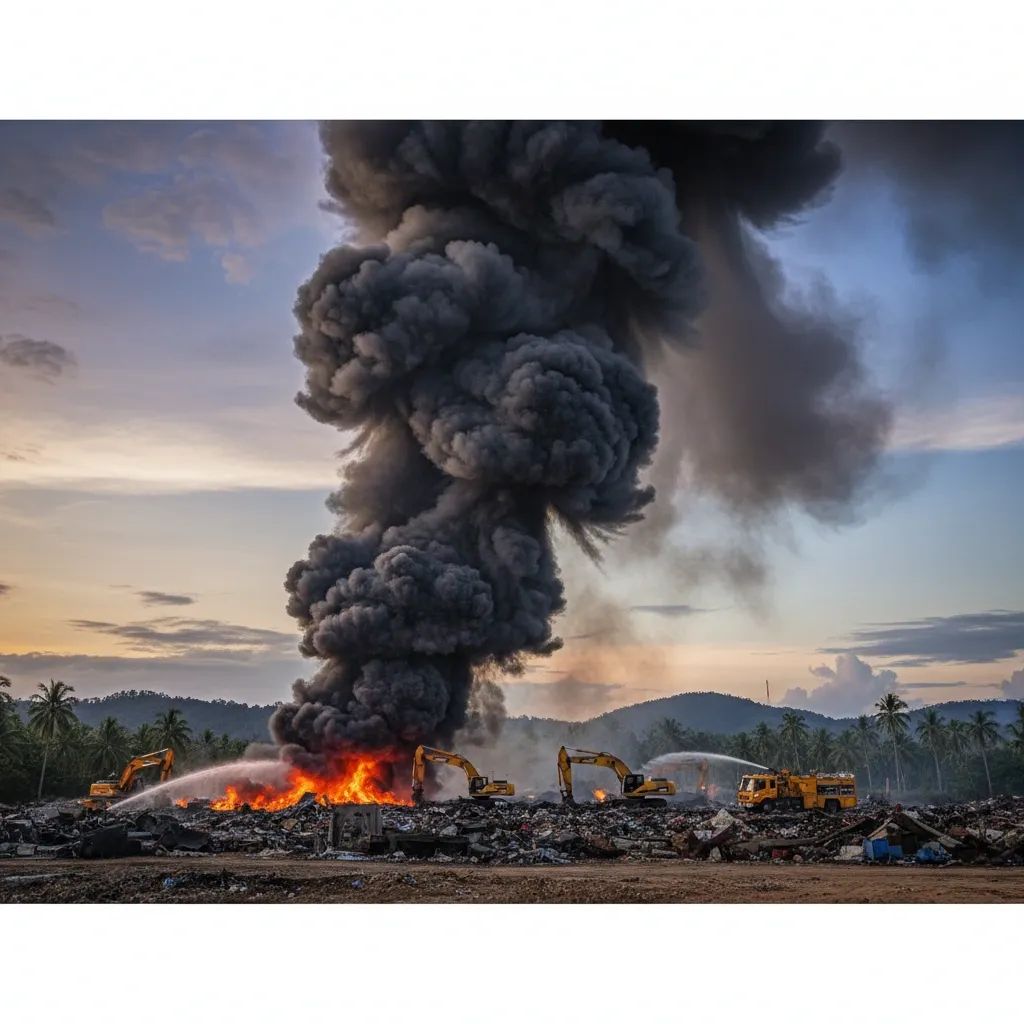
The Saphan Hin landfill in Phuket caught fire on Saturday, April 11, 2026, in the afternoon, forcing the island's waste management crisis from behind the scenes into the headlines. What started as a contained blaze in pits 4 and 5 became a stark reminder that the island's booming tourism economy is generating far more garbage than its aging infrastructure can safely handle.
Why This Matters
• Immediate health advisory: Residents near Saphan Hin are advised to wear N95 or surgical masks when outdoors to filter smoke and particulate matter; vulnerable populations (children, elderly, those with respiratory conditions) face heightened risk.
• Wind saved the day—this time: Smoke is currently blowing out to sea, but a weather shift could blanket Phuket town and residential areas within hours.
• Structural problem, not isolated incident: Phuket produces 1,100–1,300 tonnes of waste daily during off-season months, surging to 1,400–1,500 tonnes during peak tourism. The island's sole incinerator processes only 700 tonnes daily—a permanent deficit of at least 400 tonnes every single day.
The Fire and Immediate Response
At roughly 3:10 PM on April 11, the Phuket Municipality Disaster Prevention and Mitigation Center fielded reports of a blaze engulfing refuse pits in the incinerator zone. Emergency crews arrived to find burning waste piled so high and densely that fire trucks could not access the flames. Excavators had to carve corridors through mountains of garbage just to clear enough space for hoses to reach the fire. Chalermpong Saengdee, the local MP, inspected the scene and described the operational paralysis: crews were battling not just the fire but the landfill's own mountainous geometry.
The smoke column rose higher than a five-story building, visible across the island and foul enough to sting eyes and throats. Burning waste mixed with sewage fumes created a particularly noxious cocktail—not just irritating but genuinely hazardous to firefighters and nearby residents. Officials estimated 2–3 hours to bring the fire under control, assuming excavators could maintain access and equipment held up under continuous operation in a chaotic scene.
Fortunately for Phuket town, wind patterns pushed the smoke seaward. Had the breeze reversed or stalled, the same plume would have blanketed residential neighborhoods, schools, and shopping districts. This narrow margin between containment and widespread exposure underscored how vulnerable the island's communities are to landfill incidents.
What Residents Need to Know Now
If you live within 1–2 kilometres of Saphan Hin, take these precautions immediately:
• N95 or surgical masks are strongly recommended when outdoors to filter smoke and particulate matter. Cloth or wet fabric provides marginal protection only.
• Keep windows and doors sealed. A single open window negates any indoor sanctuary. Air conditioning units with external intakes should be switched to recirculation mode.
• Monitor official updates from the Phuket Municipality and provincial health office. Air quality apps tied to real-time monitoring stations offer crucial hourly updates.
• Limit outdoor activity, especially for children, the elderly, and anyone with respiratory or cardiovascular disease. Exercise outdoors must wait.
The wind direction is the critical variable. Any shift toward the island could send smoke, particulate matter (PM2.5), carbon monoxide, and sulphur dioxide across residential zones. Weather reports become your early warning system.
A Simmering Crisis Boils Over
This fire did not emerge from nowhere. It is the inevitable pressure release from a system operating far beyond its design capacity. The Saphan Hin site now contains an estimated 1.2 million tonnes of accumulated waste—roughly equivalent to the annual refuse from a city of 200,000 people living there permanently for five years. Much of this is organic matter: food scraps, yard trimmings, and spoiled seafood—the tourist industry's invisible shadow.
Organic waste comprises approximately 60% of Phuket's trash stream, and in the island's humid climate, that creates two cascading problems. First, the moisture content makes incineration inefficient; you cannot burn wet garbage efficiently at typical operating temperatures. Second, decomposing organic matter generates methane gas, a highly flammable compound that accumulates beneath the waste surface. Add in leftover firecrackers from festivals like the Phuket Vegetarian Festival (celebrated annually in October), and the landfill becomes prone to combustion events—from spontaneous heat during decomposition, sparks from machinery, or static discharge during excavation operations.
Residents living adjacent to the landfill have previously raised concerns about ongoing health impacts, including respiratory and other illnesses linked to prolonged exposure to landfill fumes and emissions. These health concerns contributed to calls from local officials for urgent health monitoring and environmental remediation efforts in the area.
The Numbers Reveal a Permanent Crisis
Phuket's waste problem is not seasonal desperation but a structural deficit embedded into everyday operations. During low-tourism months, the island still produces 1,100–1,300 tonnes daily. The existing incinerator handles 700 tonnes. That means 400–600 tonnes of fresh garbage enters the landfill every single day, 365 days a year, accumulating at a rate of roughly 150,000–220,000 tonnes annually even when tourists are scarce.
During December through February—peak season—the deficit widens dramatically. Daily waste generation surges to 1,400–1,500 tonnes, while incineration capacity remains frozen at 700 tonnes. The shortfall expands to 700–800 tonnes daily, meaning 210,000–292,000 tonnes of excess waste piles into landfills during peak season alone.
The Saphan Hin site was never designed to be a permanent dumping ground. It was supposed to be a transit point: receive waste, incinerate it, reduce volume, manage ash. Instead, it has become a storage facility because incineration cannot keep up.
Phuket's Attempted Solutions—And Why They Are Insufficient
The Phuket Governor announced in February 2026 that a new waste-to-energy plant with a capacity of 500 tonnes daily would open by year-end 2026. This facility would theoretically bring total incineration capacity to 1,200 tonnes daily—enough to cover average off-season demand. But this announcement carries significant caveats. The project has faced repeated delays from state agency approval processes, and even if it opens on schedule, it provides no safety margin for growth or seasonal spikes. The island will be operating at or near maximum capacity immediately, with no buffer for unexpected disruptions.
A third incinerator appears on official planning documents but has no firm construction timeline, budget allocation, or finalized design specifications.
Meanwhile, authorities have pushed an aggressive waste separation initiative, asking households and businesses to divide trash into organic, recyclable, and general categories. Proposals include reduced garbage collection fees for compliant households—a carrot to incentivize sorting. The Phuket Municipality has also deployed EM spray—an organic fermentation solution—to suppress landfill odors, a pragmatic but limited approach that addresses immediate nuisance without expanding capacity.
Phuket is also pursuing refuse-derived fuel (RDF) conversion, a process where mixed waste is processed and compressed into fuel briquettes for industrial use. Officials project this could remove 200,000 tonnes from the waste stream within a year. Yet waste management experts consistently note: incineration and fuel conversion are end-of-pipe solutions. They address garbage after it already exists. Reducing waste generation at the source—through consumption changes, product design for durability, and cultural shifts—receives less political priority and funding than infrastructure expansion.
How Other Thai Cities Respond to the Same Challenge
Bangkok, facing similar pressure, operates waste-to-energy facilities such as the On Nut plant, which burns trash at 850–1,100°C to generate electricity while managing emissions through advanced scrubbing systems. The capital also enforces mandatory waste separation rules, legally dividing household and commercial refuse into organic, recyclable, hazardous, and general categories. Violators face fines.
Chiang Mai, which contends with severe seasonal air pollution from agricultural burning and landfill emissions, has invested heavily in community-led initiatives that offer farmers alternatives to open-field burning and promote composting networks.
Nationally, Thailand is drafting a comprehensive Clean Air Act designed to establish integrated governance frameworks for air quality across provinces. The proposed legislation would empower local authorities to declare pollution zones, enforce corrective measures on major emitters, and coordinate with industrial facilities and waste managers. The Ministry of Public Health, partnering with the World Health Organization Thailand, is identifying and disseminating best-practice strategies to mitigate health impacts during pollution episodes.
When landfill fires occur elsewhere in Thailand, the standard response involves deploying excavators to smother flames with soil or push burning waste into water bodies and monitoring air quality continuously for sulphur dioxide, carbon monoxide, and PM2.5. Health advisories guide public behavior, and affected residents are counseled on protective measures and air quality monitoring.
The Real Question: Can Phuket Break the Cycle?
Saturday's fire was not an isolated incident, and without fundamental changes to how the island generates and processes waste, similar events are likely to recur. Favorable wind conditions prevented widespread acute air pollution on April 11. But wind is not a policy, and chance weather patterns are not infrastructure solutions.
Phuket's waste crisis will persist until three things happen simultaneously: the new incinerator opens and operates reliably; households and businesses systematically separate waste at the source; and most importantly, the island's tourism economy confronts the environmental cost of its growth and takes deliberate steps to reduce the volume of garbage produced per visitor per day.
For now, residents near Saphan Hin should assume masks are a necessary precaution until air quality returns to normal baseline levels. Watch weather forecasts closely for wind direction changes. And recognize that fires, odors, and ongoing health concerns in adjacent communities reflect a waste management system operating beyond safe capacity—a situation that will worsen as Phuket's tourism continues to expand without corresponding waste infrastructure investment.


