
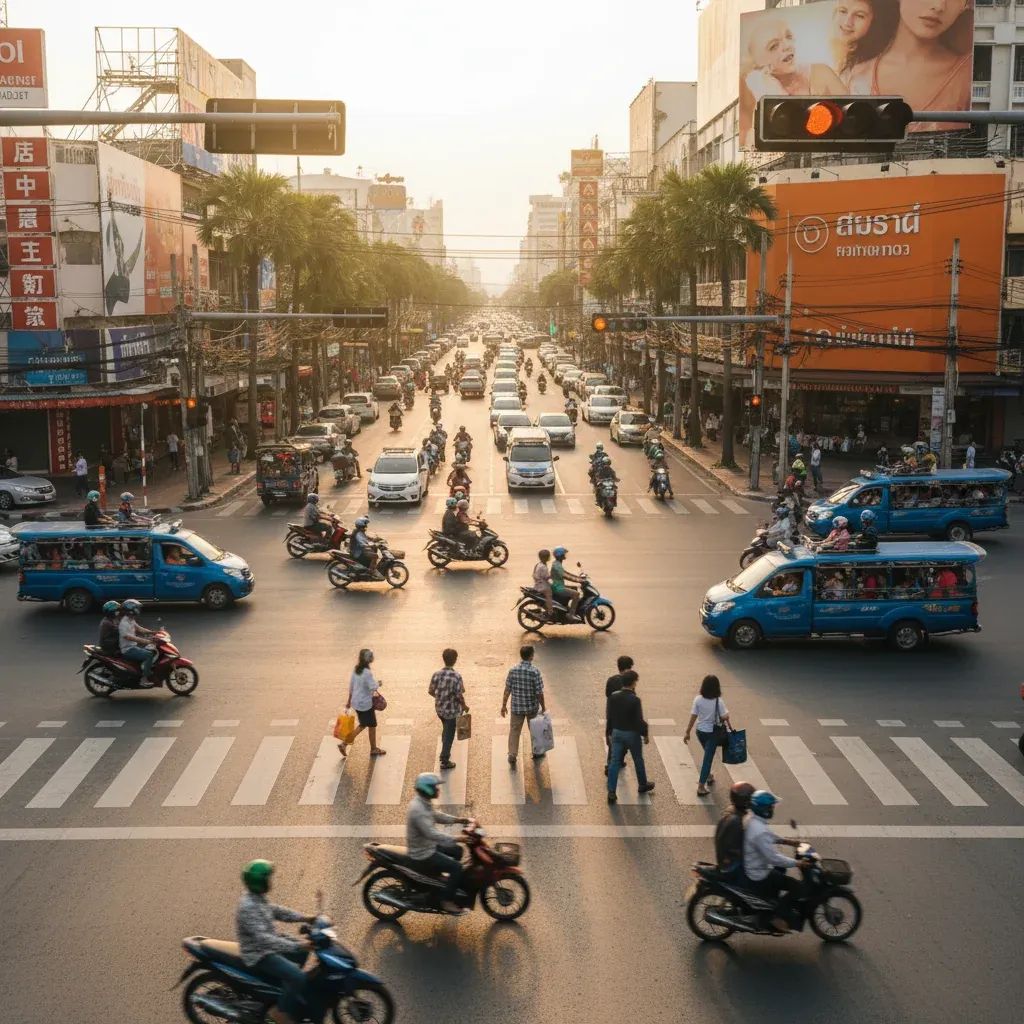
The Thailand Royal Police and Pattaya City Hall promise smart cameras, QR code checkpoints, and "zero tolerance" enforcement campaigns on a near-monthly basis. Yet a Chinese tourist and a Thai woman crossing South Pattaya Road this week joined the long list of pedestrians struck by motorcyclists who ignored crosswalk markings, a pattern so entrenched that locals now assume the painted stripes are decorative rather than legally binding.
Why This Matters:
• Chonburi Province, home to Pattaya, ranks among the top 3 provinces nationwide for motorcycle fatalities alongside Bangkok and Nakhon Ratchasima.
• 78.55% of Thailand's road deaths in 2023 involved motorcycles; in Chonburi, 86.82% of riders killed were not wearing helmets.
• Enforcement campaigns surge during festivals but fade within weeks, leaving pedestrians to gamble with their safety on every crossing.
A City Built on Broken Rules
Pattaya's pedestrian-crossing problem is not a secret. Residents and expats have been complaining about it for years on forums, describing daily near-misses at zebra stripes equipped with traffic lights. Motorcyclists, both foreign renters unfamiliar with Thai law and local delivery riders on tight deadlines, routinely blow through red signals, distracted by phones or simply unwilling to yield. The latest collision on South Pattaya Road triggered the usual online cycle: outrage, demands for tougher licensing rules for foreign renters, calls to lower speed limits to 30 km/h in pedestrian zones, and a chorus of resignation from long-term residents who have watched this script repeat itself without resolution.
The infrastructure exists—painted crossings, overhead lights, warning signs—but the social contract that makes those tools effective has never taken hold. One commenter captured the mood succinctly: "I cross this road every day. Even at crossings with lights, motorcycles don't stop." Another noted that riders often ignore signals entirely, glued to their screens or racing to the next passenger pickup.
The Festival Spike and the Post-Festival Fade
During the Songkran enforcement period in mid-April 2026, Thailand recorded 1,242 road accidents nationwide, killing 242 people and injuring 1,200 others over seven days. Pattaya itself logged multiple serious incidents, including a Russian motorcyclist killed on the Sukhumvit artery. The New Year 2026 period (December 30–January 5) saw 1,511 crashes, 272 deaths, and 1,464 injuries across the country, with Bangkok leading the fatality count at 20. Chonburi consistently appears in the top tier for motorcycle deaths, a reflection of the resort belt's dense traffic, high tourist numbers, and a rental culture that puts unlicensed foreigners on 125cc bikes with minimal instruction.
Authorities respond with predictable vigor during these "seven dangerous days": mobile patrols, breathalyzer checkpoints, and stern warnings broadcast on local radio. The Thailand National Police has designated 10 priority offenses in tourist zones—riding on sidewalks, driving without a license, skipping helmets, drunk driving, illegal parking—and Pattaya's police deployed AI facial-recognition cameras and a "MyDel Pattaya" real-time alert system at high-risk intersections. Yet when the festival ends, so does the intensity. The cameras remain, but the follow-through does not. Residents say the same intersections that saw heavy enforcement in mid-April are back to their chaotic baseline by late April.
What Pattaya Has Promised (And What Happens Next)
Pattaya City Hall and the Royal Thai Police Region 2 have announced a suite of measures over the past year, many of them technologically ambitious:
• Pattaya Smart Safety QR checkpoints, allowing patrol officers to scan codes at complaint hotspots and file instant reports.
• Odd-even parking enforcement on congested streets, coupled with studies for one-way traffic in narrow sois like Aruno Thai 9 and South Pattaya 1.
• 2,500 CCTV cameras across the mainland and 200 more on Koh Larn, integrated with the Pattaya Connect app that streams live feeds to residents.
• A proposed One-Stop Safety Center on a main boulevard, staffed 24 hours to assist tourists and residents.
• Road re-striping for Walking Street, now completed and patrolled regularly, and 11,000 LED streetlights installed along 10 major routes as part of the city's underground-cabling project.
On paper, these initiatives position Pattaya as a contender in the "smart city" race. In practice, residents see little change in day-to-day behavior. The core issue is not infrastructure but enforcement consistency. Fines are issued in bursts, impounded vehicles are released after brief detention, and the underlying culture—speed over caution, convenience over compliance—persists.
Why Enforcement Keeps Failing
Analysts and local commentators point to three overlapping failures:
Songthaew lawlessness. The ubiquitous two-row pickup trucks that serve as Pattaya's unofficial bus network operate with minimal regulation. They change lanes abruptly, stop in no-parking zones to load passengers, and occasionally show aggression toward other drivers. Their sheer numbers and political clout make them difficult to discipline.
Tourist rider ignorance. A significant share of motorcycle renters—particularly Middle Eastern and Chinese tourists flagged in recent police briefings—have never held a valid motorcycle license. Rental shops rarely check credentials, and many first-time riders learn throttle control in live traffic on Beach Road.
Cultural tolerance for risk. Thai road culture has historically prized adaptability and flow over rigid rule-following. That works in low-density rural areas; in a congested resort city with 15 million annual visitors, it produces carnage.
Even aggressive crackdowns face structural limits. A March 2026 incident saw a sedan veer off Sukhumvit after swerving to avoid a motorcycle, rolling over and seriously injuring the driver; investigators found cough syrup in the car, suspected of causing drowsiness. In February, a couple riding a motorcycle with GPS navigation toward Pattaya were crushed by an 18-wheel trailer turning into a factory on the parallel motorway road—an intersection locals had complained about for months. On April 23, a 57-year-old woman reversed her sedan into five foreign pedestrians on Pattaya Second Road, reportedly forgetting to disengage reverse gear.
Each case illustrates a different failure mode: distracted riding, infrastructure gaps, driver error. No single enforcement push can address all of them.
What This Means for Residents
If you live in Pattaya or plan to stay long-term, treat every crosswalk as a suggestion rather than a right of way. Make eye contact with approaching riders. Cross in groups when possible; solo pedestrians are easier to ignore. Avoid crossings near bars or late-night entertainment zones between midnight and 3 a.m., when drunk riding peaks.
For motorcycle riders—foreign or Thai—understand that Chonburi police have specifically targeted unlicensed tourists in recent months. Rental companies may accept a foreign passport as collateral, but Thai traffic law does not. If stopped without a valid international driving permit or Thai license, expect a fine and potential impoundment. The 10 priority offenses list includes riding on sidewalks, helmet violations, and illegal parking; penalties range from ฿500 to ฿2,000 on the spot, with higher fines in court.
For parents and teachers, note that school-age pedestrians account for a disproportionate share of injuries during morning and afternoon commutes. Pattaya City Hall has launched awareness campaigns in schools, but enforcement near campuses remains inconsistent.
The Uncomfortable Truth
Pattaya's pedestrian-safety crisis is not a mystery. The city knows which intersections are dangerous, which rider behaviors cause the most harm, and which enforcement measures work during festival crackdowns. The missing ingredient is political will to sustain enforcement beyond the seven-day sprint. Until fines become automatic via camera systems—as in Singapore or parts of Europe—and until rental shops face real consequences for handing keys to unlicensed tourists, the cycle will continue: incident, outrage, short-lived crackdown, return to baseline.
Bangkok, Nonthaburi, and Phuket have achieved helmet compliance rates above 80% through relentless ticketing and public shaming campaigns. Pattaya's rate hovers near the national average of 52% for riders, 21% for passengers. The gap is not technological; it is cultural and administrative.
For now, crossing the street in Pattaya remains an act of faith. The stripes are there, the lights flash, but the riders keep coming. The city can install another thousand cameras, but unless someone reviews the footage, issues the tickets, and makes the penalties stick, pedestrians remain at elevated risk despite available infrastructure.


