
Opening
Pattaya's streets remain challenging for those navigating them on two wheels, especially when a casual traffic comment escalates into violence. A 32-year-old food delivery rider learned this lesson on the morning of February 18 when a verbal exchange with cyclists traveling against traffic transformed into a physical assault that left him injured and filing complaints at Pattaya City Police Station. The incident—occurring in a dimly lit residential alley at 1:20 a.m.—reveals the persistent vulnerability of gig workers operating in Pattaya, where road tensions and confrontations present ongoing occupational hazards. No arrest has been made, and the suspect remains at large.
Why This Matters
• Gig workers face occupational violence that falls outside standard labor protections, leaving riders like Suphachok with limited legal recourse and no automatic injury compensation.
• Pattaya's overnight violence dynamics show enforcement gaps in residential zones despite the city's security programs concentrated in tourist areas.
• Aggressive confrontations on roads frequently involve teenagers and young adults, suggesting a pattern of using violence to settle traffic disputes.
The Incident: A Dangerous Escalation in North Pattaya
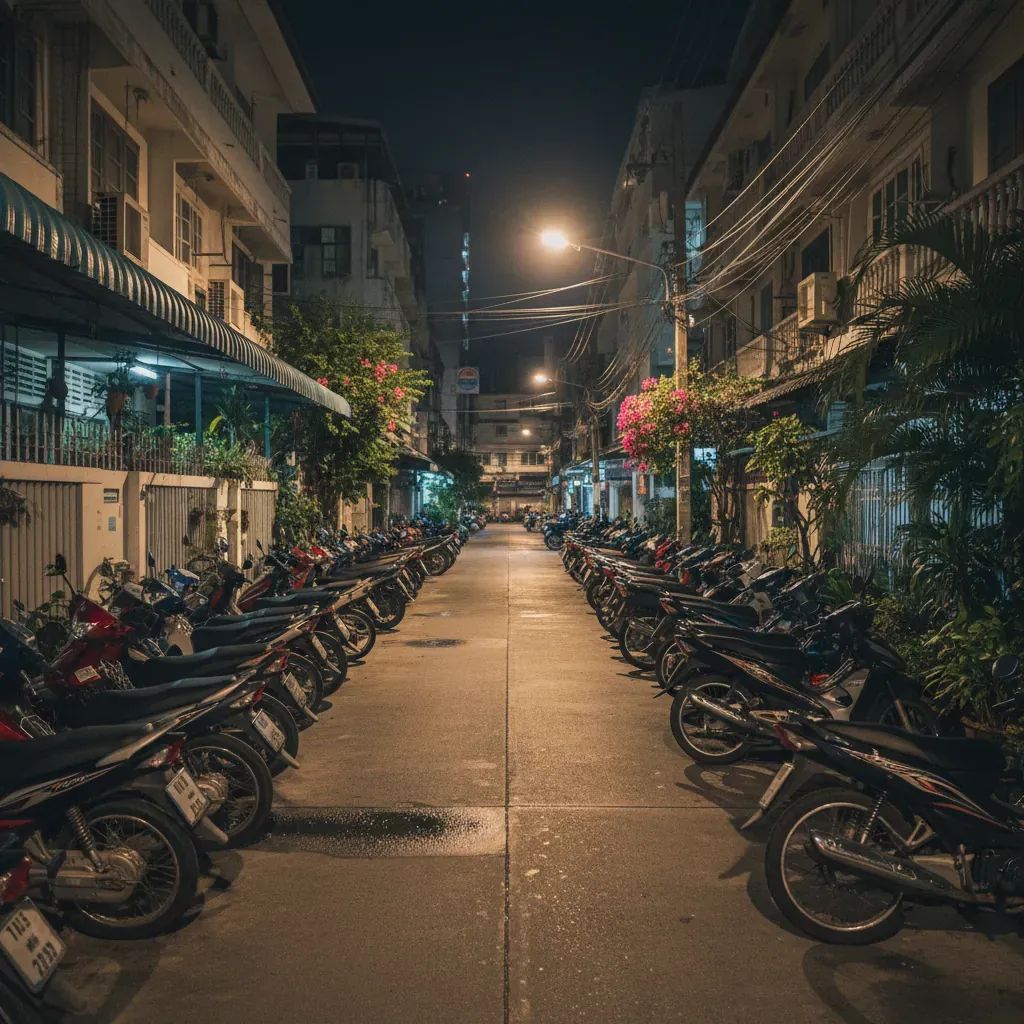
Suphachok Sammamek was conducting a routine delivery that night, navigating the compact sois of North Pattaya on his motorcycle. His route took him through Soi Phothisan 7, a narrow residential lane typical of Pattaya's maze-like street network—poorly illuminated, tight turns, and often congested with parked vehicles and pedestrian activity.
That's when he encountered three teenagers sharing a single motorcycle traveling against the direction of traffic, a reckless maneuver common in Pattaya but dangerous nonetheless. The wrongness of it startled him. In a reflexive moment, Suphachok shouted an expletive at the riders as they passed.
What he couldn't have anticipated was that this momentary outburst would trigger a violent pursuit. The teenager driving the motorcycle spun around, and the confrontation reversed roles—Suphachok, now the hunted, was chased down the soi by a cyclist carrying an iron rod. Witnesses and online video footage later captured a heated verbal escalation before the suspect wielded the metal object as a weapon, striking Suphachok repeatedly and causing injuries requiring medical attention.
The police complaint was filed in the hours that followed. As of the time of reporting, the Thailand Royal Police have not publicly identified or arrested a suspect, and the case remains under investigation. Investigators are reviewing video evidence and attempting to track down the three riders. Late-night assaults in poorly lit residential zones present significant investigative challenges, particularly when attackers have no prior criminal records or registered addresses that surface quickly in police databases.
The Toll on Thailand's Gig Workforce
Suphachok's experience reflects a broader pattern in Thailand's delivery sector. Delivery riders across Thailand—and especially in Pattaya—operate in an environment of constant occupational hazard without the safety protections most employees receive. The legal classification of these workers as independent contractors rather than direct employees means they fall into a protective gap.
Under Thailand's Labor Protection Act and Workmen's Compensation Act, gig workers receive no automatic injury coverage. If Suphachok had worked as a salaried deliverer for a restaurant, his injuries would likely qualify for full medical expenses and wage replacement. Instead, his recourse is limited to voluntary enrollment in Social Security Article 40, a self-funded insurance scheme many riders either don't know about or can't afford given their already thin margins.
The Motor Vehicle Accident Victim Protection Act offers some coverage for traffic-related injuries, but deliberate assaults like this occupy murky legal territory. Criminal assault charges might be filed against the attacker if arrested, but that hardly compensates Suphachok for lost income, medical costs, or psychological trauma.
Beyond this individual case, riders face pressures that amplify risk across the profession. Delivery platforms reward speed—faster deliveries mean higher earnings and access to better orders. This incentive structure pushes riders to violate traffic laws: running red lights, driving against traffic, weaving between lanes. When economic pressure to meet delivery quotas combines with Thailand's enforcement gaps outside tourist zones, the result is an industry-wide pattern of risky practices.
Pattaya's Road Violence Context
The broader context matters here. Pattaya and the surrounding Chonburi Province experience significant numbers of road incidents. During the seven-day New Year period (December 27, 2024 – January 2, 2025), Chonburi recorded multiple accidents involving motorcycles, resulting in deaths and injuries. Motorcycles remain the dominant vehicles involved in traffic incidents in the region.
Thailand's national road safety record shows concerning trends. Traffic accident statistics indicate motorcycles account for a substantial proportion of incidents in urban centers. Young riders, often without formal defensive driving education, operate these vehicles in congested urban environments where traffic rule enforcement varies significantly by location.
Several high-profile incidents in Pattaya illustrate ongoing traffic safety challenges:
In December 2024, a luxury van driver traveling at excessive speed struck multiple vehicles on Thepprasit Road, leaving one person dead and several others injured.
In November 2024, a tourist on a motorcycle evaded a police checkpoint and struck a traffic officer, resulting in serious injuries requiring hospitalization.
In January of this year, a domestic dispute led to an individual deliberately driving a vehicle into a roadside barrier following a quarrel with family members.
These incidents point to a pattern where aggressive driving and confrontational behavior occur repeatedly in Pattaya's traffic environment. The city's dense vehicle congestion, high pedestrian and tourist activity, and widespread enforcement gaps in residential areas create conditions where traffic disputes can escalate.
Surveillance and Enforcement Initiatives
Pattaya authorities have undertaken several security initiatives to address violence and traffic incidents. These programs are worth examining for their approach and limitations.
Pattaya launched surveillance and enforcement programs beginning in 2025, focusing on major tourist zones including Pattaya Beach, Walking Street, and Bali Hai Pier. These programs deployed increased police patrols, checkpoint operations, and surveillance technology. Initial reports indicated improvements in reported assault and property crime statistics in these monitored zones during early 2025.
However, a critical limitation exists: Soi Phothisan 7, where Suphachok was attacked, is a residential alley in North Pattaya—not a major tourist zone. This creates a geographic disparity in safety infrastructure and police presence. Gig workers typically operate in residential soi networks rather than tourist corridors, meaning surveillance and enforcement concentrated in tourist zones does not necessarily protect where delivery riders actually work.
Thailand's national traffic enforcement intensifies during holiday periods, including roadblocks, speed enforcement, and alcohol checkpoints. However, these are concentrated around specific holidays. For the remainder of the year, enforcement in residential areas remains inconsistent and reactive rather than preventive.
What This Means for Residents and Workers
For residents living in North Pattaya's residential zones, the assault underscores a practical reality: safety programs concentrated in tourist areas don't necessarily provide protection in residential neighborhoods where many people live and work. Delivery riders, security personnel working night shifts, and residents commuting during early morning hours navigate streets where police presence varies significantly.
For foreign residents and expats, particularly those who ride motorcycles, the incident provides important context. Experts and local authorities recommend that riders avoid verbal confrontations with aggressive drivers or reckless riders, regardless of who is technically at fault in a traffic situation. Confrontations that escalate can occur rapidly.
Those renting motorcycles or driving vehicles should understand that traffic disputes can escalate quickly, especially in late-night hours or zones where police presence is less consistent. The appropriate response to aggressive behavior is disengagement: adjust speed, take an alternate route, or move to populated areas. If directly threatened, the Tourist Police at 1155 offers multilingual support.
Protective Strategies for Delivery Riders
Given the occupational hazards, riders operating in Pattaya should consider practical approaches to reduce vulnerability. Safety guidelines emphasize several protective measures:
Before Each Shift: Prioritize rest and proper nutrition before working. Verify your motorcycle is mechanically sound. Wear protective gear including helmets, gloves, and reflective clothing for nighttime visibility.
On the Road: Plan routes in advance to minimize exposure to high-risk areas or poorly lit zones. Avoid confrontations entirely—any verbal escalation can quickly turn dangerous. If confronted by aggressive drivers or riders, the only appropriate response is disengagement.
Communication and Documentation: Keep a fully charged phone with emergency contacts saved. The national emergency line 191 should be programmed in your phone. Consider dashcam installation to document incidents for police reports.
Financial Protection: Understand your insurance coverage options. Verify enrollment in available protective programs for accident-related injuries.
The Structural Gap: Platform Economics and Worker Protection
What Suphachok's case illuminates is a structural issue in Thailand's gig economy model. Delivery platforms operate without bearing the insurance, training, or safety oversight costs that would typically accompany employment relationships. Riders absorb the risks—traffic accidents, aggressive encounters, occupational injuries—while platforms maintain distance through contractor classifications.
The rise of food delivery has coincided with increased traffic activity during peak delivery hours in urban zones like Pattaya. Platform algorithms reward faster delivery times, creating incentive structures that encourage risky riding practices.
Regulators face challenges addressing this gap. Thailand's labor laws were developed for traditional employment relationships and don't cleanly address platform-based gig work. Police investigations into incidents like Suphachok's are complicated by the randomness of the violence and lack of traditional employer-employee infrastructure.
Looking Forward: Expert Recommendations
Experts and advocates suggest several approaches that could reduce traffic violence in Pattaya:
Extending surveillance and enforcement presence into residential soi networks where gig workers operate, rather than concentrating resources solely in tourist zones, could improve safety across the entire city.
Platforms could integrate safety metrics into their algorithms—for example, adjusting payment systems to avoid incentivizing excessive speed—to align business operations with rider safety.
Stronger legal frameworks addressing gig worker protections—including automatic injury compensation, subsidized insurance access, and workplace safety standards—would address the structural vulnerabilities that workers currently face.
The Thailand Royal Police will continue investigating the Soi Phothisan 7 attack. Identification and prosecution of the suspect remain uncertain. What remains clear is that Suphachok is not the first delivery rider to experience violence in Pattaya, and current approaches to enforcement and worker protection have not eliminated these risks. Until systemic changes occur, personal awareness and disengagement strategies remain the most available tools for riders operating in the city.


