
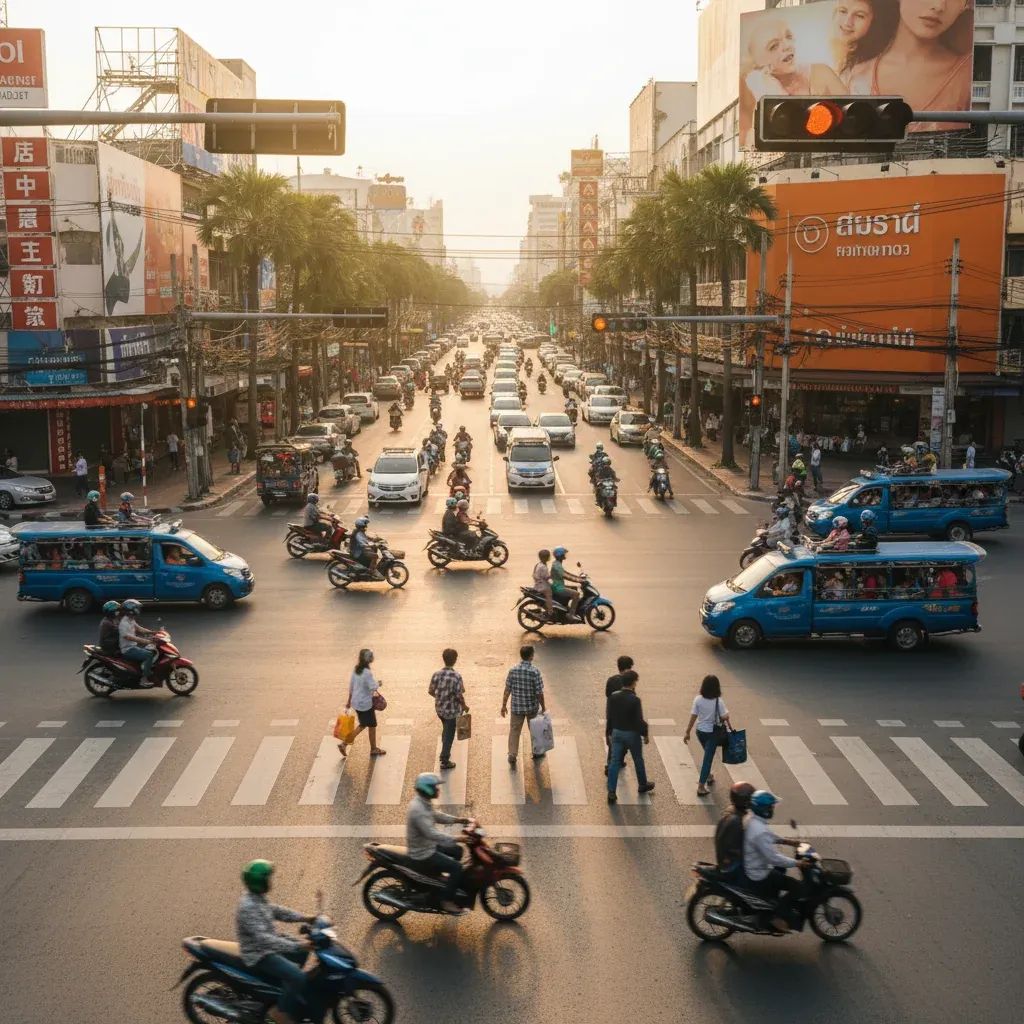
Crossing a street in Pattaya requires more than pressing a button or waiting for a green signal. For residents and visitors navigating the city's busier zones, moving from curb to curb involves constant assessment of vehicle behavior. This tension reflects years of accumulated disconnect between pedestrian infrastructure and actual driver compliance.
What Changed: New Enforcement Policy
On April 1, 2026, the Thailand Royal Police ended its warning-first approach to traffic violations. Drivers now face immediate fines up to 20,000 baht for violations including failing to yield at crossings. This policy reversal affects both residents and visitors behind the wheel. Patrols have expanded on central corridors, and a "catch, fine, and tow" policy began February 3 for parking violations on South Pattaya Road.
Why This Matters
Death toll context: Thailand experiences approximately 506 pedestrian fatalities annually, with motorcycles accounting for 74% of all traffic deaths. Pattaya, as a high-traffic tourist destination, concentrates this risk in dense areas.
Recent incidents: In April 2026, three separate collisions injured or killed multiple people. On April 22, a BMW sedan reversed into five pedestrians near Second Road's Made in Thailand mall, including a 2-year-old Australian boy and two Indian nationals. On March 21, a 55-year-old Finnish tourist died after being struck by a motorcycle on Jomtien Second Road. A third incident on April 26 involved a Chinese national and Thai woman struck by a motorcycle at a crossing.
Over the past decade, Thailand records 506 pedestrian fatalities annually and 5,870 hospitalizations for traffic-related pedestrian injuries. During "7 Dangerous Days" periods surrounding Songkran and New Year, casualty rates triple or quadruple.
What Residents Observe on the Ground
Forum discussions on expat community platforms such as Thai Visa and local Pattaya expatriate groups reveal consistent patterns. Users describe a city where traffic signals serve more as suggestions than rules. One longtime resident reported never witnessing voluntary stops at unmarked zebra crossings—only occasional compliance at red lights.
Another person, visibly impaired and dependent on marked crossings, compared the experience to "Russian roulette, even when pedestrians have legal right-of-way."
High-risk zones include Beach Road, Second Road, and Soi Buakhao. Near Mike Shopping Mall on Second Road, users report cars "simply do not stop." Jomtien Second Road carries its own hazards: deteriorating sidewalks force pedestrians into traffic.
Residents note that red lights prompt acceleration. Pedestrian signals matter less than driver convenience. Motorcyclists treat crossings as minor routing obstacles. Enforcement, they note, remains inconsistent—a reality that undermines regulatory intent.
Motorcycles: 74% of the Fatality Problem
Motorcycles dominate Pattaya's transport landscape and its traffic casualty data. They account for three-quarters of all road deaths in Thailand, yet riders operate as if different rules apply. They run red lights, weave through pedestrian zones, mount sidewalks, and block crossings mid-turn.
Forum participants describe the dynamic this way: "A motorcycle is just a way to get from Point A to B as fast as possible, ignoring every rule." The observation applies across demographics—expat riders and car owners behave identically to Thai operators. The problem is learned normalization of rule-breaking, not nationality.
Motorcyclists are symptomatic of a broader issue. Any meaningful pedestrian safety improvement must address this category directly through enforcement or re-education.
Infrastructure Exists; Compliance Doesn't
Pattaya deployed intelligent crosswalks along Second Road near Soi 6 in July 2025, complete with reflective markings, LED light strips, and button-activated warning systems designed to alert drivers. The Thailand Municipality of Pattaya also introduced zigzag road markings 15 meters before crossings—a European design concept intended to trigger automatic visual-braking responses.
On paper, these measures should work. In practice, residents call them decorative. "The red stripes are just decoration," one forum commenter wrote. The infrastructure sends a message; drivers choose not to receive it. Technology functions as intended; human compliance does not follow.
Modern tools and markings are in place. Driver behavior has not shifted proportionally. A well-lit crossing with clear signals still generates anxiety because driver behavior remains unpredictable.
Sidewalks: A Separate Hazard Layer
Pedestrian danger extends beyond vehicular traffic. Jomtien Second Road, particularly between Thappraya Road and Soi 7, shows chronic neglect. Broken pavement, missing sections, and uneven surfaces force walkers onto streets—creating secondary risk independent of vehicles. Older tourists, a significant demographic in Pattaya, face compounded exposure.
Recent upgrades to LED streetlighting and undergrounding of electrical lines in 10 zones help with nighttime visibility but do not address foundational structural problems that make basic walking hazardous.
Why Enforcement Remains Inconsistent
Pattaya traffic police intensified patrols on Beach Road, South Pattaya, and Central Pattaya zones following April incidents. Crackdown operations focused on parking violations and crosswalk enforcement. During major festivals—Countdown 2026, Music Festival, Songkran—authorities coordinated with immigration and municipal staff to manage crowds.
However, consistency remains elusive. Forum participants note that enforcement is applied unevenly. The prevailing pattern is reactive—casual violations tolerated until an incident sparks temporary attention, after which enforcement fades.
Without enforcement certainty, drivers have no compelling reason to comply. A driver who has violated rules hundreds of times without consequence faces little deterrent from rules that may or may not be enforced today.
Practical Information for Residents
Fine payment and appeals: Details regarding fine payment locations, appeals processes, and whether different penalties apply to foreigners versus locals remain unclear from official sources. Residents should confirm payment procedures with the Pattaya Police Traffic Division.
Effective crossing strategy: Assume vehicles will not stop, even at lit crossings with pedestrian signals. Make direct eye contact with approaching drivers before entering the street.
For families and vulnerable pedestrians: Plan movement routes to avoid high-speed corridors like Beach Road and Second Road during peak hours. Use overpasses and underpasses where available. For daily routes in Jomtien zones, minimize vehicle exposure by selecting alternative paths.
Tourism's Reputational Stakes
Pattaya markets itself as a family and retirement destination, attracting older tourists and international visitors for whom walkability and street safety are baseline expectations. When crossing streets becomes a high-risk activity, the city's competitive positioning erodes. Negative word-of-mouth spreads rapidly among key demographics: families, retirees, and disability-aware travelers.
Without demonstrable improvements in both infrastructure and driver compliance, Pattaya risks cementing a reputation as beautiful but dangerous—a destination one visits once and warns others against.
What Solutions Residents Propose
Residents and advocates identify three interconnected approaches:
Enforcement predictability: Random checkpoints, license verification, and vehicle impoundment must become routine, not episodic. The absence of certainty is the root cause of violation persistence.
Driver re-education: Many violations stem from learned behavior and poor training rather than malice. Mandatory retraining emphasizing pedestrian rights and crosswalk protocols could shift norms incrementally.
Infrastructure redesign: Raised crossings, median refuges for mid-street stops, and separate stop lines for motorcycles and cars prevent blocking and clarify spatial hierarchy. These are proven designs successfully implemented across Asia and Europe.
What remains absent is sustained, consistent implementation. Pattaya has the technical means. It lacks behavioral follow-through—the conviction that rules apply equally and consistently to every driver, every day.
Current Status
For now, crossing the street in Pattaya remains a calculated assessment rather than a guaranteed safe passage. The new April 2026 enforcement policy has not yet produced observable changes in driver behavior. Residents and visitors navigate this reality daily, making risk assessments with each curb approach. Until enforcement certainty, re-education, or infrastructure redesign shifts driver behavior, the fundamental vulnerability persists.


