
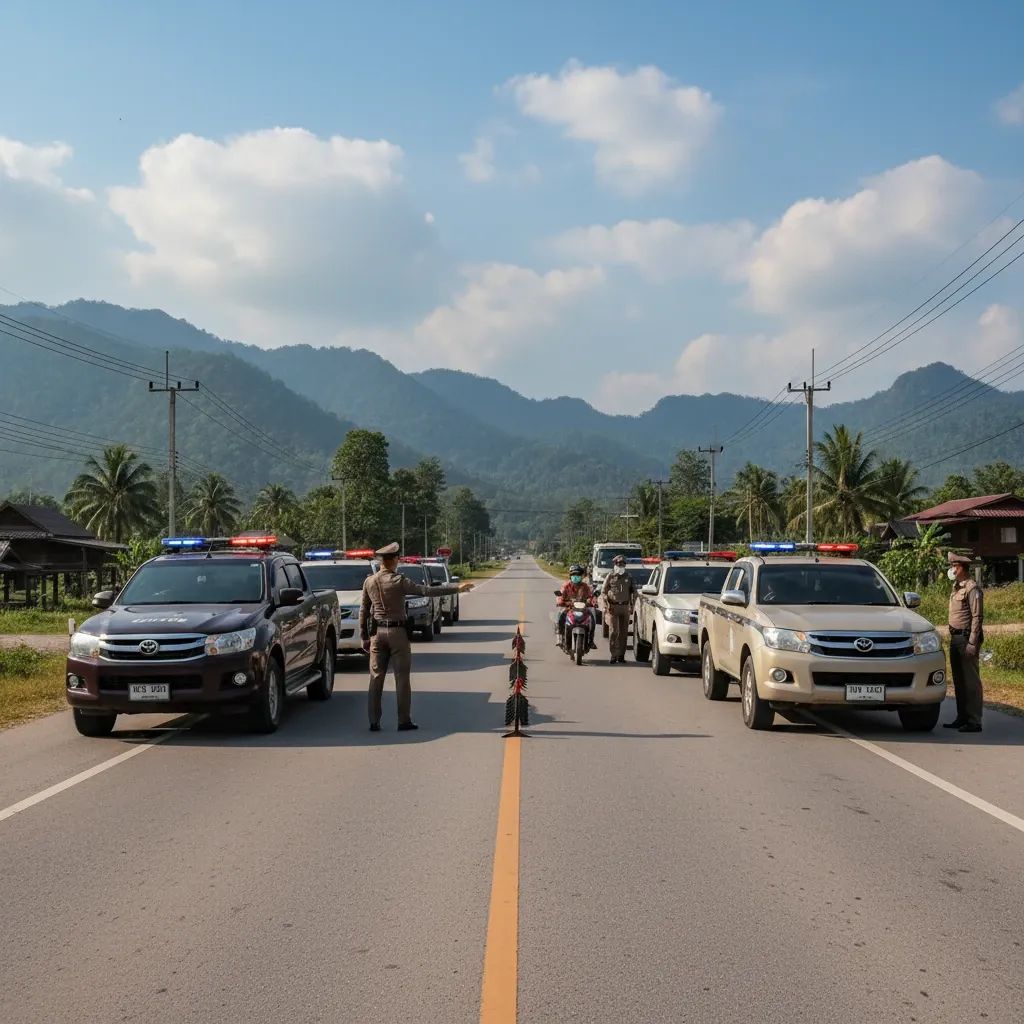
PHAYAO, June 16, 2026 — Authorities in Phayao Province have dismantled a major narcotics warehouse in the northern district of Chiang Kham, seizing 8 million methamphetamine pills and 1 kilogram of crystal methamphetamine (ice) hidden inside sacks of fresh ginger. The June 15 bust represents one of the largest single-location drug seizures in the region this year and marks a significant escalation in law enforcement pressure on cross-border trafficking networks originating from Myanmar's Shan State.
Why This Matters
• Major trafficking method exposed: The ginger-sack concealment tactic is now a confirmed strategy used by smugglers across northern Thailand, following a separate 597 kg ice seizure in March 2026 that also used ginger as camouflage.
• Three suspects arrested, but kingpins remain at large: Those detained confessed to being paid 50,000 baht each per run, and admitted to at least one prior smuggling operation in late May.
• Phayao sits on a critical supply route: The province borders Laos and serves as a waypoint for narcotics flowing from Myanmar through Laos into Thailand's interior and onward to Bangkok and international markets.
The Chiang Kham Warehouse Operation
The Thailand Police Region 5 command coordinated the raid on a storage facility in Chiang Kham District after weeks of intelligence work. Investigators had been tracking shipments tied to a March 12 operation that intercepted nearly 600 kg of crystal meth concealed in ginger bags at the same border crossing point.
During interrogation, the three suspects — all Thai nationals — revealed they had been contracted by a larger network to transport narcotics disguised as agricultural produce. Each courier received 50,000 baht per successful delivery, with the understanding that they would handle logistics for packaging and short-term storage. The suspects admitted to completing at least one prior run in late May without incident.
Prosecutors in Phayao have opened formal charges under Thailand's Narcotics Act, but investigators confirm that the primary organizers and financiers of the network escaped before the raid. Police Region 5 has issued arrest warrants and is coordinating with intelligence units in Chiang Rai, Chiang Mai, and cross-border liaison offices in Laos to track the fugitives.
Fresh Ginger as a Trafficking Tool
The use of fresh ginger sacks is not accidental. The bulky, odorous produce provides effective olfactory camouflage against drug-sniffing dogs, and the perishable nature of ginger encourages faster customs processing at checkpoints. Since March 2026, Thai authorities have identified at least three major seizures involving ginger-concealed narcotics along the northern border corridor.
Thai Customs has since issued internal guidance to officers at agricultural inspection stations, emphasizing random sampling and X-ray scanning of ginger shipments originating from border zones. However, enforcement remains patchy due to high cargo volumes and limited scanning infrastructure at secondary checkpoints.
What This Means for Residents
For those living in northern Thailand, the Phayao bust underscores an uncomfortable reality: narcotics transit routes increasingly overlap with civilian commercial corridors. Traffickers exploit agricultural supply chains, using legitimate produce shipments as cover. This creates friction for farmers and exporters, who now face intensified inspections and potential delays at checkpoints.
Practical implications:
• Expect longer wait times at provincial border crossings and agricultural inspection stations, particularly for vehicles carrying bulk produce.
• Small-scale traders and logistics operators should ensure all documentation is current and transparent; authorities are prioritizing random inspections of ginger, tamarind, and bamboo shoot shipments.
• Communities near the Thai-Lao-Myanmar border triangle should remain vigilant and report suspicious warehouse activity or unusual late-night cargo movements to local police hotlines.
The Broader Context: Surge in Methamphetamine Production
The United Nations Office on Drugs and Crime (UNODC) reported in 2025 that methamphetamine pill production in the Golden Triangle reached historic levels, with Thailand seizing over 1 billion pills that year alone — 85% of all regional seizures. Myanmar's Shan State, wracked by armed conflict and weakened governance, remains the epicenter of industrial-scale meth labs supplying Southeast Asia, East Asia, and Oceania.
In 2026, enforcement activity has remained aggressive. Notable recent operations include:
• June 2026: The Royal Thai Navy intercepted over 6 million pills on the Mekong River in Chiang Rai's Wiang Kaen District.
• May 2026: Border Patrol Police seized 7.56 million pills in Bueng Kan Province, smuggled from Laos.
• April 2026: A crackdown in Phetchabun Province netted two separate networks — "Bank Phetchabun" and "New Phetchabun" — resulting in the confiscation of nearly 15 million pills combined.
Traffickers have adapted by diversifying routes. While the traditional northern border corridor (Chiang Rai, Chiang Mai, Mae Hong Son) remains active, smugglers increasingly use secondary routes through northeastern provinces — Loei, Nong Khai, Bueng Kan, Mukdahan, and Nakhon Phanom — where enforcement resources are stretched thinner. The Mekong River, with its numerous islands and informal ferry crossings, serves as a natural highway for contraband.
Thailand's Enforcement Response
Thailand's Ministry of Interior and Royal Thai Armed Forces have deployed a multi-layered interdiction strategy:
• Over 120 Border Liaison Offices (BLOs) now operate along the Thai-Lao and Thai-Myanmar frontiers, enabling real-time intelligence sharing and joint patrols.
• The Royal Thai Navy conducts continuous surveillance operations on the Mekong River, using rapid-response patrol boats to intercept smuggling vessels.
• Military ranger units in five northeastern provinces — Mukdahan, Nakhon Phanom, Bueng Kan, Nong Khai, and Loei — have launched sweeping anti-narcotics operations targeting riverside staging areas.
• Thailand allocates budget support to neighboring governments (Myanmar, Laos, Cambodia, Vietnam) for operational expenses, vehicles, and drug-detection equipment.
Despite these efforts, the sheer volume of contraband overwhelms enforcement capacity. Thai authorities seized nearly 130 tons of methamphetamine pills in 2024 alone, yet UNODC estimates suggest this represents only a fraction of total production output from Shan State labs.
The Economics of Smuggling
Law enforcement estimates each methamphetamine pill costs roughly 20-30 baht at the Thai border but retails for 200-300 baht in Bangkok and up to 1,000 baht or more in international markets like Japan, South Korea, Australia, and New Zealand. An 8 million pill seizure thus represents a wholesale value of approximately 160-240 million baht at border pricing, or over 1 billion baht at destination retail prices.
For couriers like those arrested in Phayao, the 50,000 baht payment is life-changing in rural economies but trivial compared to the profits captured by network organizers and international brokers. This asymmetry makes recruitment easy, as traffickers can replace detained couriers quickly.
Border Communities Under Pressure
Villages along the Thai-Lao-Myanmar triangle face mounting social and economic disruption. Increased military and police presence has brought security but also heightened surveillance, restricted movement, and economic slowdowns as checkpoints delay legitimate commerce.
Local officials in Chiang Kham and neighboring districts report that small businesses — particularly those in transport, agriculture, and hospitality — are experiencing revenue declines due to cargo inspection delays and reduced cross-border trade. At the same time, communities fear retaliation from trafficking syndicates if they cooperate too openly with law enforcement.
Outlook: No Quick Resolution
The Phayao seizure is a tactical victory, but the underlying drivers of the narcotics flood remain intact. Myanmar's ongoing civil conflict has fragmented state authority in Shan State, allowing armed groups to fund operations through drug production and trafficking. Until political stability returns to Myanmar — a prospect that appears distant — the supply side of the methamphetamine trade will continue unabated.
For Thailand, the challenge is containment rather than elimination. Police Region 5 and allied agencies are focused on disrupting high-volume shipments, dismantling storage networks, and arresting mid-level organizers. However, the kingpins behind operations like the Chiang Kham warehouse remain elusive, often operating from across international borders where Thai jurisdiction ends.
Residents in northern and northeastern Thailand should anticipate that enforcement operations will remain intense through 2026 and beyond. The Thailand Ministry of Justice has signaled that prosecutors will pursue maximum penalties for traffickers, including asset seizures and extended prison terms, as part of a broader deterrence strategy. Whether this approach will significantly reduce the flow of narcotics into Thailand remains an open question.


