
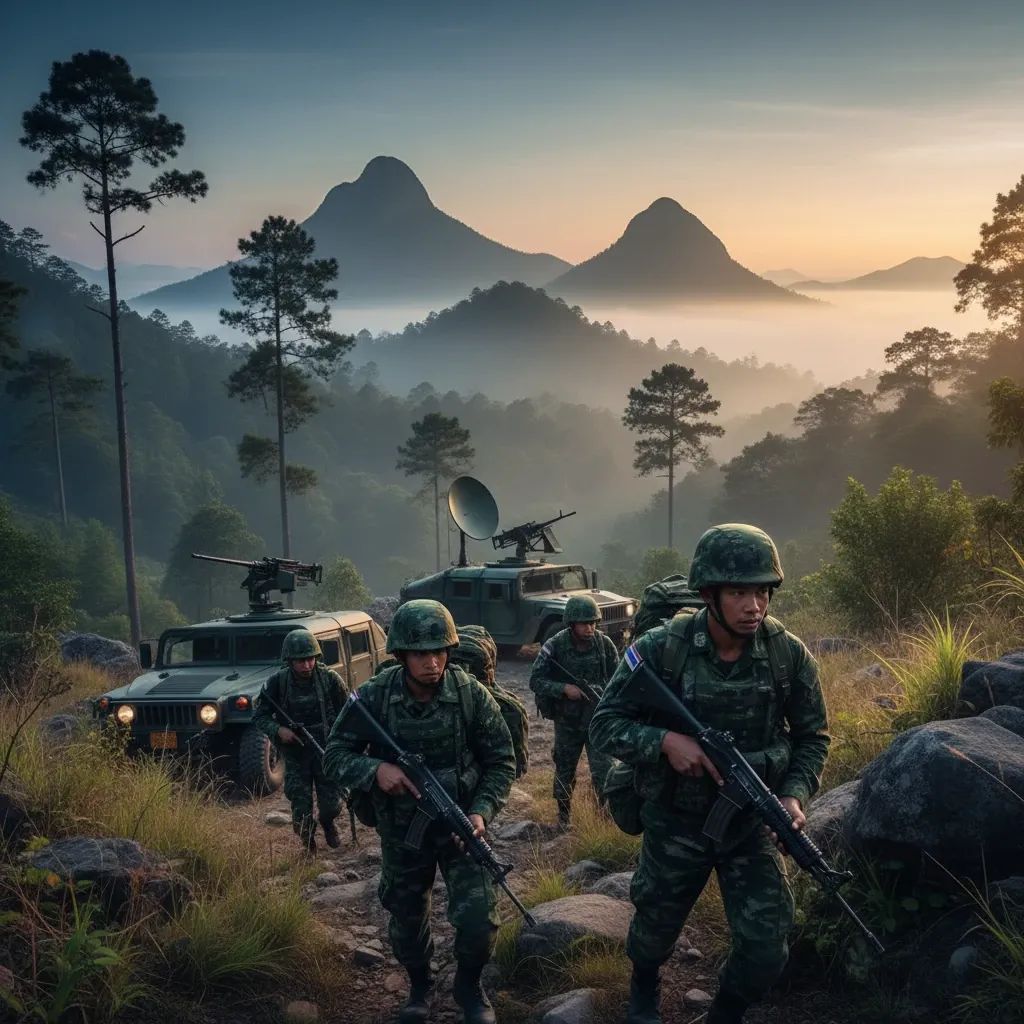
The Thailand Royal Police Border Patrol Unit 334 has intercepted 2.8 million methamphetamine pills following an armed clash in Mae Ai district, Chiang Mai province on June 16, 2026 (2569 BE), marking one of the largest single seizures in northern Thailand this month. The operation left one trafficker dead and exposed a high-volume smuggling route feeding narcotics from Myanmar into urban centers across the kingdom.
Why This Matters
• Border security intensifies: This is the latest in a series of violent interdictions along the Thai-Myanmar frontier. Thailand's border defense forces recorded 907 drug-related arrests between January and March 2026—up from 878 the previous year—apprehending 1,210 suspects and seizing narcotics worth billions of baht on the street market.
• Regional trafficking surge: Civil war in Myanmar has fueled a dramatic spike in drug production. Intelligence assessments cited by Thailand Royal Police Region 5 indicate that some facilities operate around the clock, churning out 2.4 million pills daily. An estimated 80% of methamphetamine entering Thailand originates from labs within 50 km of the Thai-Myanmar frontier.
• Local impact: Communities in northern border provinces face rising addiction rates. Health officials in Chiang Mai report that methamphetamine addiction has become the leading cause of psychiatric hospital admissions among working-age adults, straining provincial health budgets.
The Firefight
Border patrol officers stationed in Mae Ai spotted a suspicious white Honda CR-V traveling along a public road in Baan Pong Hai village, Tambon Mae Sao, late in the evening on June 16. When officers identified themselves and attempted a vehicle inspection, occupants opened fire. A sustained gun battle ensued before traffickers fled on foot into dense jungle terrain. Upon securing the scene, authorities found one deceased suspect—whose identity remains undisclosed—and 14 sacks of methamphetamine tablets hidden inside the vehicle, totaling approximately 2.8 million pills. No officers were injured in the exchange.
The Mae Ai corridor has become a flashpoint for narcotics interdiction. Just one day later, on June 17, the Thailand Army's Pha Muang Task Force engaged another trafficking convoy in the same district at Baan Huai Pa Sang, seizing an identical quantity of pills but with no reported casualties among law enforcement. These back-to-back operations suggest coordinated smuggling efforts timed to exploit perceived gaps in patrol coverage.
Pattern of Violence
June 2026 has been a month marked by deadly confrontations for anti-narcotics operations in Chiang Mai and Chiang Rai provinces. The Thailand Border Patrol Police documented at least five major confrontations in the first 18 days of the month alone:
• June 3: Border Patrol Unit 335 discovered over 1 million pills abandoned in a garbage dump in Chiang Dao district, likely discarded during a holiday weekend when traffickers anticipated heightened surveillance.
• June 6–7: Pha Muang Task Force conducted five separate interdictions across Chiang Rai, netting 2 million pills, 669 kg of crystal methamphetamine (ice), and 520 kg of ketamine.
• June 9: A firefight in Fang district left two traffickers dead and resulted in another substantial seizure.
• June 14: Naval patrol units on the Mekong River intercepted 6 million pills near the Thai-Lao border in Wiang Kaen district, Chiang Rai—the largest single haul of the month.
These incidents reflect an intensifying enforcement response across the region's border provinces.
What This Means for Residents
For Thais living in the north, the escalating enforcement operations translate to three immediate realities:
Increased military presence: Expect more checkpoints, patrols, and occasional road closures in Mae Ai, Chiang Dao, Fang, and Mae Taeng districts. Residents have reported extended wait times at internal security points, particularly after dark.
Rising addiction crisis: The Thailand Ministry of Interior has warned that 31 border provinces are now classified as high-risk zones. Mental health services are under strain, with Chiang Mai's provincial rehabilitation center operating at 180% capacity and waiting lists for court-ordered treatment programs stretching beyond six months. Thailand's Department of Probation reports that first-time drug offenders under age 25 now account for 37% of narcotics convictions in the north, up from 22% in 2023.
Property and safety concerns: Traffickers increasingly use remote villages as staging posts. The June 3 dump-site discovery in Chiang Dao highlights how smugglers exploit public and semi-public spaces, raising contamination and violence risks for nearby communities. Local authorities urge villagers to report suspicious activity rather than confront suspects directly.
The Myanmar Connection
Thailand's northern drug crisis is inseparable from the collapse of governance across the border. Since the 2021 military coup in Myanmar, Shan State has become the world's most prolific methamphetamine manufacturing hub. Armed ethnic groups and criminal syndicates operating in the region fund their operations through narcotics production. Production facilities in Myanmar operate around the clock, with some churning out 2.4 million pills daily, according to intelligence assessments.
The ongoing civil conflict has disrupted traditional smuggling hierarchies, fragmenting supply chains into smaller, more agile cells that are harder to track and interdict.
Regional Enforcement Response
Recognizing the transnational nature of the threat, Thailand joined a four-nation anti-drug campaign launched June 15, 2026, alongside Vietnam, China, Laos, and Myanmar. The three-month initiative, running through September 15, focuses on coordinated border sweeps, intelligence sharing, and interdiction of precursor chemicals used in methamphetamine synthesis.
Within Thailand, the Ministry of Interior has ordered governors in all 31 border provinces to implement enhanced surveillance protocols, including drone monitoring of natural transit corridors and increased collaboration between military, police, Border Patrol Police (BPP), and the Office of the Narcotics Control Board (ONCB). Rewards for actionable intelligence have been increased, and community informant networks are being expanded in ethnic minority villages where traffickers often recruit mules.
The Human Cost
While enforcement statistics reflect aggressive interdiction, the human toll mounts on both sides. At least three suspected traffickers have been killed in June firefights alone, and authorities acknowledge that many low-level couriers are impoverished ethnic minority youth coerced or deceived into smuggling.
Rehabilitation capacity lags far behind demand. Public health advocates have called for expanded harm-reduction services, but funding remains concentrated on interdiction rather than treatment.
What Comes Next and Safety Information
The Thailand Royal Police anticipate that trafficking pressure will intensify through the monsoon season, when cloud cover and heavy rains provide natural concealment for cross-border movements. Pha Muang Task Force has pre-positioned additional units in Mae Ai, Chiang Saen, and Mae Sai districts, and helicopter surveillance has been doubled.
For residents, the government's message is clear: report suspicious activity to authorities rather than attempt to intervene. Traffickers are increasingly armed with military-grade weapons. Anyone spotting suspicious activity should contact:
• ONCB (Office of the Narcotics Control Board) Hotline: 1386
• Local police or Border Patrol Police units
The June 16 seizure in Mae Ai represents a tactical victory in a war that shows no signs of abating. With production surging across the border and enforcement stretched thin, northern Thailand's communities remain on the front line of Southeast Asia's most intractable narcotics crisis.


