
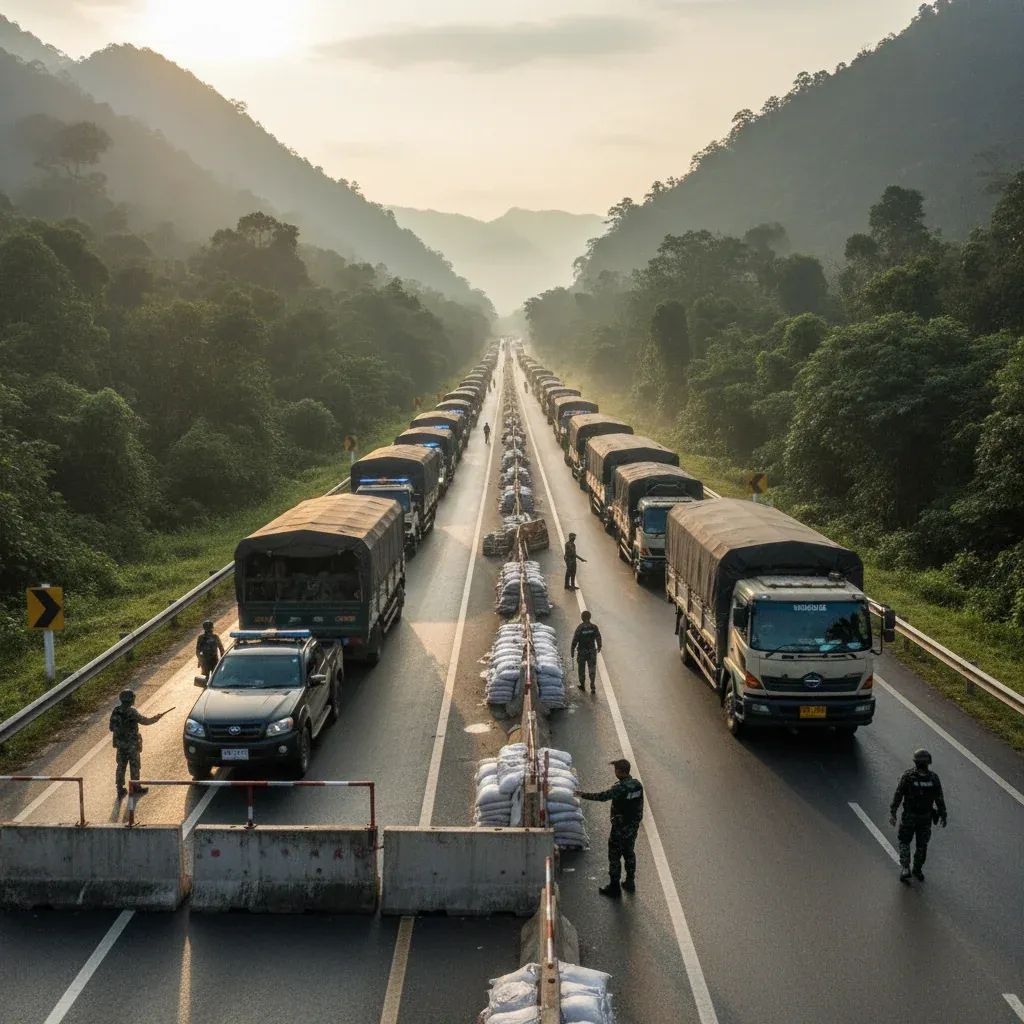
Laos authorities in Bokeo Province have intercepted 16 million methamphetamine tablets concealed in a commercial transport vehicle near the Golden Triangle border, underscoring the region's escalating role as a narcotics transit corridor and production hub. The seizure, one of the largest recorded this year in the tri-border area, highlights how rapidly methamphetamine supply continues to flood Southeast Asia despite intensified cross-border enforcement. (This report details developments through early 2026.)
Why This Matters
• Regional transit hub: Bokeo Province accounted for 9 of the 10 largest drug busts in Laos during 2025, cementing its status as the primary gateway for narcotics flowing from Myanmar's Shan State into Thailand.
• Production surge: Myanmar-based labs are churning out methamphetamine at record volumes, driving street prices down and making pills more accessible than basic food in some border communities.
• Thai exposure: Thailand seized over 915M meth pills in the first eight months of 2025 alone, with the majority traced back to routes through Laos.
The Bokeo Corridor: Gateway for Golden Triangle Narcotics
Bokeo Province sits at the junction of Myanmar, Laos, and Thailand, a geographic sweet spot for traffickers exploiting porous borders and limited enforcement resources. The region has emerged as both a transshipment route and, increasingly, a production zone for synthetic drugs. Laos-based labs in northern provinces like Bokeo and Xayabury now manufacture methamphetamine using precursor chemicals smuggled from Myanmar's Shan State, the world's largest producer of the drug.
The latest bust involved a commercial vehicle—traffickers routinely disguise bulk narcotics as legitimate cargo—traveling along known transit corridors toward the Thai border. Laos security officials discovered the 16M pill cache following intelligence sharing with regional counterparts, though details on the driver's arrest or intended destination remain sparse.
During 2025, Bokeo Province alone accounted for more than 115M methamphetamine tablets and 2,577 kilograms of crystal meth seized across the 10 largest operations in Laos, according to state media. This concentration of activity reflects both the province's strategic location and the volume of narcotics moving through the corridor.
Myanmar's Political Chaos Fuels Production Boom
The root cause of the methamphetamine surge lies across the border in Myanmar's Shan State, where ongoing civil conflict since the February 2021 coup has created a governance vacuum. Armed groups and criminal syndicates exploit this instability to operate industrial-scale labs with near impunity. UNODC reported in May 2025 that methamphetamine production in the Golden Triangle has climbed steadily since 2021, with tablet seizures across East and Southeast Asia jumping 24% year-on-year in 2024.
Thailand, the primary destination market, intercepted 1 billion pills in 2024—representing 85% of all methamphetamine tablets seized in the region. Thai authorities logged over 180,000 drug cases in the first eight months of 2025, confiscating 915M pills and 34,116 kg of crystal meth, alongside asset seizures worth 7.1 billion baht (approximately $200M).
Yet despite record busts, street prices for methamphetamine continue to fall, signaling that production capacity far exceeds interdiction efforts. Pills that once cost hundreds of baht now sell for a fraction of that amount, making the drug accessible to younger and poorer demographics and complicating public health responses.
Laos: From Transit Route to Production Hub
While Myanmar remains the manufacturing epicenter, Laos has transitioned from a passive corridor to an active participant in the methamphetamine economy. Northern provinces like Bokeo, Xayabury, and Bolikhamxay now host labs producing pills using precursor chemicals smuggled from Shan State. This shift reflects traffickers' strategic adaptation: by producing closer to Thai and regional markets, they reduce transportation risks and exploit Laos' limited enforcement capacity.
Thailand's Ministry of Public Health has identified at least 18 fugitive traffickers believed to be operating from Laos. During Thailand-Laos bilateral drug control meetings held in early 2026, Lao authorities agreed to cooperate in tracking and apprehending these individuals. Thai and Lao agencies also pledged to enhance intelligence sharing, precursor chemical controls, and joint operations targeting major syndicates.
One such target, Xaysana Keopimpha—known as "Playboy"—is a Lao national suspected of running a major methamphetamine network. Another key figure, Zhao Wei, was sanctioned by the U.S. Treasury Department in 2018 for allegedly using his Kings Romans Casino in Laos' Golden Triangle Special Economic Zone for money laundering and drug trafficking. Thai and regional authorities have confirmed knowledge of multiple "big fish" traffickers operating from Lao territory, but bureaucratic and sovereignty constraints complicate cross-border arrests.
What This Means for Thailand Residents
For anyone living in Thailand, the methamphetamine flood has tangible consequences. Lower prices have expanded the user base, contributing to rising property crime, domestic violence, and traffic accidents linked to drug use. Thai police report that methamphetamine now features in the majority of drug-related arrests, with users spanning urban professionals to rural laborers.
The Thailand Narcotics Control Board (ONCB) has ramped up prevention campaigns targeting schools and workplaces, while the Royal Thai Police have deployed additional checkpoints along the Chiang Rai, Chiang Mai, and Loei borders. In early 2026, Thailand enhanced cooperation initiatives with Laos' customs checkpoints, part of a broader effort to bolster Lao enforcement capacity at key transit points.
However, residents should recognize that interdiction alone cannot solve the problem. As long as Myanmar's Shan State remains unstable and production continues unabated, methamphetamine will keep flowing south. The Thai government is pursuing a dual-track approach: enforcement to disrupt supply chains, and alternative development programs in border communities to reduce local participation in trafficking.
Regional Cooperation: Progress and Persistent Gaps
The Thailand-Laos-Myanmar enforcement nexus operates through multiple frameworks, including the Safe Mekong Initiative and the Golden Triangle Action Plan. These platforms facilitate intelligence exchanges, joint investigations, and extradition coordination. In April 2026, Thai authorities successfully extradited "Noo Chen," a major trafficker, from South Korea following a months-long manhunt.
Yet cooperation remains hampered by resource disparities, corruption, and political sensitivities. Laos' enforcement agencies face severe budget constraints, while Myanmar's military junta prioritizes internal conflict over drug control. Thai officials privately acknowledge that some Lao and Myanmar officials may be complicit in trafficking, complicating efforts to dismantle networks.
The UNODC and UN agencies advocate for a sustainable development approach, promoting legal livelihoods—such as rubber and coffee farming—to replace opium and drug production in source areas. While some progress has been made in opium eradication, the methamphetamine economy operates independently of poppy cultivation, driven by synthetic chemistry rather than agriculture.
The Bigger Picture: A Crisis Without Quick Fixes
The 16M pill seizure in Bokeo is simultaneously a success and a warning. It demonstrates that Lao and Thai authorities can disrupt large shipments when intelligence aligns. But it also underscores the staggering scale of production and the limited impact of interdiction alone. For every bust, countless other loads slip through.
For Thailand, the challenge is existential. Methamphetamine has become the country's most pressing public health and law enforcement issue, straining hospitals, prisons, and police resources. The Thai Cabinet has designated narcotics control a national priority, with billions allocated to enforcement, treatment, and prevention.
Residents, particularly those in northern provinces, should remain vigilant. The Royal Thai Police encourage reporting suspicious activity along border routes, and community-based prevention programs—modeled on the "3 Builds" initiative (drug-free villages, schools, and workplaces)—are expanding. Meanwhile, anyone traveling near the Golden Triangle should be aware that security checkpoints are now routine, and customs inspections have intensified.
The methamphetamine crisis in the Golden Triangle reflects a volatile mix of geopolitical instability, weak governance, and entrenched criminal networks. Until Myanmar's conflict subsides and regional states can harmonize enforcement and development strategies, the flood of pills will continue—making every major bust like the one in Bokeo a temporary reprieve rather than a turning point.


