
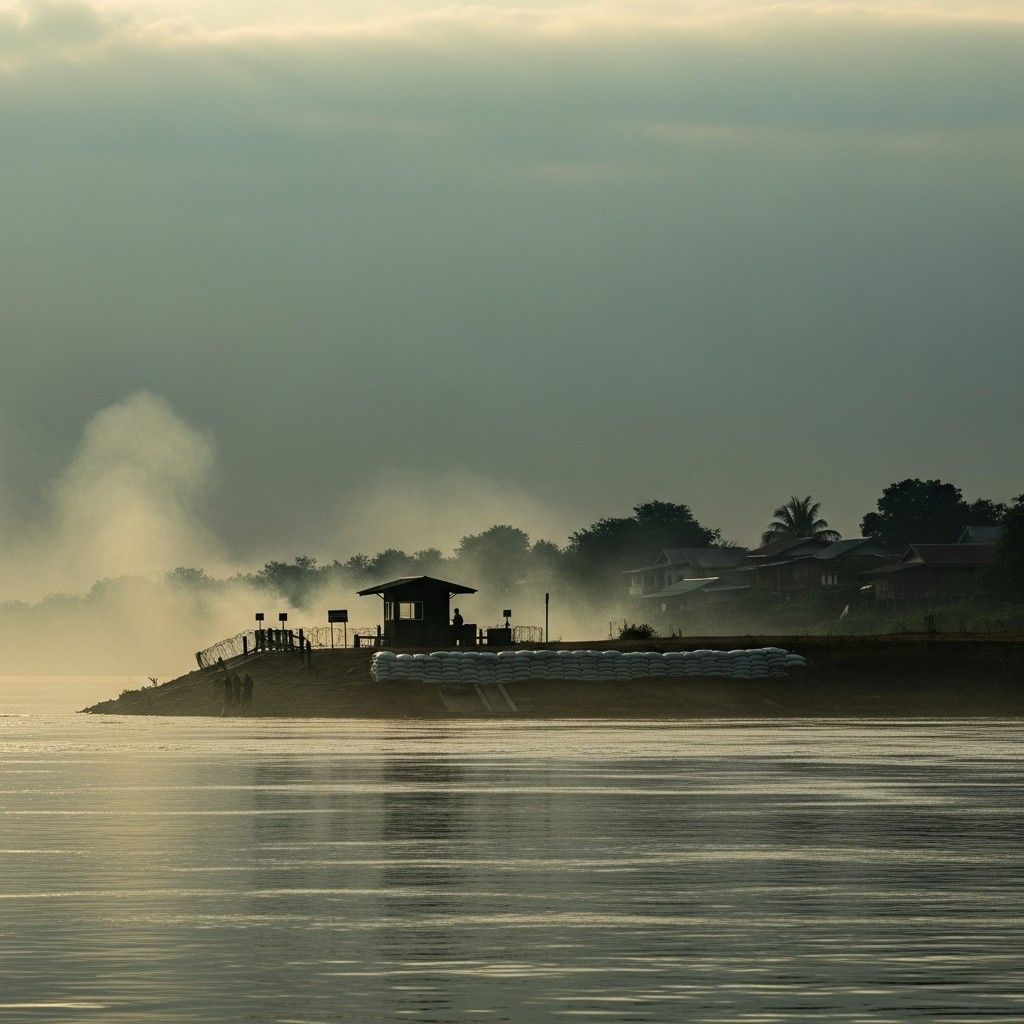
The Thailand-Myanmar Second Friendship Bridge in Mae Sot district, Tak province, has resumed operations after an 8-month shutdown, potentially restoring a trade artery that normally handles up to 290,000M baht in annual cross-border commerce—though Myanmar's martial law enforcement could still throttle cargo movement inland.
Why This Matters:
• Exporters regain access: Businesses lost an estimated 5,600M baht per month during the closure, equivalent to roughly a quarter of Thailand's border trade revenue with Myanmar.
• No guarantee of smooth flow: Myanmar authorities may still block trucks at checkpoints beyond the border, limiting the practical benefit of the reopening.
• Alternative routes remain critical: Traders who diversified to Ranong-Yangon sea routes or Mae Sai-Tachileik land crossings may not immediately return.
Eight Months of Economic Bleeding
Myanmar immigration officials notified their Thailand counterparts on April 27 that Naypyidaw would lift the unilateral closure imposed in August 2025, when the Myanmar military government sealed the span to choke revenue streams for anti-junta rebel groups. Armed resistance forces, particularly the Karen National Union (KNU) and allied People's Defense Force units, had established roadblocks along the Myawaddy-Yangon corridor and levied fees on hauliers—cash the junta wanted to deny them.
The Mae Sot-Myawaddy crossing, which accounts for approximately 80% of bilateral Thailand-Myanmar trade by value, handles everything from consumer electronics and fuel to garments and agricultural inputs. Before the closure, the Thailand Customs Department projected the Second Friendship Bridge would lift total Mae Sot border-trade turnover from 190,000M baht to 290,000M baht annually—a 22% gain—and push vehicle throughput up 10% from the baseline of 230,000 trucks per year.
When Myanmar sealed the bridge without advance notice last August, that projection evaporated. Thailand exporters watched container trucks idle on the Thai side while perishable goods spoiled. Mae Sot district businesses reported liquidity crunches, and logistics companies began redirecting clients to sea-freight options via Ranong or Laem Chabang ports, or overland through the Mae Sai-Tachileik checkpoint in Chiang Rai province—routes that add days and cost to delivery schedules.
What This Means for Traders and Border Communities
The reopening offers relief but not certainty. Thailand Ministry of Commerce officials and local chambers have cautioned that Myanmar's internal conflict remains volatile. Even with the bridge open, cargo may stall at inland military checkpoints or face arbitrary taxation by whichever faction controls the road on a given day. The junta's martial-law zones extend well beyond Myawaddy, and clashes between the Tatmadaw and ethnic armed organizations can close highways on short notice.
For Thailand-based exporters, the immediate upside is the ability to quote shorter lead times and lower freight costs to Myanmar buyers—critical advantages when competing against Chinese and Indian suppliers. Consumer goods, construction materials, and diesel fuel are the top categories moving across Mae Sot; many of these items serve Myanmar's commercial capital, Yangon, which lies just 280 kilometers from the bridge via the East-West Economic Corridor (EWEC), a regional highway network linking the Andaman Sea to the South China Sea.
Mae Sot district hosts Thailand's Special Economic Zone (SEZ), a tax-incentivized cluster of garment factories, food processors, and electronics assemblers that employ thousands of Myanmar migrants. The closure forced some plants to cut shifts and defer expansion. Reopening the bridge should stabilize labor flows and raw-material imports, provided Myanmar authorities honor visa and work-permit arrangements.
Why Myanmar Closed—And Why It Reopened
The August 2025 closure was rooted in battlefield economics. Rebel units had seized control of several border trading posts and imposed "taxation"—essentially protection fees—on trucks entering Myanmar. This diverted revenue from the junta's customs apparatus and funded opposition operations. By shutting the bridge, Myanmar's military government aimed to force all trade through official channels it controlled, starving the insurgents of cash.
Reports from the Thai side indicated that more than 200 Myanmar soldiers withdrew from camps near the Myawaddy bridgehead and repositioned at the span's base, raising fears of a close-quarters firefight that would endanger civilian crossers. Thai immigration and customs officers moved staff back from the frontier temporarily.
Why reopen now? Analysts suggest two factors. First, Myanmar's economy, already battered by sanctions and civil conflict, cannot afford prolonged isolation from Thailand, its largest trading partner. Second, the junta may have secured enough tactical ground around Myawaddy to feel confident it can police the route without rebel interference—though that confidence may prove premature.
Structural Limits and Backup Plans
Even before the closure, the Second Friendship Bridge faced operational hiccups. Opened officially on October 30, 2019, the structure was designed to relieve congestion on the older First Friendship Bridge, where heavy trucks often queued for hours waiting to switch lanes. The newer span features separated approach lanes and can handle heavier axle loads, but its utility depends entirely on Myanmar's willingness to staff immigration and customs posts on the far bank.
Thailand Customs Mae Sot has advised traders to maintain contingency routes. Sea freight via Ranong-Yangon or Laem Chabang-Yangon takes longer but bypasses land-border uncertainties. The Mae Sai-Tachileik crossing offers a northern alternative, though it serves a different hinterland and adds overland distance for goods bound to central Myanmar. Some shippers have begun exploring rail options through Laos and China, though these require transshipment and customs clearance in multiple jurisdictions.
For residents of Mae Sot and surrounding districts, the bridge's status is a barometer of economic health. When trucks roll, hotels fill, fuel stations see lines, and border markets buzz. When the bridge sits idle, unemployment spikes and property values sag. Local officials estimate that prolonged closures could trigger permanent business migration to more stable crossings, undermining decades of infrastructure investment.
Looking Ahead: Fragile Connectivity
The resumption of operations is a positive signal, but stakeholders are wary. Thailand-Myanmar trade dynamics remain hostage to a civil conflict with no clear endgame. Martial law, checkpoint tolls, and sudden road closures mean that even an "open" border can function as a bottleneck.
For Thailand policymakers, the episode underscores the risks of concentrating border trade on a handful of crossings. Diversifying trade infrastructure—improving port capacity at Ranong, upgrading the Mae Sai facilities, and pursuing multilateral trade corridors through ASEAN—could insulate the economy from future Myanmar disruptions.
Exporters who weathered the 8-month closure by pivoting to alternative routes may not rush back. Trust, once broken, is expensive to rebuild, and the next unilateral shutdown could come at any time. The bridge is open, but the road beyond remains uncertain.


