
Japan's Aviation Authority has rolled out a ban on using and charging power banks during flights, a regulatory shift that will take effect on April 24, 2026, and carries penalties steep enough to make travelers think twice before attempting to use a device mid-flight. The move, driven by a spike in lithium-ion battery fire incidents aboard aircraft, will affect every passenger passing through Japanese airspace—residents, tourists, and business travelers alike.
Why This Matters:
• No using or charging devices mid-flight: Power banks cannot be used to charge phones, tablets, or any electronics once airborne, nor can they be recharged using in-seat USB ports or outlets.
• Two-unit maximum: Each traveler is capped at two power banks, each under 160 watt-hours (Wh)—roughly 43,000 mAh. Power banks themselves remain permitted under these conditions.
• Serious penalties: Violators face fines up to ¥1M (about ฿240,000) or imprisonment for up to two years.
• Immediate enforcement: The rules apply to all flights departing from, arriving in, or transiting through Japan starting April 24, 2026.
The Fire Risk Behind the Crackdown
The Japan Ministry of Land, Infrastructure, Transport and Tourism (MLIT) enacted these restrictions after a troubling pattern of lithium-ion battery incidents both domestically and worldwide. In January 2025, a suspected defective power bank ignited a fire aboard an Air Busan flight, prompting emergency protocols. Months later, an ANA flight from Okinawa to Tokyo Haneda saw smoke billowing from a passenger's carry-on, traced back to a malfunctioning power bank. A Japan Airlines flight (JAL10) experienced a similar battery fire while taxiing at Chicago's O'Hare International Airport, underscoring that the hazard is not confined to Japanese carriers or airspace.
Thermal runaway—the technical term for lithium-ion batteries overheating uncontrollably—poses a unique threat in pressurized cabins. Unlike incidents on the ground, a fire at 35,000 feet limits response options and can rapidly endanger hundreds of passengers. The International Civil Aviation Organization (ICAO) responded by updating global safety specifications in March 2026, and Japan is among the first major aviation markets to enforce compliance with penalties that reflect the gravity of the risk.
What This Means for Residents and Travelers
For anyone living in Thailand and traveling to or through Japan—whether for business, leisure, or connecting flights—the practical implications are immediate. You can bring power banks onboard, but once the cabin door closes, they become inaccessible for their primary purpose: charging your devices. Business travelers accustomed to working through long-haul flights will need to ensure laptops, phones, and tablets are fully charged before boarding. Power banks, once a convenient fallback during marathon meetings or email sprints, are now strictly ornamental once airborne.
The two-unit cap requires careful planning for travelers who use multiple devices. Many frequent flyers carry multiple backup batteries to support cameras, drones, and other gadgets. Under the new regime, anything beyond two units will be confiscated during security screening, and there's no guarantee of retrieval. Moreover, power banks must remain within arm's reach—stored under the seat or in a seat pocket, not tucked into overhead bins. This rule is designed to allow cabin crew to respond instantly if a device begins smoking or emitting heat.
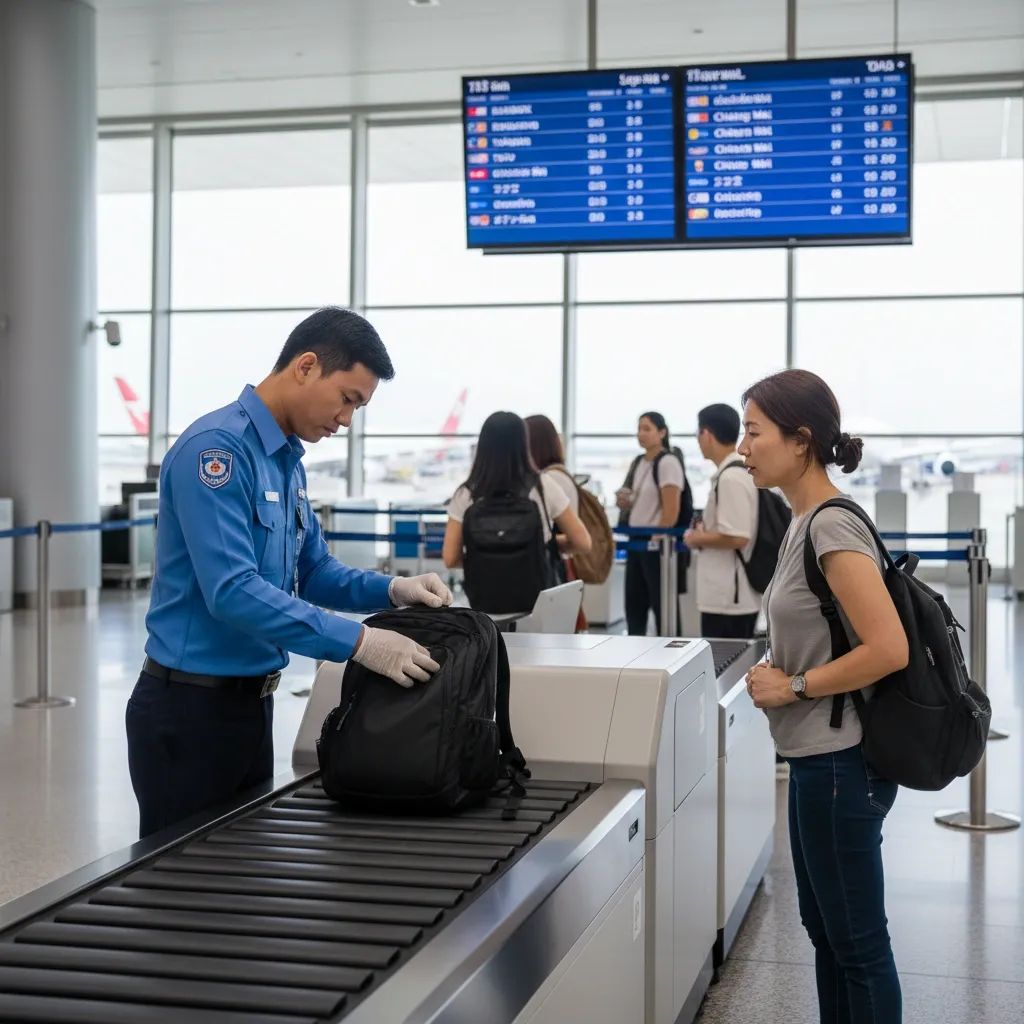
Checked baggage is a hard no. Power banks discovered in suitcases during X-ray screening will be removed and disposed of without notice or compensation. For travelers departing from Bangkok's Suvarnabhumi or Don Mueang airports en route to Narita, Haneda, or Kansai, double-checking carry-on contents before check-in is now essential. Forgetting a power bank in a toiletry kit or laptop bag could mean losing it permanently.
Capacity Calculations and Compliance
Most consumer power banks fall below the 100 Wh threshold, which translates to roughly 27,000 mAh at the standard 3.7-volt rating used in lithium-ion cells. High-capacity models marketed for charging laptops or multiple devices often push into the 100–160 Wh range. These are still permitted but only in pairs and only if the watt-hour rating is clearly printed on the casing. Devices with faded, missing, or illegible labels are subject to immediate confiscation.
To calculate watt-hours when only mAh is listed, use the formula: Wh = (mAh ÷ 1,000) × 3.7. A 20,000 mAh power bank, for example, equates to roughly 74 Wh—well within the limit. A 50,000 mAh unit, however, clocks in near 185 Wh and is outright banned. Travelers who rely on ultra-high-capacity batteries for extended trips or remote work will need to recalibrate their packing strategies or invest in smaller, compliant alternatives.
Global Context: Japan Joins a Tightening Consensus
Japan's regulations mirror a broader international tightening. The Lufthansa Group—encompassing carriers like Lufthansa, SWISS, Austrian Airlines, and Brussels Airlines—imposed similar restrictions starting January 15, 2026. Australian airlines including Qantas, Jetstar, and Virgin Australia followed suit in mid-December 2025, limiting passengers to two units and banning in-flight use. India's Directorate General of Civil Aviation issued parallel directives, and several US carriers including Southwest Airlines and American Airlines have restricted or prohibited in-flight power bank charging.
The convergence suggests that Thailand-based travelers flying virtually anywhere in the Asia-Pacific or Europe should anticipate similar rules. While Thailand's aviation regulator has not yet announced parallel measures, the global trajectory is unmistakable. Expats and frequent flyers accustomed to using devices mid-flight on carriers like Thai Airways, Bangkok Airways, or AirAsia should verify current policies before departure, as airlines may adopt stricter standards independently of government mandates.
Practical Adjustments for Frequent Flyers
The ban on using power banks mid-flight forces a shift in travel habits. Pre-flight device charging becomes non-negotiable—arriving at the gate with a phone at 40% is no longer a minor inconvenience but a potential productivity killer on a 12-hour flight to Tokyo or Osaka. For business passengers attending conferences or client meetings immediately upon landing, the inability to use power banks to top up devices mid-flight could mean arriving with depleted batteries and scrambling for charging stations in crowded terminal corridors.
One workaround: Invest in devices with longer battery life or enable aggressive power-saving modes during flights. Another: Use in-seat USB ports and power outlets for direct device charging where allowed—these remain operational for laptops and phones under the new regulations. Japan's regulations do not prohibit powering a laptop from an AC outlet or charging a smartphone from a seat USB port; they specifically target the use of power banks themselves, which are seen as the primary fire vector.
Travelers should also budget extra time for security screening. Japan's airport authorities are conducting spot checks for power bank compliance, and non-compliant devices will delay boarding. Wrap each unit in a clear plastic bag or protective case to prevent short circuits—exposed terminals can spark fires if they contact metal objects like keys or coins. Insulating terminals with electrical tape is a simple, effective precaution.
Enforcement and Penalties: A Real Deterrent
The ¥1M fine and two-year imprisonment clause is unusually severe by aviation regulatory standards and signals Japan's seriousness about deterring non-compliance. Most aviation safety violations result in confiscation or administrative penalties; criminal sanctions are reserved for egregious breaches. The stringent penalty structure reflects the catastrophic potential of an in-flight lithium fire—an incident that could down an aircraft and claim hundreds of lives.
For foreign travelers, ignorance of the law is unlikely to serve as a defense. Multilingual signage is being deployed across Japanese airports, and airlines are required to notify passengers during booking and check-in. Those transiting through Japan on connecting flights are equally bound by the rules, even if their origin and final destination lie elsewhere. A traveler flying from Bangkok to Los Angeles via Tokyo must comply with Japanese regulations for the Tokyo leg, and any violation during that segment could trigger enforcement action.
Looking Ahead: Expect Further Restrictions
MLIT officials have hinted that the 160 Wh cap may drop to 100 Wh by January 2027, aligning with anticipated International Air Transport Association (IATA) recommendations. Such a shift would render many high-capacity power banks currently on the market non-compliant, forcing another round of consumer adjustments. Travelers investing in new power banks should opt for models well below the 100 Wh mark to future-proof against regulatory tightening.
The broader implication: Lithium-ion battery technology, despite its ubiquity, remains a recognized hazard in aviation environments. Until solid-state or alternative battery chemistries mature and enter mass production, expect incremental restrictions on consumer electronics. For Thailand residents who travel frequently, staying informed about evolving regulations across key destinations—Japan, the EU, Australia, and North America—will be essential to avoiding disruption, financial penalties, and the loss of expensive equipment.


