
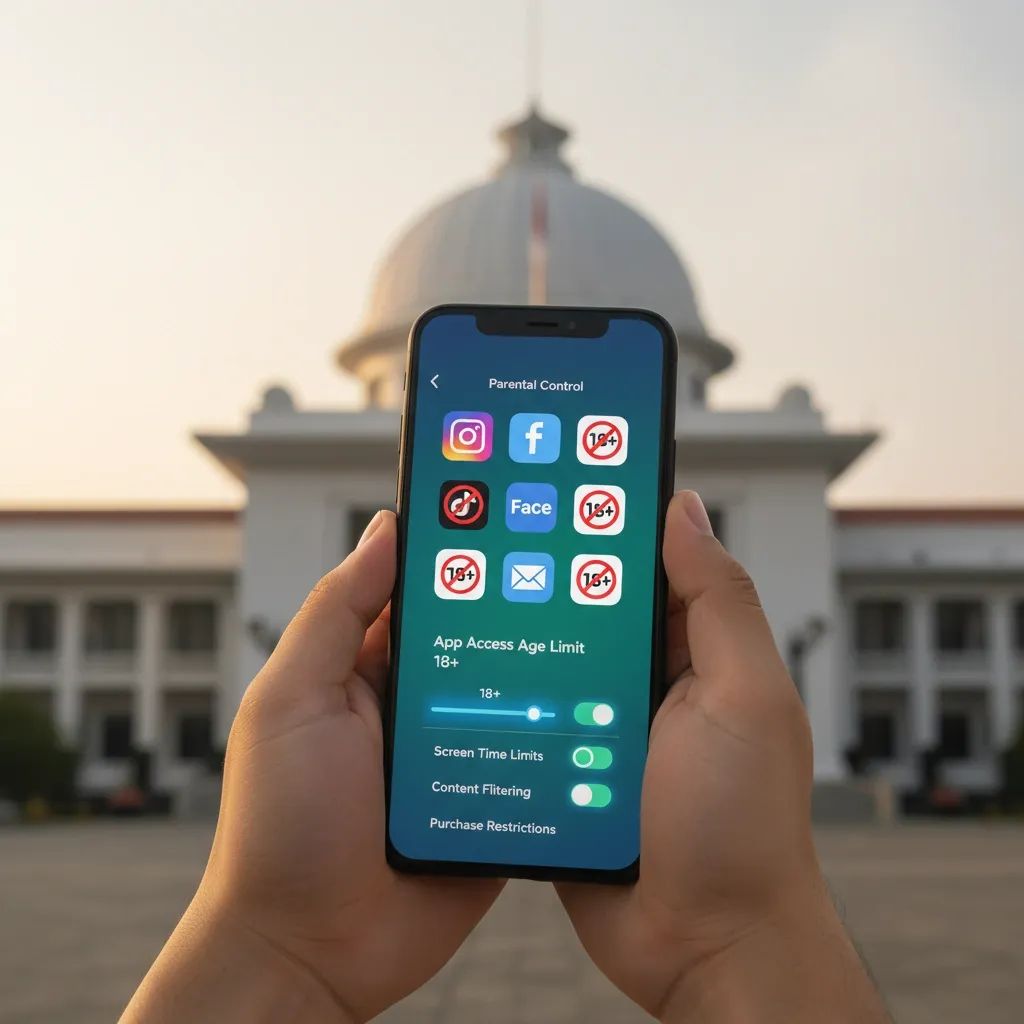
Indonesia's Ministry of Communication and Digital Affairs has finalized a sweeping social media ban targeting minors, making it one of the first Southeast Asian nations to institute age-based platform restrictions. Starting March 28, the ban will progressively lock children under 16 out of YouTube, TikTok, Instagram, and five other major platforms—a policy that could ripple across the region's digital landscape and reshape how millions of families interact with the internet.
Why This Matters
• Enforcement begins March 28: Accounts registered to under-16 users on YouTube, TikTok, Facebook, Instagram, Threads, X, Bigo Live, and Roblox face phased deactivation.
• Platforms, not parents, face penalties: Non-compliance could trigger warnings, fines, suspensions, or full access termination—similar to Australia's A$49.5M (US$32M) fine structure.
• Age verification mandates kick in by March 2027: Companies must deploy standard-based age checks and parental controls, or risk regulatory action.
The Legal Framework
The restrictions stem from Ministerial Regulation No. 9 of 2026, announced by Communication and Digital Affairs Minister Meutya Hafid on March 6. This directive operationalizes Government Regulation No. 17 of 2025—colloquially known as PP Tunas—which establishes electronic governance standards for child protection. PP Tunas sorts Indonesian minors into three tiers: children below 13 are confined to low-risk, child-specific services with parental approval; those aged 13 to under 16 remain restricted to low-risk platforms unless parents consent; and teenagers 16 to under 18 gain broader access but still require safeguards and parental oversight.
The classification of platforms as "high-risk" focuses on services where algorithmic feeds, user-generated content, and interactive features converge. Minister Hafid framed the policy as a response to what she described as an asymmetric battle, stating that parents should no longer have to fight "the giant algorithm" alone. The government cited mounting evidence linking unrestricted social media use to exposure to pornography, cyberbullying, online fraud, and behavioral addiction as primary catalysts for the crackdown.
What This Means for Residents
For expatriate families and Indonesian households with teenagers, the practical impact unfolds in stages. Existing accounts belonging to under-16 users will begin disappearing from the targeted platforms as of late March. Parents will need to navigate parental-consent mechanisms once platforms roll out compliant infrastructure—likely involving identity verification, age attestation, or government-issued digital IDs. Unlike peer nations where enforcement has faltered due to self-declaration loopholes, Indonesia's regulation explicitly mandates standard-based age verification and holds platforms accountable for systemic failures.
The ban does not criminalize minors or impose fines on families. Instead, it shifts the burden to platform providers, who must audit their child-safety architectures, deploy content moderation tools, cap in-app purchases for minors, and submit to oversight by the Ministry of Communication and Digital Affairs (Komdigi). Companies have until March 28, 2027 to achieve full compliance, a 12-month window designed to allow for technical infrastructure upgrades and stakeholder consultation.
For international schools and educational institutions that rely on YouTube for curriculum delivery or Google Classroom integration, the regulation introduces a grey area. PP Tunas distinguishes between "low-risk" educational platforms and "high-risk" social networks, but the precise criteria for exemptions remain under clarification. Parents may need to secure explicit consent credentials or demonstrate educational necessity to maintain access for children between 13 and 16.
What This Means for Thailand Residents
Thailand residents, particularly expat families and those with Indonesia connections, need to understand how this policy affects them. Cross-border families with children moving between Thailand and Indonesia will face compliance challenges; teenagers may have accounts deactivated when traveling or relocating to Indonesia, requiring immediate re-verification and parental consent processes. For expat parents managing digital permissions across two jurisdictions, Indonesia's stricter age-based restrictions contrast sharply with Thailand's current approach.
Thailand's current regulatory environment takes a lighter-touch approach to youth social media use. While Thailand has child-protection laws and content guidelines, there is no blanket ban on social platforms for minors under 16. However, Indonesia's policy signals a regional trend toward stricter digital governance. Thai policymakers and child-protection advocates have not yet formally proposed comparable measures, though the success or challenges of Indonesia's implementation could influence future Thai regulatory discussions. Thailand residents should monitor whether Bangkok follows suit in coming years.
For expat families in Thailand, this development has practical implications: if you have children in Indonesia or plan cross-border schooling arrangements, be prepared for account deactivation and new parental verification requirements. Educational institutions with campuses or programs spanning Thailand and Indonesia will need to clarify how students maintain access to learning platforms during the transition. Additionally, families using social media for communication across borders should establish backup contact methods, as account suspensions may occur without prior notice.
Thailand's digital landscape may also shift if Indonesia's enforcement succeeds in reducing youth exposure to harmful content while maintaining educational platform access. If Indonesia's model demonstrates effective child protection without widespread circumvention or unintended consequences, Thai regulators might consider similar frameworks. Conversely, if privacy concerns or enforcement loopholes undermine Indonesia's ban, Thailand residents should expect these lessons to inform local debates on data security and parental consent mechanisms.
Regional and Global Context
Indonesia's move places it alongside Australia, which enacted one of the world's strictest bans in December 2025, barring under-16s from TikTok, Instagram, Facebook, Snapchat, Reddit, X, and YouTube. Australian platforms face penalties of up to A$49.5M for non-compliance and must deploy verification methods that include government IDs, facial recognition, or voice analysis. The United Kingdom introduced the Online Safety Act in 2023, requiring "highly effective" age assurance for services hosting sensitive content, while the European Parliament adopted a non-binding resolution in November 2025 urging an EU-wide minimum age of 16 for social media, with parental consent for 13- to 16-year-olds.
Indonesia is the first non-Western nation to operationalize such a comprehensive framework. Malaysia announced a similar under-16 ban in November 2025, effective January 2026, leveraging eKYC (electronic Know Your Customer) protocols. Brazil passed legislation in September 2025 requiring parental account linking and age-appropriate content filters for minors. France, Germany, and Italy have enacted parental-consent requirements for children under 15, 16, and 14, respectively, though enforcement remains patchy due to weak verification infrastructure.
Critics, including UNICEF, warn that blanket bans risk pushing children toward less regulated platforms or darknet alternatives, where monitoring and safeguards are virtually non-existent. They argue that restrictions undermine children's rights to participation, privacy, and self-expression—especially for marginalized youth who rely on social networks for community building and mental health support. Digital rights advocates also raise concerns about mass surveillance and data privacy, noting that robust age verification often requires biometric scans or government ID linkage, creating vast troves of sensitive personal information vulnerable to misuse.
Enforcement and Platform Obligations
Komdigi has signaled a phased rollout to allow platforms time to adapt. Between March 28 and the March 2027 compliance deadline, the ministry will conduct audits, issue warnings for partial non-compliance, and escalate to fines or access suspensions for repeat offenders. The exact fine structure for Indonesia has not been publicly disclosed, but observers expect it to mirror Australia's regime given the similar policy architecture.
Platforms must implement age-gating mechanisms at account creation, flag existing accounts for re-verification, and deploy parental dashboards that allow guardians to approve or deny access to specific features. The regulation also mandates transparent content moderation policies, including automated filters for pornography, violence, and self-harm content, and human-review escalation paths for borderline cases. Companies that fail to meet these standards risk temporary suspension of access within Indonesia's borders—a penalty that carries significant financial weight given the country's 278M population and high mobile-internet penetration.
The Debate Over Effectiveness
Proponents argue that the ban addresses a public health crisis. Studies in Indonesia have documented rising rates of screen addiction, cyberbullying-related suicides, and grooming incidents involving minors on platforms with minimal moderation. By forcing companies to redesign their products with safety-by-design principles, the government hopes to reduce harm at the source rather than relying on parental vigilance alone.
Skeptics counter that digital literacy programs and platform-design reform offer more durable solutions than age gates, which determined teens can circumvent using VPNs, shared devices, or fabricated credentials. Research from the EU's Digital Services Act implementation suggests that factors like parental engagement, critical-thinking education, and algorithmic transparency are as crucial as age thresholds in shaping online outcomes. Some child-rights experts caution that Indonesia's approach risks shifting responsibility from profit-driven platforms—whose engagement-maximizing algorithms often amplify harmful content—to families and authorities, without addressing the root economic incentives that prioritize user retention over safety.
Next Steps for Families
Parents should anticipate account deactivation notices from March 28 onward. Platforms will likely email registered account holders requesting age verification or parental consent re-confirmation. Families may be asked to link a parent's government-issued ID or submit biometric data depending on the verification method each company adopts. For teenagers nearing their 16th birthday, maintaining dated proof of age—such as a national ID card or passport—will streamline re-access once they cross the threshold.
International residents should check whether their home-country IDs are recognized by Indonesian verification systems, as interoperability remains a technical hurdle. Expatriate advocacy groups have urged Komdigi to clarify how foreign nationals with dependent visas will navigate the consent process, particularly for blended families or guardianship arrangements that lack formal Indonesian documentation.
The regulation's long-term success will hinge on Indonesia's ability to balance child protection with digital inclusion, ensuring that safety measures do not inadvertently widen the digital divide or stifle the positive aspects of online connection—creative expression, educational resources, and peer support networks that have become integral to adolescent development in the 21st century.


