
The Thailand Ministry of Agriculture and Cooperatives is steering the nation's farming sector through a transformation that extends far beyond simple organic labels, a shift that promises to reshape what residents eat, what exporters can charge, and how rural incomes evolve over the next two years.
Why This Matters
• Premium pricing: Certified sustainable produce now commands 15% to 50% higher prices in urban Thailand markets, with organic retail sales reaching ฿6B in 2023
• New export rules: From January 2026, all Thai agricultural exports to the European Union must comply with deforestation-free traceability using GPS-verified plot coordinates
• Air quality impact: Over 100 Thai corporations pledged in April 2026 to adopt full supply chain traceability to eliminate agricultural burning, targeting a 15% reduction in PM2.5 from crop residue fires
The Certification Arms Race
Thailand's farms are no longer competing solely on yield or cost. The Agricultural Research Development Agency (ARDA) launched the EUDR Thailand Traceability Platform in January, requiring exporters of rubber, palm oil, cattle, timber, coffee, cocoa, and soybeans to provide tamper-proof digital records proving products originated from land not deforested after December 2020. Non-compliance locks producers out of the European Union market entirely.
Meanwhile, burn-free certification became mandatory for all corn imports used in animal feed as of January 2026. Importers must maintain five-year traceability records demonstrating the grain came from farms that did not use agricultural burning. The domestic market is following suit: major Thai conglomerates including Charoen Pokphand Foods have committed to tracking rice, maize, and sugarcane from field to factory using satellite data and blockchain ledgers.
This is not abstract regulation. For farmers, it means adopting digital platforms that record planting dates, input applications, and harvest logistics in real time. For consumers in Thailand, it translates to fewer days of hazardous air quality during burning season and visible supply chain accountability on product packaging.
Beyond Organic: The New Standards Hierarchy
Traditional Thai Organic Certification remains valuable, particularly for affluent urban buyers and expatriates willing to pay premiums for chemical-free produce. But a suite of newer certifications is reshaping the competitive landscape.
Global GAP (Good Agricultural Practices) and HACCP (Hazard Analysis Critical Control Points) certifications set international benchmarks covering not just pesticide use but also worker safety, water management, and waste handling. These are the certifications most relevant for residents shopping in Thailand—they indicate rigorous food safety from farm to shelf. Charoen Pokphand Foods achieved Global GAP certification for its livestock feed operations in early 2026, demonstrating that both domestic and foreign buyers increasingly view such credentials as non-negotiable.
Rainforest Alliance, ISCC (International Sustainability and Carbon Certification), and Fairtrade Standards address environmental and ethical concerns that resonate strongly with foreign importers—these are less immediately visible on products found in most Thai supermarkets. Regenerative agriculture, pioneered by farms like an aromatic coconut operation in Ratchaburi, represents the frontier beyond organic, focusing on practices that actively restore ecosystems and rebuild soil fertility.
What This Means for Residents Right Now
For consumers living in Thailand, these shifts are creating tangible, immediate changes:
At the supermarket: Urban supermarkets and specialty grocers across Bangkok, Chiang Mai, and other major cities are stocking more products with visible certification logos—ThaiGAP, HACCP, ISO 22000, and FSSC 22000. These are the labels residents should prioritize when shopping. At Central World and EmQuartier in Bangkok, certified organic rice now costs approximately ฿80–100 per kilogram compared to conventional rice at ฿30–40, while Global GAP-certified vegetables at Villa Market command roughly ฿120–180 per kilogram versus conventional alternatives at ฿60–80. Certified products are most readily available in supermarkets in central and eastern Bangkok, with emerging availability in Chiang Mai and Phuket.
Air quality improvements: Residents in northern provinces like Chiang Mai and Lamphun, and northeastern provinces like Udon Thani and Khon Kaen, should see measurable air quality improvement during burning seasons (typically February-April) if the corporate burning reduction pledge holds. The Thailand Pollution Control Department identified agricultural fires as the primary driver of hazardous PM2.5 spikes; corporate traceability commitments aim to convert crop residues into biofertilizer and biomass fuel instead. Early indicators from provinces with established traceability programs suggest potential for the targeted 15% PM2.5 reduction by 2027.
Rural income stabilization: The Organic Agriculture Action Plan 2023-2027 targets 320,000 hectares of organic farmland by 2027, with farmers adopting these standards reporting cost savings from reduced fertilizer and pesticide purchases, alongside access to premium pricing. Some are also benefiting from Climate Smart Loan packages offered by Thai banks, which channel investment toward green agriculture practices.
How Residents Can Verify Certifications When Shopping
Look for these logos and labels on product packaging:
• ThaiGAP – indicates adherence to Thai Good Agricultural Practices
• HACCP – guarantees hazard control at critical points in production
• Organic Thailand – national organic certification
• Global GAP – international food safety standard
Ask staff at your local supermarket or market stall where certified products are sourced; major retailers like Big C, Tesco Lotus, and Villa Market maintain supplier transparency documents.
The Technology Layer
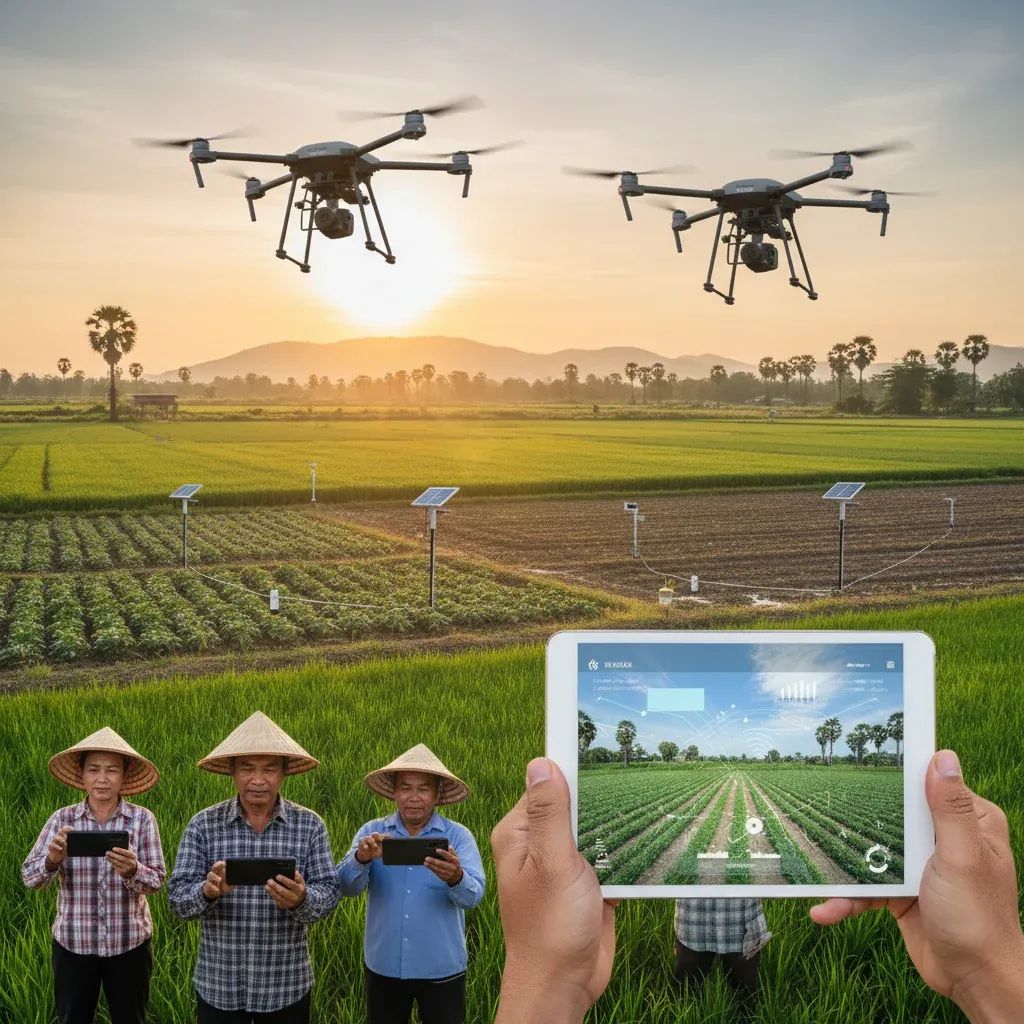
Agriculture 4.0, announced by the Thailand Cabinet in October 2025 and rolling out across provinces since January, integrates precision tools—sensors, drones, data-driven irrigation—that allow farmers to optimize inputs and respond to real-time weather data. For residents, this means farmers can reduce chemical runoff and improve crop consistency, indirectly benefiting water quality and food safety.
Digital platforms are also connecting smallholders directly to buyers, improving price transparency. Blockchain-enabled traceability creates tamper-proof records that satisfy both export regulators and domestic buyers. For farmers, this means learning new skills, but also accessing markets previously reserved for large agribusinesses.
The Economic Calculus
Switching to certified sustainable practices involves upfront costs. Organic conversion typically requires 12 to 18 months for domestic certification or 2 to 3 years for export standards, during which yields can drop 13% to 61% and products cannot yet carry premium labels. Smallholders often struggle to absorb this income gap without credit or subsidies.
Yet the payoff is substantial for those who persist. A transition to sustainable rice farming alone could generate $50B in net economic benefits for Thailand by 2050, according to sector analyses. Exporters with Global GAP credentials access buyers in Southeast Asia, Europe, and North America willing to pay more for traceability and environmental stewardship. Domestically, organic staple foods reached ฿6B in retail sales in 2023, with 7% annual growth outpacing conventional alternatives.
The Bio-Circular Green (BCG) economic model, embedded in the Sufficiency Economy Philosophy, emphasizes circular resource flows and value addition from agricultural waste. Government incentives are designed to attract adoption of green technology, though accessibility for smallholders remains uneven.
Persistent Friction Points
Fragmented landholdings, high input costs, and weather volatility continue to constrain progress. While digital tools promise efficiency gains, they remain out of reach for many smallholders lacking smartphones, internet access, or technical literacy. International certification costs are rising, prompting some farmers to explore Participatory Guarantee Systems (PGS), a lower-cost community-based alternative, though PGS credentials do not unlock premium export markets.
Consumer education also lags domestically. While affluent urban Thais recognize organic labels, awareness of Global GAP, ISCC, or other advanced certifications remains low among general residents. Without targeted marketing, the domestic market premium for these credentials is limited, leaving exporters as the primary beneficiaries.
The Road Ahead
Thailand's agricultural overhaul is unfolding through parallel tracks: government mandates, corporate commitments, and farmer-led innovation. The EUDR Thailand Traceability Platform is the most concrete enforcement mechanism, with export access as the leverage. The corporate pledge to eliminate burning by tracking supply chains tests whether private-sector accountability can succeed where regulation has struggled.
For residents, the immediate impacts center on food safety transparency (through clearer certification labels), air quality improvement (particularly in northern and northeastern provinces), and availability of premium-certified produce in local supermarkets and markets. For rural communities, the stakes are higher: whether digital tools, certification programs, and green finance can genuinely lift incomes or merely add compliance burdens to already-thin margins. The outcome will determine not just what Thailand exports, but how its farming heartland adapts to a world where sustainability is no longer optional.


