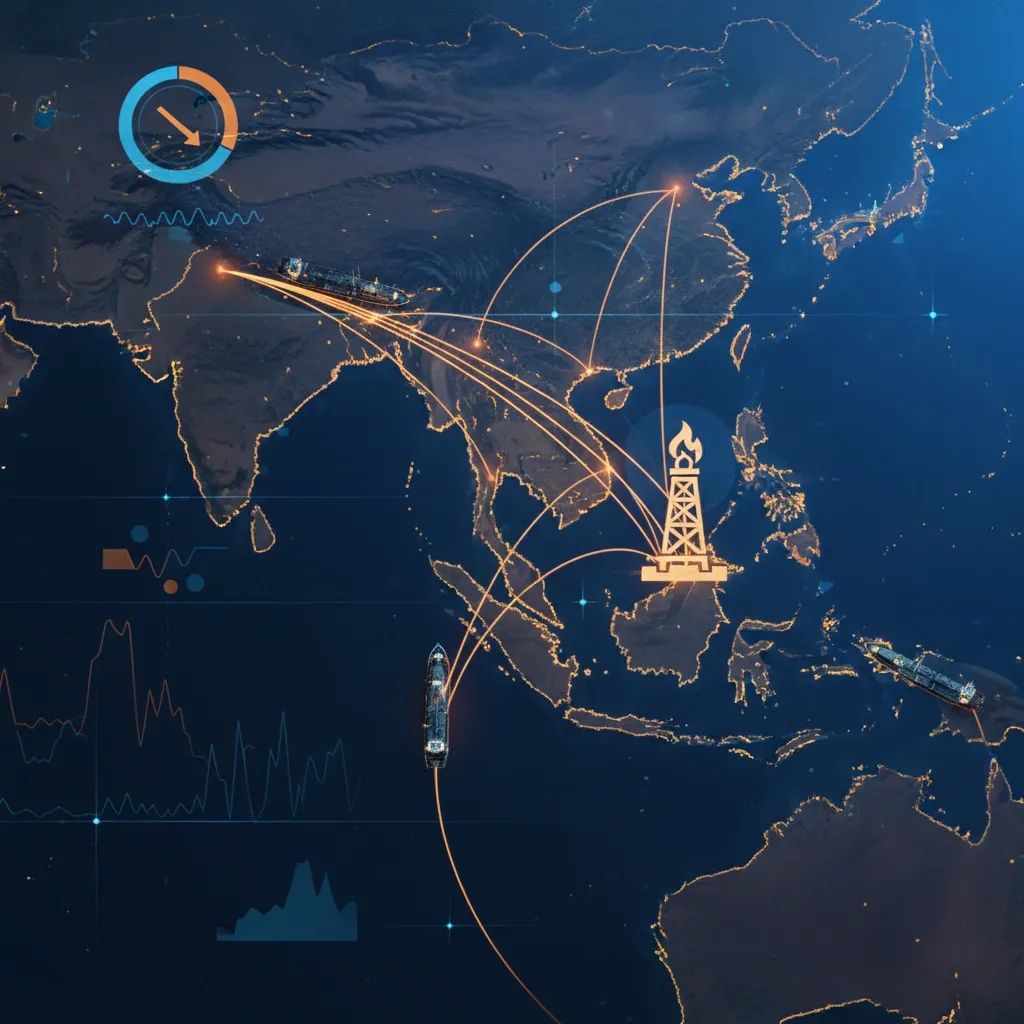
Thailand's electricity bills are about to become more volatile. PTT Plc, the state-backed energy giant, is ramping up liquefied natural gas imports to 10 million tonnes per annum by 2030. The aggressive expansion positions Thailand as a major LNG player in Southeast Asia—but also locks residents and businesses into a costly, price-sensitive energy system.
Why This Matters
• Price vulnerability: Every 10% increase in gas prices pushes electricity tariffs up 3.5%, directly affecting household bills and factory costs. A typical Bangkok household consuming 400 kWh monthly could see bills rise by THB 150-300 if gas prices spike 15%.
• Economic slowdown: Thailand's GDP growth is forecast to drop to 1.6% in 2026, tempering energy demand and raising questions about whether the country has overcommitted to expensive LNG contracts.
• Market dominance: Thailand controls an estimated 27% of Southeast Asia's LNG import market in 2026, the largest share in ASEAN, reflecting its expanding role as a regional energy player.
• Infrastructure expansion: A third LNG terminal at Map Ta Phut will add 5 million tonnes of annual capacity by 2027, though experts question whether it's needed given current underutilization.
The LNG Pivot: Thailand's Energy Reality
As domestic natural gas reserves decline and pipeline imports from Myanmar falter, the Thailand Ministry of Energy has locked the country into a dependence on imported LNG that now accounts for 31% of the national gas mix. That figure is projected to climb to 40% by 2030 and could exceed 60% by the mid-2030s, fundamentally reshaping the kingdom's energy security.
For 2026 alone, Thailand has secured 8.3 million tonnes of LNG through long-term delivery contracts. These include 1 million tonnes of US LNG mandated under a deal struck with the Trump administration in October 2025, valued at approximately $5.4 billion annually in total energy purchases. PTT signed a separate agreement in June 2025 to import 2 million tonnes annually from Alaska's LNG project over 20 years, while Gulf Energy finalized a 15-year supply deal with France's Engie in January 2026.
The kingdom operates three LNG receiving terminals in Rayong province, about 180km southeast of Bangkok, within the Eastern Economic Corridor, with a combined capacity of 27 million tonnes per year. Yet current utilization remains well below capacity, raising alarms among energy economists who warn that the third terminal—jointly developed by PTT and Gulf Development—risks becoming a costly stranded asset if domestic demand fails to keep pace with infrastructure expansion.
Regional Hub Ambitions Meet Stiff Competition
Thailand's push to establish itself as a Regional Energy Balancing Hub faces aggressive competition from Vietnam, the Philippines, and Singapore. Vietnam is developing 14 LNG projects that could expand its import capacity from 4 million tonnes to 25.9 million tonnes, with consumption projected to reach 20 million tonnes by 2026 as it rapidly expands its manufacturing sector.
The Philippines, confronting the depletion of its Malampaya gas field by 2027, plans to add four new LNG terminals in 2026, boosting regasification capacity—the ability to convert LNG back into usable gas—to 10.72 million tonnes. Meanwhile, Singapore launched state-owned GasCo in January 2026 to handle strategic LNG procurement, leveraging its established regulatory framework and port infrastructure.
Despite these regional rivals, Thailand holds a critical advantage: existing physical capacity. The kingdom's 19 million tonnes per annum of operational import terminals already represent the largest in ASEAN, and the government's Gas Plan 2024 (covering 2024-2037) envisions the third terminal expanding to 10.8 million tonnes once fully online by 2029. However, analysts note that the first two terminals alone provide sufficient capacity until 2037, casting doubt on the economic rationale for further expansion.
Thailand aims to host Gastech 2026 in September, using the global LNG conference as a showcase to attract international investment. PTT International Trading, the conglomerate's wholly-owned subsidiary, has signed cargo swap agreements with Korea Southern Power Co and a five-year contract with Oman for 300,000 tonnes annually, signaling its evolution from domestic importer to regional trader.
The Price of Gas Dependency
The kingdom's deepening reliance on imported LNG exposes businesses and households to volatile global markets and geopolitical shocks. When the Strait of Hormuz faced temporary closure in early 2026, LNG prices spiked sharply, immediately driving up domestic electricity tariffs. Because natural gas fuels nearly 60% of Thailand's electricity generation, price swings in Rotterdam or Houston directly translate into higher costs for Bangkok's manufacturers, logistics firms, and residential consumers.
This vulnerability is particularly acute for Thailand's export-oriented industries—petrochemicals, automotive, plastics, textiles, and packaging—all of which depend on stable, affordable energy. Rising electricity costs erode competitiveness against regional rivals with cheaper power or more diversified energy mixes. Manufacturing hubs in the Eastern Economic Corridor face the highest exposure, as proximity to LNG terminals also means exposure to related industrial risks.
Economic forecasts for 2026 paint a sobering picture. The Thailand Development Research Institute and other analysts project GDP growth to slow to 1.6% this year, down from 2.5% in 2024. Sluggish growth tempers industrial electricity demand, meaning the kingdom's massive LNG import commitments and expanded terminal capacity could sit underutilized, locking ratepayers into long-term contracts requiring payment even when gas isn't needed—contracts that utilities must honor regardless of actual consumption.
What This Means for Residents and Businesses
For expatriates, investors, and Thai citizens alike, the nation's LNG strategy carries immediate practical consequences:
Energy bills: Household electricity tariffs remain vulnerable to international gas price shocks. The Energy Regulatory Commission (ERC) typically announces tariff adjustments quarterly, usually in February, May, August, and November. Monitoring these announcements provides advance warning of changes. Residents are generally locked into their regional provider—either MEA (Metropolitan Electricity Authority) if in Bangkok or affiliated areas, or PEA (Provincial Electricity Authority) elsewhere—and cannot switch providers. However, installing rooftop solar can reduce grid dependence and hedge against future tariff increases.
Industrial costs: Factory operators and logistics companies should factor in electricity cost volatility when budgeting for 2026 and 2027. Long-term power purchase agreements with fixed rates or on-site solar installations can hedge against grid tariff increases. Businesses in the Eastern Economic Corridor may face higher exposure to both tariff volatility and industrial risks associated with LNG terminal proximity.
Investment climate: The government's commitment to gas-fired power and LNG infrastructure signals confidence in fossil fuel baseload, but the delayed renewable transition raises questions about Thailand's long-term competitiveness as global supply chains increasingly favor low-carbon manufacturing hubs.
Property and location: The Eastern Economic Corridor, home to all three LNG terminals in Rayong, continues to attract industrial investment tied to petrochemicals and energy-intensive manufacturing. Residential property in nearby provinces benefits from infrastructure spending and industrial investment, but also faces environmental and safety considerations associated with LNG handling facilities.
The Renewable Energy Paradox
Thailand's Power Development Plan 2026-2050, expected to be finalized in August or September 2026, targets 60% "clean electricity" by 2050, a definition that controversially includes small modular nuclear reactors and imported Lao hydropower alongside solar and wind. The plan accelerates the kingdom's Net Zero target from 2065 to 2050, a commitment made in the third Nationally Determined Contribution issued in late 2025.
Yet the transition faces structural obstacles. Legacy Power Purchase Agreements with long-term contracts requiring payment even when cheaper alternatives are available create what analysts call a "carbon lock-in" effect. The existing grid infrastructure, designed for centralized fossil fuel generation, struggles to accommodate the intermittent, decentralized nature of solar and wind, necessitating costly investments in Smart Grids and energy storage systems.
The government has introduced incentives, including a personal income tax deduction of up to THB 200,000 for rooftop solar installations until December 2028, and a 2,000 MW pilot project for direct power purchase agreements allowing large industrial users to buy renewable electricity directly from generators. Floating solar projects in reservoirs and biofuel expansion for the agricultural sector also figure prominently in the plan.
Experts, however, argue that these measures remain insufficient. Thailand's reliance on imported components for renewable technologies creates supply chain vulnerabilities, while a shortage of skilled labor in the sector threatens to slow project deployment. Land acquisition challenges, risk-averse lenders, and inconsistent regulatory frameworks further complicate the renewable build-out.
Trading Strategy: From Importer to Regional Player
PTT's "Great Rebalance" strategy, unveiled in March 2026, emphasizes securing 5-10% equity stakes in LNG production projects across the United States and the Middle East. The company is in discussions with Woodside Energy Group regarding its Louisiana LNG facility, aiming to lock in long-term supply and reduce dependence on spot market purchases.
By positioning itself as both an importer and a re-exporter, PTT seeks to capitalize on seasonal price differentials and portfolio flexibility, buying LNG when prices dip and reselling cargoes to regional buyers when markets tighten. The company traded 2.3 million tonnes in the previous year and aims to increase this nearly sevenfold to 15 million tonnes by 2035, a trajectory that would place it among Asia's top independent LNG traders.
However, the economics of this strategy depend on volatile arbitrage opportunities and Thailand's ability to attract international counterparties willing to use its terminals as a trading hub. Singapore's established financial and legal infrastructure, coupled with its strategic location along global shipping lanes, gives the city-state a competitive edge that Thailand must overcome through competitive terminal fees, efficient cargo handling, and supportive customs regulations.
A Calculated Gamble
Thailand's heavy bet on natural gas reflects a pragmatic assessment of near-term economic needs versus long-term climate commitments. Industrial growth, stable electricity supply, and export competitiveness hinge on affordable, reliable energy—qualities that intermittent renewables cannot yet guarantee at scale without significant investment in storage and grid infrastructure.
Yet the risks are substantial. Global LNG markets remain subject to geopolitical disruption, from Middle Eastern tensions to US export policy shifts. The kingdom's slowing economy may leave expensive new terminals underutilized, while delayed renewable deployment threatens to saddle consumers with higher electricity costs and expose Thailand to carbon border adjustment mechanisms being introduced by trading partners in Europe and North America.
For residents and businesses, the immediate takeaway is clear: energy costs will remain volatile, and the kingdom's energy transition will unfold over decades, not years. Those planning long-term investments should monitor quarterly tariff adjustments announced by the ERC, consider on-site renewable generation where feasible, and prepare for a prolonged period in which fossil fuels and renewables coexist in Thailand's power mix.