
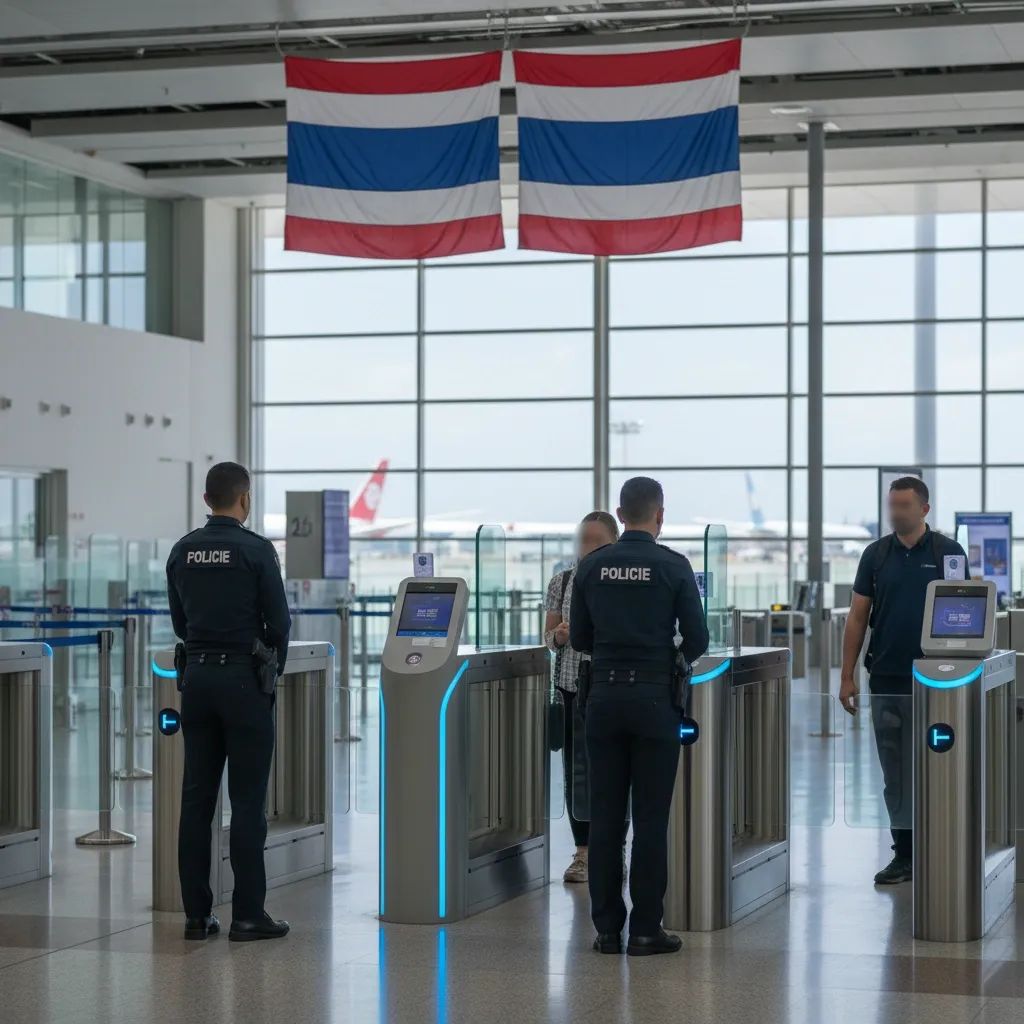
Thailand Immigration Bureau officers apprehended a 37-year-old Canadian national at Suvarnabhumi Airport on April 22 (officially announced April 23) after tracking him from Pattaya, where he had been hiding from an Interpol red notice linked to a transnational MDMA smuggling operation into South Korea. The arrest marks another case in Thailand's ongoing campaign to flush out international fugitives using coastal resort cities as safe havens.
Why This Matters
• Pattaya remains a hotspot for transnational criminals blending in among tourists, with multiple busts of scammers, drug dealers, and violent offenders in recent months.
• Biometric screening and Interpol databases are now standard at major airports, making exit routes increasingly risky for wanted individuals.
• South Korean authorities are seeking extradition for the suspect's alleged role in smuggling 20,000 MDMA tablets into Busan in 2017.
• Thailand's immigration law allows immediate deportation for individuals deemed international threats under Section 12(7) of the Immigration Act B.E. 2522.
The Arrest
On April 22, surveillance teams from the Thailand Immigration Bureau's Division 3 tracked the suspect, identified only as Mr. Wesley (full name: NG Wesley Wai Chun, a Canadian national of Hong Kong descent), as he departed his lodging in Pattaya and traveled by highway to Bangkok. Officers followed him into the international departure terminal at Suvarnabhumi Airport, where he attempted to check in for a flight to Kuala Lumpur.
No narcotics were found in his luggage or on his person during the search. However, biometric verification flagged him as a match for an Interpol red notice issued by South Korea. The notice accuses him of leading a transnational narcotics ring responsible for trafficking MDMA (commonly known as ecstasy) across borders, with a specific allegation tied to a 20,000-tablet shipment to Busan in 2017.
The operation was part of a directive from senior Thailand Royal Police leadership to identify foreign criminals masquerading as tourists. Intelligence reports had pinpointed the suspect's presence in Pattaya days earlier, prompting round-the-clock monitoring until his attempted departure.
Legal Status and Next Steps
Thailand Immigration revoked Wesley's tourist visa authorization under Section 12(7) of the Immigration Act, which permits the expulsion of individuals classified as prohibited persons or international security risks. He is currently held by immigration investigative units pending formal deportation proceedings.
South Korean authorities have been notified and are coordinating extradition protocols. Thailand maintains bilateral extradition treaties with both Canada and South Korea, enabling legal transfer of suspects in criminal cases. The deportation process will likely involve both countries, though South Korea's active warrant makes it the primary requesting jurisdiction.
Pattaya: A Recurring Problem
The coastal city of Pattaya, located roughly 150 kilometers southeast of Bangkok in Chonburi Province, has become a recurring problem for law enforcement targeting international criminals. The city's large expatriate population, affordable long-term rentals, and proximity to Bangkok's international airports make it an attractive staging ground for fugitives.
In recent months, authorities have intensified enforcement in the region, with reports indicating the dismantling of scam rings, arrest operations targeting visa irregularities, and immigration sweeps at luxury villas and residential areas. The pattern reflects broader challenges as foreign nationals of varying backgrounds—including those from Eastern Europe, Central Asia, South Asia, and Africa—are documented across multiple law enforcement operations.
Thailand Immigration has stepped up enforcement in the region, conducting hotel sweeps and coordinating with local police to identify visa overstays, illegal workers, and individuals with outstanding warrants. The Wesley case represents the agency's ability to extend surveillance beyond static checkpoints and into dynamic pursuit scenarios.
What This Means for Residents
For expatriates and long-term visitors in Thailand, this arrest underscores several realities:
Airport screening is no longer just passport control. Biometric systems now cross-reference facial scans, fingerprints, and travel history against Interpol databases in real time. Even individuals traveling on valid passports can be flagged if they match a red notice or other international alert.
Overstaying or visa violations draw scrutiny beyond fines. Immigration officers are now trained to assess whether a foreign national poses a broader security risk. Individuals deemed a threat can be detained and deported under Section 12(7), even if their primary offense is a visa irregularity.
Pattaya's reputation is attracting law enforcement attention. If you're living or traveling in the city, expect more frequent ID checks, hotel registration audits, and street-level police presence as authorities attempt to restore the area's image.
The Bigger Picture
Thailand's cooperation with Interpol and foreign law enforcement agencies has intensified in the past two years, with high-profile arrests including:
• April 10: A Swedish national and alleged Nordic mafia leader arrested in Phuket on weapons and drug-related charges.
• December 2024: A Swiss man detained under a red notice for smuggling over 2,000 methamphetamine pills into Switzerland, sourced from contacts in Thailand.
• July 2025: Two major transnational crime sweeps in Pattaya netted a Chinese fugitive and a South Korean drug broker.
These cases highlight Thailand's dual role as both a transit hub for narcotics and a hideout for individuals wanted in their home countries. The Thailand Ministry of Foreign Affairs and the Royal Thai Police have publicly committed to tighter immigration enforcement as part of broader efforts to combat organized crime and human trafficking.
For Wesley, the next steps involve deportation hearings and likely extradition to South Korea, where he faces prosecution on drug trafficking charges. His arrest serves as a reminder that Thailand's reputation as a relaxed destination no longer extends to those with outstanding warrants—airports, highways, and coastal cities are all under active surveillance.


