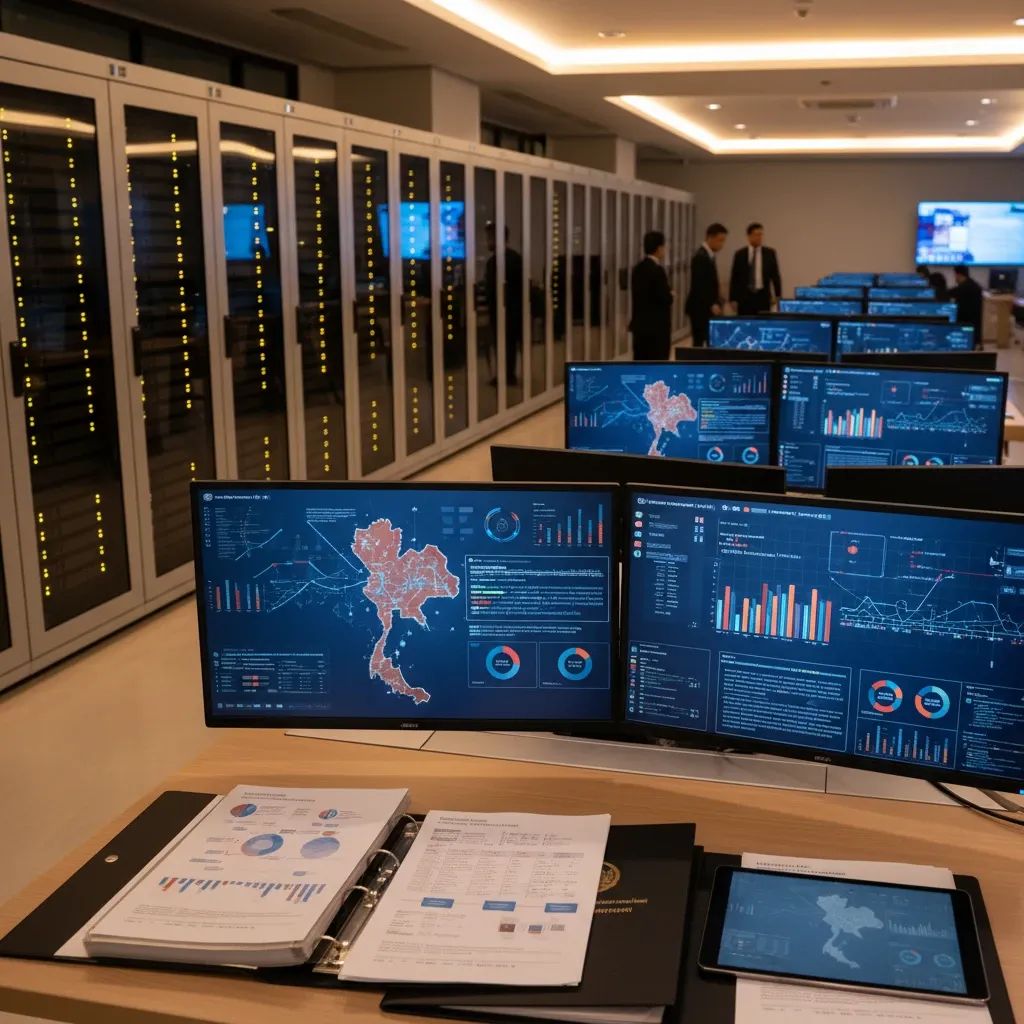
The Thailand Commerce Ministry is staring down a dual-pronged trade offensive from Washington that could stack 25% in additional tariffs on billions of dollars' worth of Thai exports—a move that would fundamentally reshape the economics of doing business between the two countries. With the July 24 expiration of temporary Section 122 measures looming, exporters and manufacturers face a new era of uncertainty as the US Trade Representative (USTR) completes two parallel Section 301 investigations that threaten to outlast any negotiated pause.
Why This Matters:
• Thailand could face 12.5% tariffs for alleged failures to control forced labor in supply chains, plus another 12.5% for structural overcapacity in manufacturing—totaling 25%.
• Critical export sectors—electronics, automotive parts, seafood, textiles, and rubber—stand to lose competitive ground in the US market.
• Unlike prior temporary measures, Section 301 tariffs have no automatic sunset clause, meaning the financial hit could persist indefinitely.
• The existing 10% tariff under Section 122 expires July 24, 2026, replaced by these far more punitive mechanisms unless Thailand secures exemptions.
The Two Investigations Driving the Threat
The current crisis stems from separate but overlapping inquiries launched by the USTR in March 2026. The first targets 60 trading partners—Thailand among them—for allegedly failing to implement or enforce prohibitions on goods produced with forced labor. A preliminary USTR assessment concluded that Thailand lacks sufficient regulatory measures to screen imports tainted by coerced labor, despite the country's stated commitments. Public hearings wrapped up in April, and the USTR proposed a 12.5% tariff on June 2. Final determinations are expected by the end of July.
The second investigation, initiated on March 11, scrutinizes 16 economies for structural excess capacity in manufacturing. Washington's argument is straightforward: these countries produce far more than they consume domestically, flooding global markets and undercutting US factories. Public hearings ran from May 5 through May 8, and the USTR aims to impose tariffs by July 24—precisely when the Section 122 reprieve expires. This investigation also carries a proposed 12.5% levy.
Combined, the two probes could double the tariff burden on Thai goods entering the United States, with no guarantee of relief. Unlike the Section 122 framework, which allowed for negotiated rollbacks and clear timelines, Section 301 tariffs can remain in place indefinitely and carry no statutory ceiling.
For exporters already navigating a labyrinth of US trade policy—including the 19% reciprocal tariff agreed under the October 2025 Framework for an Agreement on Reciprocal Trade, and the lingering 36% "Liberation Day" rate that applies to certain categories unless extended pauses hold—this represents a new tier of risk.
What This Means for Thai Exporters and Manufacturers
The sectors most exposed read like a roll call of Thailand's industrial base. Electronics and electrical equipment—including mobile phones, computers, and transformers—top the vulnerability list. These goods account for a significant share of Thai exports to the US, and a 25% tariff would effectively erase the price advantage Thai manufacturers hold over competitors in Vietnam, Indonesia, and Malaysia.
Automotive and parts face a similarly dire outlook. The concern extends beyond finished vehicles; Thailand supplies critical components to assembly plants in Mexico and Japan that serve the US market. A 25% tariff on Thai-origin parts could ripple through global supply chains, forcing automakers to source elsewhere or absorb costs that ultimately get passed to American consumers.
Seafood and processed fishery products are squarely in the forced labor investigation's crosshairs. Thailand's fishing industry has long drawn scrutiny over labor practices, and the USTR's preliminary findings suggest that enforcement remains inadequate. Textiles, rubber products, machinery, pet food, gems and jewelry, rice, personal protective equipment, and solar cells all appear on the exposure list as well.
There's also the shadow issue of circumvention: goods or raw materials originating in China that undergo minimal processing in Thailand before being re-exported as "Thai" products. Washington is acutely aware of this practice, and the Section 301 probes give the USTR broad latitude to target electrical appliances, petrochemicals, steel, aluminum, and other goods suspected of skirting China-specific tariffs. For Thai manufacturers who genuinely add value, the risk is guilt by association—being lumped in with transshipment schemes.
Thailand's Negotiating Position and Government Response
The Thailand Ministry of Commerce has not been passive. High-level talks in Washington on July 15-16 aimed to accelerate progress on the Agreement on Reciprocal Trade (ART), which builds on the October 2025 framework. Under that framework, Thailand committed to eliminating tariffs on roughly 99% of US industrial, food, and agricultural products. In return, the United States agreed to maintain a 19% reciprocal tariff on most Thai goods, with certain products eligible for zero-tariff treatment.
Thai negotiators have submitted detailed proposals and participated in public hearings for both Section 301 investigations. The government has provided clarification on production utilization rates and outlined steps taken to address forced labor concerns, including regulatory reforms and enhanced enforcement. The goal is to demonstrate sufficient progress to warrant exemptions or at least a reduced tariff rate—mirroring the strategy employed by Indonesia, which secured a 10% forced labor tariff instead of the 12.5% applied to countries with weaker controls.
Thailand is also working to narrow its trade surplus with the United States, a persistent irritant in bilateral relations. The 2026 National Trade Estimate Report, released by the USTR on March 31, flagged Thailand's market distortions and tariff barriers as contributors to the widening US goods trade deficit with Thailand in 2025.
Other Southeast Asian economies offer instructive precedents. Vietnam, facing similar Section 301 probes on forced labor, excess capacity, and intellectual property, submitted a comprehensive defense highlighting nearly 20,000 IP infringement cases handled between 2021 and 2025 and over 700 criminal prosecutions. Vietnam also secured a bilateral framework in October 2025 that set a 20% reciprocal tariff rate on most goods, with zero-tariff eligibility for select products. Indonesia finalized a landmark trade agreement in February 2026, eliminating tariff barriers on over 99% of US products and addressing non-tariff issues like local content requirements and IP enforcement. Both countries demonstrate that proactive engagement and substantive concessions can yield negotiated outcomes, though neither has yet escaped the Section 301 net entirely.
Impact on Residents and the Broader Economy
For those living in Thailand—whether expatriates, long-term residents, or Thai nationals—the stakes extend beyond export statistics. A 25% tariff wall would likely trigger factory closures, layoffs, and reduced foreign direct investment in the affected sectors. Provinces reliant on electronics manufacturing, automotive assembly, and seafood processing would face the steepest economic headwinds.
Consumer prices for imported US goods could also rise if Thailand retaliates or adjusts its own tariff schedule. The baht's exchange rate may come under pressure if export revenues decline sharply, affecting purchasing power and the cost of living in a country where many households depend on remittances from relatives working in export-driven industries.
Business owners and investors need to model multiple scenarios: a negotiated outcome that reduces or delays the tariffs, a partial exemption for certain sectors, or the worst case in which both 12.5% levies land simultaneously with no end date. Supply chain diversification, alternative market development, and compliance upgrades—particularly around forced labor documentation—are no longer optional.
What You Can Do
If you work in export-facing sectors—electronics, automotive, seafood processing, or manufacturing—now is the time to assess your employer's US market exposure. Ask management about contingency plans and consider updating your professional network. Business owners should review supply chain documentation, particularly labor compliance records, and explore alternative export markets in ASEAN, the EU, or Japan. For those planning major purchases in baht or dollars, monitor exchange rate volatility through August as tariff decisions crystallize.
What Happens Next
The immediate deadline is July 24, when Section 122 measures expire and the USTR is expected to finalize its Section 301 determinations. If no agreement is reached, Thai exporters will face the new tariff regime as early as late July. The Thailand Commerce Ministry has signaled it will continue negotiations through the end of the month, but the window is narrow.
Longer term, the Agreement on Reciprocal Trade remains the best vehicle for stabilizing bilateral relations and locking in predictable tariff rates. However, that agreement is still under review in Washington, with US officials assessing Thailand's latest proposals. Further high-level discussions are anticipated, but no firm timeline has been announced.
For now, the reality is one of elevated risk and compressed timelines. Thai exporters, manufacturers, and policymakers are navigating a trade landscape more volatile than at any point in the past decade, with the potential for 25% in cumulative tariffs reshaping competitiveness, profitability, and strategic planning across the industrial heartland.