
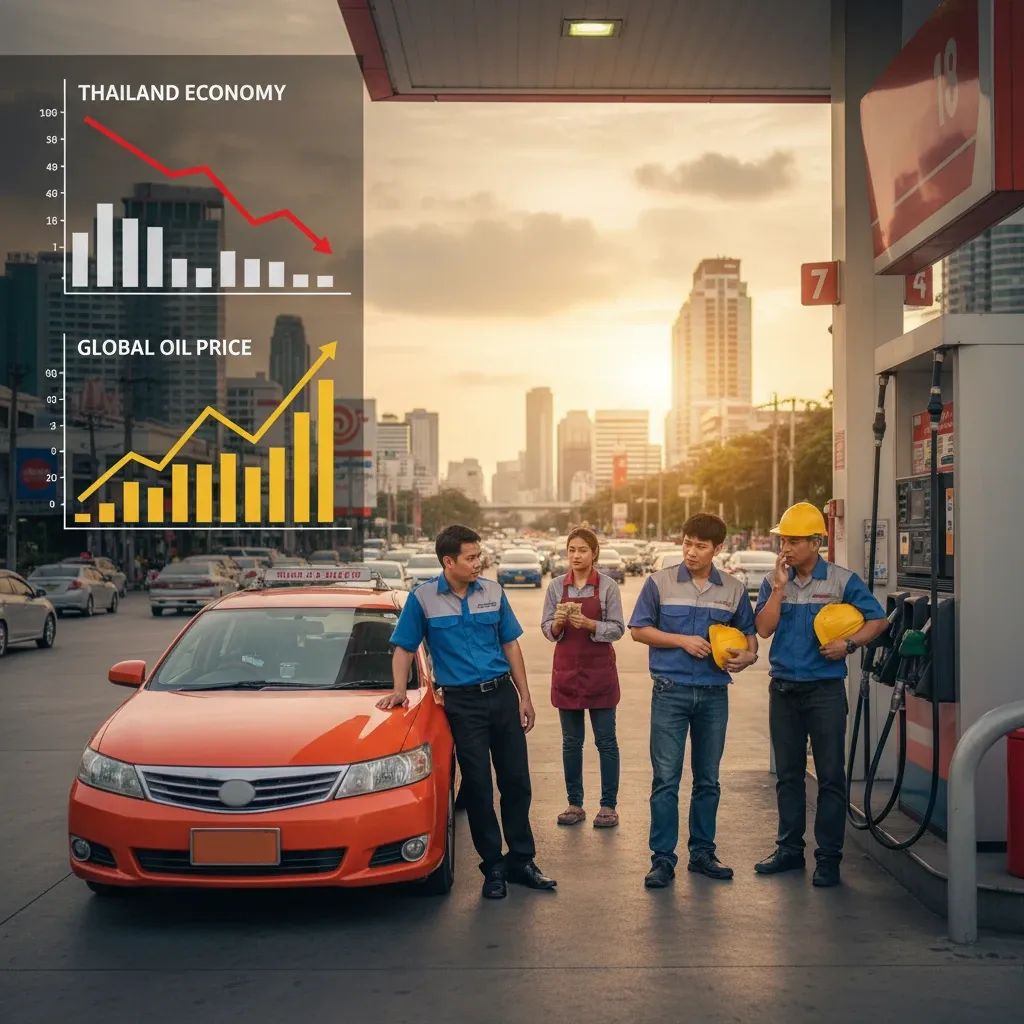
The Thailand economy faces a potential slowdown of 0.3–0.8 percentage points in GDP growth this year as Middle East military escalation disrupts global oil flows and sends energy costs soaring, according to the latest assessment from Siam Commercial Bank's Economic Intelligence Center (SCB EIC). The conflict—centered on the Strait of Hormuz, which Iran closed on February 28—has already pushed Brent crude past $100 per barrel and threatens to squeeze household budgets, industrial margins, and tourism revenues across the kingdom.
Why This Matters
• Energy dependency: Thailand imports 90% of its crude oil, roughly half of which normally transits the Strait of Hormuz. The closure has created the most severe oil-supply shock in modern history.
• Fuel and power bills: Diesel shortages have forced some Thailand petrol stations to close, and residential electricity costs are climbing as liquefied natural gas (LNG) prices surge 45%.
• Tourism hit: International arrivals dropped 8.9% in the first week of March compared to early February, with European and Middle Eastern visitors down 18% as airlines reroute and ticket prices jump 10–15%.
• Weakening baht: The Thailand baht touched a nine-month low of 33.00 per US dollar on March 19 and is forecast to weaken toward 33.50 as energy-import costs balloon.
Oil Shock Ripples Through Supply Chains
The Strait of Hormuz carries roughly 20% of global oil supply and a similar share of LNG cargoes. With Iranian forces blocking the waterway, Brent crude hit a peak of $126 per barrel and Dubai crude spiked to $166.80, levels not seen since the early 2010s. For Thailand, which relies on the Gulf for 51% of crude imports and 30% of LNG, the immediate effect is a double squeeze: scarce supply and ferocious bidding for spot cargoes.
SCB EIC estimates that if oil averages $72 per barrel as a baseline, every 10% increase shaves roughly 0.3–0.4 percentage points from GDP growth and lifts headline inflation by 0.8 percentage points. Petrochemical plants in Rayong province—including major operators like SCG Olefins—face risk of production suspensions because feedstock shipments are stuck. Paint manufacturer TOA and other downstream firms are warning of profit erosion, and freight costs have tripled on alternative routes that dodge the Gulf entirely.
The Thailand government has responded with short-term energy-conservation measures: state employees were ordered to work from home during the peak of the disruption, and officials are reviewing whether to extend the diesel price cap beyond its current ceiling to cushion households and transport operators.
Tourism Sector Takes a Direct Hit
International visitor numbers fell 8.9% in the first week of March compared with early February, according to Thailand Ministry of Tourism and Sports data. European travelers—who typically connect through Dubai and other Gulf hubs—are down 18%, as airlines cancel flights, reroute through longer corridors, and pass on surcharges. Thai Airways and competing carriers have raised ticket prices by 10–15% to cover jet-fuel premiums.
Phuket, the kingdom's signature beach destination, is bearing the brunt. The Thai Hotels Association warns that if the conflict drags on, tourism revenue losses could reach ฿29.25 billion (roughly $850 million) this year. Middle Eastern visitors, who made up a growing share of high-spending arrivals, have largely vanished as regional airspace closes and consumer confidence collapses.
What This Means for Residents
Inflation is already biting. LNG, which fuels more than 55% of Thailand's electricity generation, has jumped 45% in spot-market pricing, and the Electricity Generating Authority of Thailand (EGAT) is reviewing tariff adjustments for the second quarter. Motorists face sporadic diesel shortages—some Thailand petrol stations ran dry in early March—and the Energy Ministry is coordinating emergency stockpile releases to prevent prolonged outages.
For exporters, the disruption cuts two ways. Thailand-based petrochemical producers cannot secure naphtha and condensate feedstock, idling capacity and delaying shipments. At the same time, freight bottlenecks mean that finished goods—electronics, auto parts, plastics, rubber, rice, and cassava—struggle to reach European and Middle Eastern buyers. Analysts estimate Thailand could lose $110 million per day in export revenue if shipping lanes remain disrupted, with the hardest-hit sectors being industrial plastics (where resin prices have climbed 30%), rubber (where farmer input costs for fertilizer and fuel have jumped), and timber products destined for Gulf construction markets.
The baht weakened to 33.00 per US dollar on March 19, its softest level since mid-2025, and currency strategists expect it to test 33.50 this week. A weaker baht makes imports—especially energy—more expensive in local-currency terms, amplifying inflation. The Bank of Thailand cut its policy rate to 1.0% in early March to support growth, but Governor Sethaput Suthiwartnarueput has signaled that further easing will depend on whether inflation stays within the 1–3% target band through the second half of next year.
Scenario Planning: How Long Will This Last?
SCB EIC has modeled three scenarios. In the base case, the strait remains closed for two weeks, oil averages $75–$85 per barrel, and Thailand GDP growth slows by 0.3 percentage points. A moderate scenario assumes a four-week closure, $90–$100 oil, and a 0.5-point hit to growth. The severe case—a six-week blockade pushing Brent toward $107—would knock 0.8 percentage points off GDP and lift headline inflation to 3–5%, well above the central bank's comfort zone.
University of the Thai Chamber of Commerce (UTCC) researchers warn that a conflict lasting three months could shrink GDP by 1.1%, while a six-month war risks tipping the economy into contraction. TRIS Rating echoes that pessimism: if hostilities persist beyond mid-year, baseline growth of 2.1% could collapse to 1.0%.
The International Monetary Fund (IMF) has flagged the Hormuz closure as a stress test for the global economy, noting that 80% of Asia's oil imports pass through the strait. The US Federal Reserve Bank of Dallas estimates that a one-quarter closure would shave 2.9 percentage points off global GDP, with knock-on effects for trade-dependent economies like Thailand.
Regional Vulnerability: ASEAN in the Crosshairs
Across Southeast Asia, energy dependency is acute. The Philippines sources 95% of its crude from the Gulf, Vietnam 88%, Malaysia 69%, Thailand 59%, and Singapore 52%. Vietnam also relies on the Gulf for 49% of its gas imports. Manila has already moved state workers to a four-day week and is targeting a 20% cut in government electricity use. Malaysia has increased fuel subsidies to shield consumers from pump-price spikes.
Competition for non-Gulf LNG cargoes has turned "ferocious," in the words of one Singapore-based trader, disadvantaging ASEAN buyers who lack the long-term contracts and strategic reserves of Japan and South Korea. Spot prices for delivered LNG in Asia have doubled since late February, and Thailand is competing with the Philippines, Vietnam, and Pakistan for a shrinking pool of available molecules.
Government Response and Outlook
The Thailand Cabinet is weighing a package of relief measures, including extended diesel-price caps, electricity-tariff freezes for low-income households, and accelerated disbursement of tourism-promotion funds to offset the visitor slump. The Ministry of Energy is also exploring whether to tap the kingdom's 90-day strategic petroleum reserve if shortages worsen, though officials acknowledge that reserve stocks cannot replace sustained supply disruptions.
Currency intervention remains on the table. The Bank of Thailand has said it will monitor baht volatility "closely" and stands ready to smooth "excessive" swings, though it stopped short of announcing direct market operations. The baht traded in a 32.10–33.06 range during the week of March 17–23, reflecting headline-driven swings as ceasefire rumors alternated with reports of renewed strikes.
For now, the central bank is betting that inflation pressures will prove transitory—provided the conflict does not drag into the second half of the year. If oil retreats toward $80 and shipping lanes reopen by May, Thailand can still achieve 2.5–2.7% growth in 2026, officials say. But if the war grinds on, the kingdom faces a stagflationary squeeze: rising prices, falling output, and a tourism sector starved of visitors.
Residents should brace for higher utility bills, fuel-pump sticker shock, and potential rolling shortages if LNG cargoes remain scarce. Businesses with exposure to petrochemical feedstock or Gulf export markets are already re-routing supply chains and locking in hedges, and the Thailand Board of Trade is urging members to diversify suppliers and explore alternative shipping corridors through the Cape of Good Hope and Suez Canal—though both add days to transit times and hundreds of thousands of dollars in freight.
The next few weeks will prove decisive. If diplomacy opens the strait, energy markets can begin to normalize and Thailand's economic managers can breathe easier. If not, the kingdom's 2026 growth story—already hobbled by weak domestic consumption and sluggish private investment—faces a sharp downgrade.


