
A Careless Joke Costs a Chon Buri Couple Dearly—and Paralyzes an Entire Flight
The Air Navigation Offenses Act makes no exceptions for humor. When a 45-year-old passenger from Chon Buri casually remarked "Beware of a bomb" while hoisting his carry-on into an overhead bin aboard Thai AirAsia flight FD4401 on April 26, he triggered a four-hour operational shutdown at Krabi International Airport and set himself and his traveling companion on a collision course with criminal prosecution that could land them each in prison for half a decade.
Why This Matters
• Criminal Jeopardy: Any reference to explosives aboard an aircraft—treated as a genuine threat regardless of intent—carries mandatory prosecution under Thailand's Air Navigation Offenses Act B.E. 2558 (2015) (Buddhist Era 2558, equivalent to 2015 CE), with penalties reaching 5 years imprisonment and fines up to 200,000 baht—equivalent to roughly a month's rent in central Bangkok.
• Operational Chaos: The incident tied up an Airbus A320 for over four hours, forced the evacuation of dozens of passengers, mobilized the Explosive Ordnance Disposal unit, and consumed critical airport resources—all based on a comment the accused now insists was merely a running joke among friends.
• Airline Liability Exposure: Thai AirAsia filed a formal complaint with Nuea Khlong Police Station, signaling the carrier's intent to pursue civil damages for operational losses, crew overtime, passenger rebooking, and reputational harm.
What Triggered the Lockdown
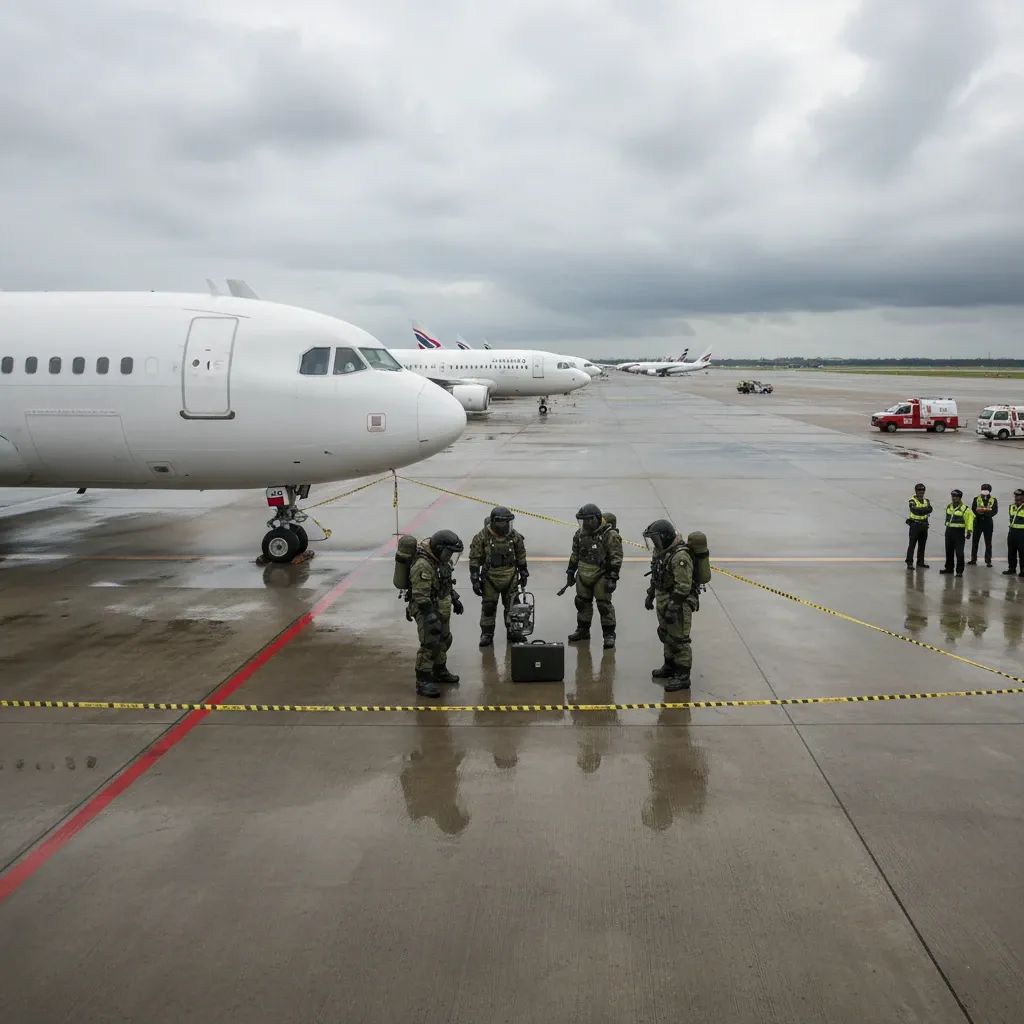
The sequence of events unfolded with the choreography of a standard emergency protocol. The male passenger made his remark while stuffing a bag into an overhead compartment. A flight attendant immediately escalated the comment to the captain, who treated it as a genuine security threat and ordered the aircraft back to its parking position. Within minutes, all passengers were evacuated onto the tarmac, and every piece of luggage was offloaded.
The couple, aged 46 and 43, insisted they were joking—a phrase the man claimed was part of their ordinary banter with acquaintances. It was a misreading of the moment, one that Thailand's aviation security apparatus, by design, cannot afford to make.
The Machinery of Threat Response
Krabi Provincial Police coordinated a response that involved the Explosive Ordnance Disposal unit and stretched past 9 PM. Every bag was inspected. The aircraft underwent a methodical sweep. No explosives surfaced. No suspicious materials emerged. The inspection consumed more than 4 hours and 15 minutes, leaving the flight significantly delayed and dozens of passengers scrambling to explain their tardiness to colleagues, clients, or family members expecting them in Suvarnabhumi.
Pol Maj Gen Sukkasem Nakhonwilai, Krabi's police chief, confirmed that both individuals faced charges under the Air Navigation Offenses Act—specifically for making a false statement causing fear, affecting flight safety, and causing damage to the airline and passengers. These are not minor infractions. They carry teeth.
The Legal Framework That Leaves No Room for Intent
Thailand's aviation security laws operate on a principle of absolute strictness: any bomb-related communication aboard an aircraft is prosecuted as a serious offense, full stop. The Air Navigation Offenses Act B.E. 2558 (2015) explicitly criminalizes the transmission of false information that causes alarm, with penalties including up to 5 years imprisonment, fines up to 200,000 baht, or both.
Deputy Transport Minister Phatraphong Phatprasit made the government's stance unmistakable in the wake of the incident. He reinforced that any actions creating panic—whether intentional or joking—are criminal, and that officials would pursue prosecution to its fullest extent. The message reflects a policy calculation: in aviation, the cost of overlooking even a single threat is deemed unacceptable, which justifies treating every threat—real or fabricated—as genuine.
Impact on Residents and Frequent Fliers
For anyone regularly traveling through Thailand's airports, the Krabi incident reinforces a hard lesson: aviation security laws prioritize operational safety over context or humor. Even offhand remarks, attempted pranks, or comments made under stress can trigger immediate detention and criminal charges. Those flying domestically—or internationally from Thailand—face a practical imperative: think before you speak to airline staff, avoid any language that could be misinterpreted as threatening, and understand that a joke is not a legal defense.
The couple now confronts years of legal proceedings, potential imprisonment, permanent criminal records that may affect visa applications, future employment, and international travel. They also face civil liability from the airline, which has already registered its intent to seek damages. The price of a poorly timed quip has escalated dramatically.
Aviation Security in Thailand: Context and Zero-Tolerance Standards
The Krabi incident sits within a broader security landscape that has tested Thai airports over recent years. While genuine terrorism-related threats remain relatively rare, Thailand's aviation authority has maintained a zero-tolerance approach to any bomb-related communications, regardless of intent or context. This is distinct from actual security breaches or terrorist plots, which are handled through separate investigative and prosecution channels. The distinction matters for residents and frequent fliers: a joke about explosives triggers automatic criminal prosecution under the Air Navigation Offenses Act, while credible threats prompt both law enforcement and counter-terrorism protocols.
Thai airports—particularly Suvarnabhumi and Don Mueang—remain among the world's safest hubs. Enhanced security measures, including increased patrols, stricter baggage inspections, and rapid-response protocols, are deployed routinely during peak travel periods and following identified threats.
A System Built for Zero Tolerance
The Krabi incident demonstrates the operational and legal infrastructure Thailand has assembled around aviation security. When a threat is reported—whether credible or not—the system responds with mechanical efficiency: ground the aircraft, evacuate passengers, deploy specialists, inspect every item, investigate the source, and prosecute to the maximum extent permissible under law. This approach has costs: operational delays, passenger frustration, and the occasional prosecution of someone whose intent was harmless.
Yet from the perspective of Thailand's aviation authority, the alternative—dismissing bomb-related remarks as jokes and investigating later—carries an unacceptable risk. The couple from Chon Buri learned this lesson in real time, discovering that Thailand's commitment to aviation safety admits no exceptions for context, humor, or claims that the remark was misunderstood.


