
Why This Matters
• Prosecution teeth have sharpened: Anyone caught deliberately burning forest now faces 4–20 years imprisonment and fines up to ฿2 million with zero leniency—a decisive shift from seasonal warnings.
• Criminal arson is escalating: Chiang Mai Province enforcement netted 43 arrests in a single coordinated sweep, while illegal miners in Kanchanaburi weaponize fire as tactical escape routes during mining operations.
• Air quality is deteriorating by design: Over 800 hotspots detected in a single national park in April alone, directly caused by deliberate arson rather than accidental agricultural burning—making prevention efforts feel futile.
The Northern Crackdown: Chiang Mai's Aggressive Enforcement Campaign
Chiang Mai Province initiated a coordinated enforcement campaign that reflects larger strategic directives from Bangkok aimed at saturating fire-prone regions with law enforcement presence.
Between early April and April 22, 2026, Chiang Mai authorities arrested 43 individuals for violations spanning forest encroachment, illegal logging, and deliberate burning. This figure represents part of a broader 17-province northern sweep that detained 192 suspects during the identical reporting window—suggesting coordinated policy direction responding to escalating fire incidents.
The Chiang Mai arrests reveal patterns distinct from mining-driven arson but equally concerning. On April 18, officers in Wiang Haeng District apprehended a suspect who ignited vegetation intended for agricultural clearing. The flames spread beyond control into Pha Daeng National Park, crossing from manageable land preparation into prohibited territory. The individual admitted burning without regard for provincial no-burn orders—a violation that triggered investigation and prosecution.
More troubling was an April 3 arrest in Chiang Dao District, where rangers caught someone entering restricted forest carrying firearm-related equipment. Upon questioning, the suspect disclosed intentions to set animal traps and distribute narcotics—revealing how forest violations frequently cluster with broader criminal activity. This suggests coordination with larger criminal networks rather than isolated incidents driven solely by economic desperation.
An earlier March 9 incident in Doi Tao District involved a 39-year-old arrested near Doi Tao Reservoir after setting fire in restricted forest. Investigative details remain limited in public filings, but the cumulative pattern suggests fires in Chiang Mai span both deliberate arson and recklessness-born accidents that gain severity during periods of acute forest stress.
Parallel Crisis in the West: Kanchanaburi Mining Operations
Meanwhile, in western Thailand, a distinct but equally serious crisis unfolds. In Kanchanaburi, illegal miners have discovered that fire serves as a tactical weapon in their confrontation with environmental enforcement.
The Thailand Department of National Parks, Wildlife and Plant Conservation confronts a situation where fire has become strategically deployed by organized networks operating in protected zones. In the western reaches of Kanchanaburi, miners digging for gold without permits have discovered that flames accomplish tactical advantages that force rangers to redirect critical resources. When a fire erupts in rugged mountainous terrain, authorities must redirect helicopter support, ground crews, and personnel toward suppression rather than apprehension. In that operational window—sometimes just minutes—suspects escape with their extraction equipment and ore.
The director of the 3rd Conservation Area Administration Office, Rachan Buasri, documented the scale as of April 22, 2026: over 800 thermal signatures across Thong Pha Phum National Park alone, with substantive evidence linking many directly to mining operations. Park Chief Yutthapong Dumsrisuk reported that confrontations have escalated beyond arson. Miners have reportedly fired weapons at rangers during escape attempts, transforming encounters from law enforcement into armed conflict scenarios that require tactical reassessment.
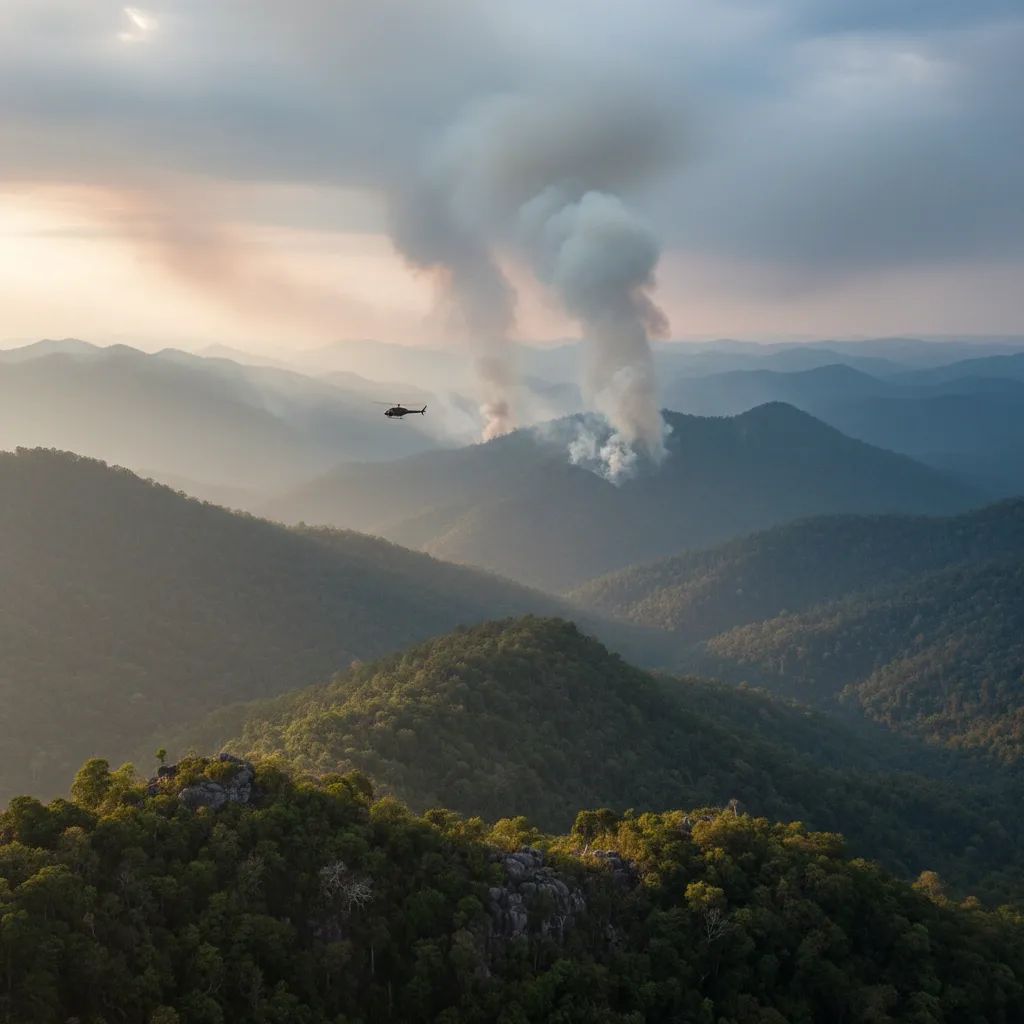
The fires have begun spilling into neighboring Khao Laem National Park, expanding destruction beyond any single agency's containment capacity. Helicopters equipped with water-dropping systems now operate routine missions, but the mountainous geography—with elevations exceeding 1,500 meters where aerial drops lose effectiveness—means ground crews remain the primary defense. Ground crews that the fires themselves create tactical pressure to overwhelm.
According to Kanchanaburi enforcement records, approximately 11 arson arrests have been made against an estimated 50 or more active mining teams operating in protected zones, suggesting that identification and successful prosecution remain procedurally difficult relative to the scale of the problem. Each investigation requires rangers to pursue suspects through terrain the miners know intimately, and apprehension typically occurs only when suspects are caught in the act of excavation or when incriminating equipment is discovered.
Financial Incentives That Drive Persistent Violation
Apprehended miners frequently cite financial desperation as primary motive. Skilled extraction can yield ฿5,000 to ฿15,000 daily—equivalent to 3–8 weeks of unskilled wage-labor income in rural Kanchanaburi. The economic calculus is straightforward: the risk of prosecution must compete against earning potential that dramatically exceeds legitimate alternatives available to workers in economically marginal areas.
The result is a system where enforcement intensity has demonstrably increased but where the underlying criminal incentive structure remains sufficiently attractive that new prospectors continue entering protected zones despite clear escalation of enforcement activity and explicit threats of arson charges carrying 4–20 year sentences.
Environmental Consequences That Extend Beyond Immediate Flames
Forest fires triggered by deliberate arson destroy far more than timber and forest floor vegetation. The immediate blaze consumes immediate habitat, but cascading secondary damage unfolds across years.
Mercury and cyanide used in artisanal extraction contaminate water sources, poisoning aquatic ecosystems and downstream communities reliant on those waterways. Arson accelerates this contamination cycle by destabilizing soil normally capable of filtering runoff. Erosion increases. Sedimentation chokes waterways. Tropical forest regeneration timelines can exceed 15 years—or fail entirely if fires recur before recovery stabilizes.
Wildlife populations already stressed by habitat fragmentation suffer compounded losses from deliberate burning. Nesting sites are destroyed in single events. Seed dispersal patterns sustain disruption across multiple seasons. Apex predators lose prey populations that required years to establish. For rare species like Asian elephants and sun bears—both inhabitants of western protected areas—fire-driven habitat loss represents an existential pressure that compounds poaching and land conversion threats.
The atmospheric dimension extends beyond regional air pollution. Burning biomass releases stored carbon, methane, and volatile organic compounds into the lower atmosphere. For a nation already grappling with seasonal air quality crises, fires triggered by deliberate criminal activity represent an entirely preventable source of haze that exacerbates conditions caused by agricultural burning and cross-border transport emissions.
What This Means for Residents Living in Fire-Prone Zones
The enforcement environment has shifted decisively for anyone with property or livelihood interests in northern or western provinces. The Thailand Royal Police and Ministry of Interior have signaled that prosecution will be aggressive, consequences severe, and ignorance an inadequate defense.
Legal Obligations for Property Owners:Agricultural landowners face acute legal jeopardy. Burning vegetation—even on private property—creates criminal exposure if flames cross into protected areas. The Forest Protection Act imposes 4–20 years imprisonment and fines between ฿400,000 and ฿2 million, with no possibility of suspended sentences. A farmer with moderate landholdings risks losing a decade of income and personal liberty for a single miscalculation during fire season. The Thailand Department of National Parks operates approximately 3,000 surveillance checkpoints nationwide during fire season, with 24-hour operations rooms in high-risk zones maintaining real-time monitoring.
Reporting Suspected Arson:Residents who observe suspicious burning activity or unauthorized mining operations can report suspected arson through several channels: (1) Contact the Department of National Parks Wildlife and Plant Conservation hotline at 1362 to report illegal activity; (2) Reach the local provincial police command in your jurisdiction; (3) Alert rangers at nearby national parks directly. Specific details including location, time, and visible activities strengthen investigations.
Real-Time Air Quality and Fire Alerts:Residents should monitor air quality and fire activity through: (1) Thailand's Air Quality and Index (AQI) website maintained by the Pollution Control Department at www.aqicn.org/thailand; (2) The "Thai Air Aware" mobile application providing hourly PM2.5 updates; (3) The Department of Disaster Prevention and Mitigation website featuring real-time fire hotspot maps updated daily during fire season; (4) Local provincial administrative office announcements regarding burn bans and fire season restrictions.
Property Valuations and Real Estate Implications:Property valuations in northern provinces experience seasonal air quality fluctuations that suppress purchase prices and rental demand during March and April. Real estate agents openly reference the "haze season discount" when discussing valuations during peak fire months.
Tourism and Business Operations:Tourism operations face cascading cancellations when air quality indices deteriorate. Hotel bookings decline up to 40% during peak haze weeks. This extends to trekking operators, elephant camps, and discretionary outdoor activities—all revenue-dependent on air quality perceptions and actual breathing conditions.
Healthcare and Insurance Considerations:Healthcare expenses rise acutely for residents with asthma, COPD, or cardiovascular conditions. Some expatriates temporarily relocate to coastal provinces during fire season. Medical insurance frequently excludes or limits coverage for pollution-related conditions, creating out-of-pocket financial exposure for affected residents.
Vulnerable Populations Face Compounding Health Risks
Air quality degradation from deliberate arson carries direct physiological consequences, particularly for populations with limited physiological resilience.
Pregnant women exposed to elevated PM2.5 levels during second and third trimesters show statistically significant increases in gestational diabetes, preeclampsia, and preterm labor, according to international public health research. Infants exposed in utero demonstrate measurable reductions in birth weight and post-natal cognitive performance. These associations persist when controlling for confounding risk factors.
Infants and young children remain at heightened risk because their respiratory and immune systems remain developmentally incomplete. Asthma incidence increases. Respiratory infections occur with greater frequency and severity. Some pediatricians recommend families with young children temporarily relocate during peak haze weeks as a harm-reduction strategy.
For elderly residents and those with pre-existing cardiovascular or pulmonary disease, the relationship between air quality and health outcomes is more direct and measurable. Airborne particulates penetrate deep lung tissue and translocate into the bloodstream. According to research conducted by Thai academic institutions and international public health organizations, each 10-microgram-per-cubic-meter increase in PM2.5 correlates with measurable increases in hospital admissions and all-cause mortality among populations exceeding 65 years. The elderly population in northern Thailand experiences this dynamic acutely during late March and early April fire season peaks.
The National Trajectory: Improvement Shadowed by Emerging Threats
Nationwide statistics reveal genuine progress alongside emerging vulnerabilities. The Thailand Department of National Parks, Wildlife and Plant Conservation reported 23,479 hotspots as of February 21, 2026—a significant 69% reduction compared to the identical date in 2025, reflecting years of accumulated prevention effort and progressively stricter enforcement protocols.
Of these hotspots, approximately 40% occurred within protected forest zones while 60% originated outside conservation areas, typically from agricultural burning that escapes control. This distribution suggests that much of Thailand's fire burden derives from farming operations rather than deliberate arson or mining-related incendiarism, though the latter generates disproportionate attention.
The year-over-year improvement reflects outcomes from fuel management programs, stricter enforcement regimes, community engagement initiatives, and technology deployment including drone surveillance and satellite monitoring. However, regional variation remains pronounced. Chiang Mai and Kanchanaburi continue experiencing acute fire pressure due to convergence of agricultural burning by farmers, illegal logging operations, and now deliberate arson by miners employing fire as tactical evasion.
The progress achieved across Thailand is demonstrably real—but increasingly fragile as emergent criminal tactics adapt to enforcement escalation.
Operational Response: From Reactive Firefighting to Preventive Integration
Thailand's Department of National Parks has evolved beyond passive firefighting toward integrated prevention and tactical coordination.
The agency has organized 14 forest cluster zones where park rangers coordinate seamlessly with forestry officials, local administrators, and military units. Fuel management occurs during pre-fire-season windows—trimming undergrowth, removing dead wood, establishing firebreaks that create buffer zones between forest and human activity zones.
Surveillance checkpoints numbering over 3,000 nationwide maintain 24-hour operations in high-risk areas. Helicopters equipped with water-dropping capabilities respond to blazes in terrain inaccessible to ground crews. Drones survey terrain and identify hotspots before they achieve uncontrollable scale. Community members hired as checkpoint watchers—three per location—create distributed intelligence networks while generating employment income in economically constrained rural areas.
The government actively promotes alternative income streams to reduce farmer reliance on burning. Biochar production initiatives and composting technologies enable agricultural waste conversion into saleable products generating revenue. The "Wet Firebreak" technique—creating moisture-rich buffer zones around vulnerable forests—has gained traction in northern districts, particularly in Chiang Mai.
Community surveillance networks operate alongside enforcement infrastructure, with local residents incentivized and trained to report suspected illegal activity to rangers. The approach balances enforcement intensity with economic engagement, though academic observers argue that grassroots solutions receive insufficient budgetary allocation relative to enforcement-heavy approaches.
The Uncertain Calculus Ahead
Whether current enforcement intensification will reverse the arson trend remains genuinely uncertain. The financial incentives driving illegal mining persist structurally. The environmental consequences of deliberate burning remain severe and cascading. Health impacts on vulnerable populations continue accumulating without clear trajectory toward mitigation.
For residents living in Thailand's fire-prone regions, the immediate practical reality is unambiguous: forest fire season now operates as an integrated enforcement environment with severe legal consequences, direct health implications, and property-value effects that demand immediate attention. The era when agricultural burning could be dismissed as a seasonal inconvenience has conclusively passed. What was once purely an environmental issue has become simultaneously a law enforcement crisis and public health emergency.
Whether the system designed to address these threats will succeed—or whether criminal ingenuity and economic desperation will simply evolve into new tactical approaches—will define one of Thailand's most consequential environmental battles across the coming years.


