
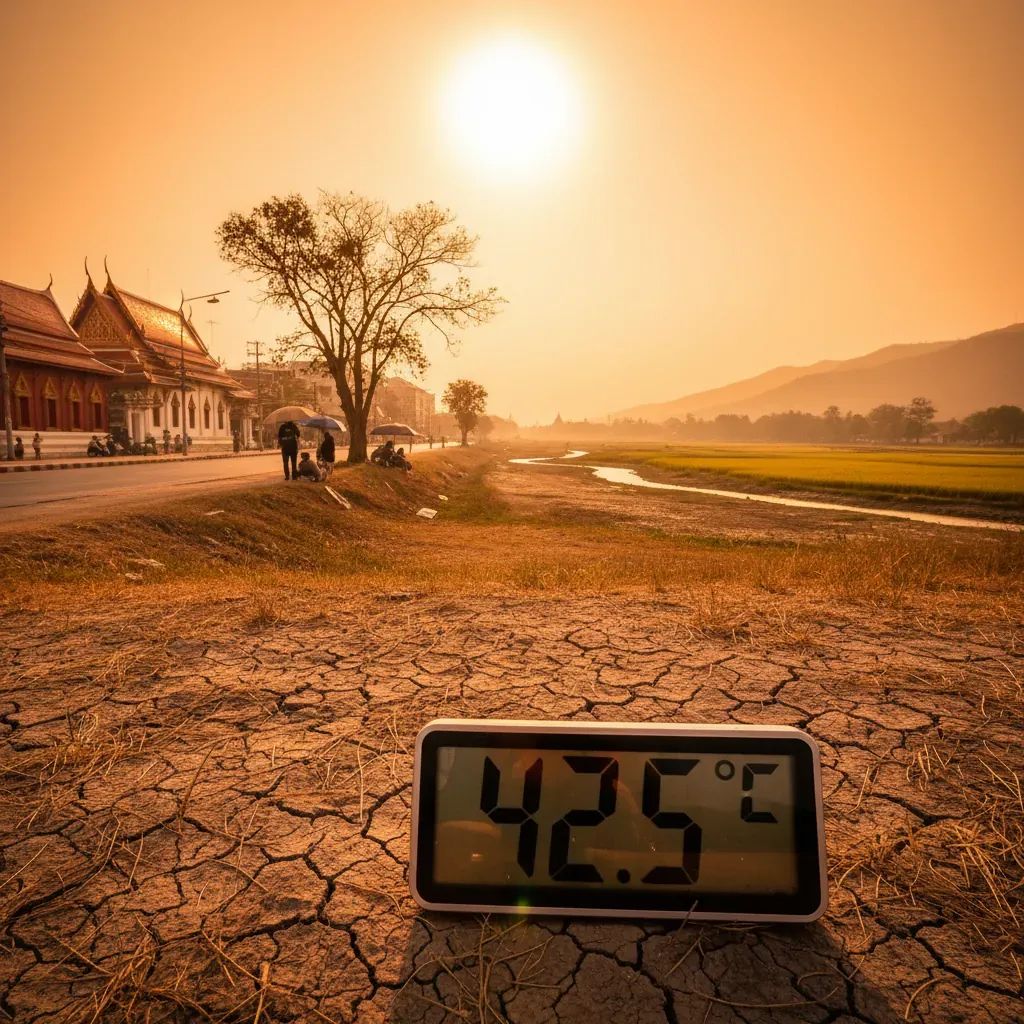
The Thailand Meteorological Department has issued a nationwide alert as the country enters a critical 10-day window where thermometers will climb into the low 40s Celsius, with the subjective sensation—what meteorologists call the heat index—potentially reaching 60°C in urban areas. For residents of Bangkok and its surroundings, this means the city will feel as if it's hovering near the physiological threshold where human bodies begin to malfunction in measurable ways.
Why This Matters
• Heat index, not just temperature: Bangkok's actual air temperature of 37-40°C becomes a body-felt 52°C when humidity is factored in—the threshold between "dangerous" and "extremely dangerous" according to meteorological standards.
• Festival timing crisis: Songkran (April 13-15) arrives precisely when outdoor heat stress peaks, creating a collision between celebratory water activities and genuine medical risk.
• Water scarcity compounding heat: Rainfall running 30-40% below seasonal normal means less evaporative cooling from vegetation and soil, while agricultural irrigation demands intensify competition for scarce supplies.
The Heat Index: Why Raw Temperature Numbers Mislead
When meteorologists talk about 60°C heat index versus 40°C thermometer readings, they're not inflating numbers for drama—they're describing two different physical realities. At 40°C with 60% humidity, the human body's primary cooling mechanism, evaporative sweating, becomes radically less efficient. Sweat doesn't evaporate readily when air is already saturated with moisture. Instead of cooling effectively, the body retains heat while losing crucial salts and fluids. The brain registers this as approximately 60°C of internal stress, even though the thermometer reads 40°C.
Understanding the Clinical Distinction
This distinction matters clinically. Emergency room physicians use heat index thresholds to trigger triage protocols and resource allocation, not thermometer readings. A patient presenting with confusion and a body temperature of 39°C during a heat index event is treated differently than the same patient on a cool, dry day—the underlying cause demands different intervention.
The Bangkok Metropolitan Administration's decision to issue a "red alert" wasn't precipitated by 40°C alone. It was triggered by the convergence: 40°C thermometer readings combined with humidity levels that push the heat index past 52°C, affecting a city of 10 million people with unequal access to air conditioning. For the 30% of Bangkok residents living in informal settlements or shared housing without mechanical cooling, the distinction between thermometer and heat index isn't academic—it's the difference between discomfort and medical emergency.
Regional Intensity Map: Where Conditions Peak
The North
The North—provinces like Mae Hong Son, Chiang Mai, and Chiang Rai—faces the most severe absolute temperatures, with forecasts suggesting 42-43°C in isolated areas. Yet the North's challenge is compounded by humidity patterns that often fall lower than in Bangkok, meaning residents there experience somewhat lower heat indices despite higher thermometer readings. The trade-off: the North also confronts isolated thunderstorms affecting 10% of the region, delivering gusty winds that shift environmental conditions within hours.
The Northeast
The Northeast, spanning provinces from Udon Thani to Nakhon Ratchasima, experiences a slower heat accumulation due to lower elevation and relatively open terrain, but temperatures reach 39-42°C with less-variable humidity. This means sustained heat index levels in the "extremely dangerous" range for longer periods without the violent weather relief that northern provinces occasionally receive.
Central Thailand
Central Thailand—including Bangkok, Nakhon Pathom, Nonthaburi, and Samut Prakan—represents the urban heat island effect at scale. Dense concrete, limited green cover, and concentrated human activity (generating vehicles, air conditioning exhaust, industrial operations) trap solar radiation. Thermometer readings of 37-40°C translate into functional heat indices exceeding 52°C, and street-level microclimates in business districts, informal markets, and transport hubs often run 2-3°C hotter than official weather station readings.
The South
The South, both coastal zones, records slightly lower maximum temperatures (34-38°C) but remains oppressive due to the marine boundary layer's influence on humidity. Seas remain relatively calm (1-meter waves baseline), though thunderstorms affecting 10-20% of southern provinces will generate temporary hazards for vessels and sudden wind shifts.
Who's at Genuine Medical Risk
The Thailand Ministry of Public Health categorizes high-risk populations: outdoor workers (construction crews, agricultural laborers, street vendors, delivery personnel), the elderly (cardiovascular efficiency declines with age, reducing heat tolerance), young children (thermoregulation mechanisms remain underdeveloped), pregnant women (metabolic heat production rises and heat dissipation efficiency decreases), individuals with chronic conditions (heart disease, hypertension, diabetes, respiratory ailments), and obese individuals (subcutaneous fat insulates against heat loss).
Outdoor Workers Face Escalating Danger
For outdoor workers specifically, the danger escalates beyond what desk-bound residents face. A construction worker in Bangkok working from 8 AM to 4 PM experiences cumulative heat exposure averaging 6+ hours. Even with hydration, core body temperature rises progressively. By 2 PM, when ambient heat index approaches 55-60°C, dehydration has already compromised cardiovascular function. The worker's blood volume decreases, reducing the heart's ability to pump cooling blood to skin surfaces. Cognitive function deteriorates—decision-making slows, accident risk multiplies. A momentary lapse in concentration around power tools or heavy machinery becomes lethal.
Hospital Preparation and Secondary Health Concerns
Hospitals across Bangkok have been instructed to staff emergency departments with additional personnel through the extended heat period. The Department of Health anticipates not only heat-related cases but a secondary cascade: acute diarrheal illnesses, urinary tract infections, and skin infections accelerate in hot, humid environments. Pathogenic bacteria multiply faster in temperatures above 35°C. Food storage without reliable refrigeration becomes hazardous. Water supplies contaminate more readily. The Communicable Disease Center is monitoring hotspot regions where both heat and poor sanitation overlap.
Practical Daily Navigation
Residents should restructure daily routines around thermal reality. Errands, exercise, and outdoor commitments belong to early morning (before 9 AM) or evening (after 6 PM). The 11 AM to 3 PM window should be treated as a mandatory indoor period. This sounds like hyperbole until you consider that emergency room admissions for heat exhaustion spike between 2-4 PM, indicating that people are, in fact, becoming incapacitated during precisely these hours.
Hydration Strategy
Hydration requires intentionality. Thirst is not a reliable indicator under sustained heat—by the time thirst registers, dehydration has already begun affecting cognition and temperature regulation. The recommendation of 6-8 glasses daily is a minimum baseline; those in outdoor environments should drink 10-12 glasses. Sports drinks containing electrolytes outperform plain water for sustained outdoor exposure, as they replace sodium losses that plain water cannot. Alcohol, caffeine, and sugary drinks accelerate dehydration and should be minimized or eliminated during heat episodes.
Clothing and Sun Protection
Clothing should be loose-fitting, light-colored (reflecting solar radiation rather than absorbing it), and made from breathable natural fabrics like cotton or linen. Tight synthetic clothing traps humidity and blocks evaporative cooling. Sunscreen with SPF 50+ prevents solar burn, which impairs the skin's ability to radiate heat.
Medication Considerations
For those with chronic illnesses—particularly heart disease and hypertension—medication efficacy can shift during heat stress. Blood pressure medications may require dosage adjustment as heat causes peripheral vasodilation. Diabetic medications may need modification as heat affects insulin absorption and activity. Individuals should contact their physicians before the heat peak to discuss whether medication adjustments are warranted.
Songkran in a Heat Crisis
The Songkran Festival, traditionally celebrated April 13-15, involves outdoor water splashing and public gathering. The irony is acute: a festival designed to cool and cleanse arrives during the year's most dangerous thermal window. Authorities are not canceling Songkran—it's too central to Thai culture—but they're urging modified participation. Water activities do provide temporary relief, but attendees often overexert in heat while celebrating, then return to outdoor heat immediately after cooling activities end.
Strategic Festival Participation
The recommendation is strategic participation: engage in water activities during cooler morning and evening hours rather than midday peak heat. For those visiting Thailand specifically for Songkran, prioritize cooler zones: northern mountain regions like Chiang Mai (roughly 5°C cooler than Bangkok due to elevation), or plan afternoon activities in heavily air-conditioned venues like shopping malls, museums, and hotels. The Grand Palace and other iconic outdoor landmarks are inadvisable for afternoon exploration—a two-hour visit between 1-3 PM creates dangerous cumulative heat exposure.
Bangkok's Emergency Infrastructure
The Bangkok Metropolitan Administration has operationalized 379 identified cooling centers across districts where residents can access air conditioning, drinking water, and first-aid services from 11 AM to 4 PM. These centers function as both refuge and triage points. If you experience dizziness, rapid heartbeat, or mental confusion outdoors, locating the nearest cooling center becomes a priority. District offices maintain posted lists; Thai-language government websites (bma.go.th) and call centers provide locations.
Heat-Health Warning System
Behind the scenes, a Heat-Health Warning System runs continuously. The Thailand Meteorological Department feeds real-time heat index forecasts to the Department of Health, which categorizes warnings into four levels: green (normal), yellow (caution), orange (alert), and red (emergency). Each level triggers specific protocols. At the red alert level, hospitals activate surge staffing, outdoor work events are rescheduled, and public health announcements escalate in frequency and directness.
Hospital Capacity and Ambulance Services
Emergency room capacity is being expanded. Additional staff are being trained in heat exhaustion and heatstroke treatment. Supplies of cooling blankets, electrolyte solutions, and monitoring equipment are being stockpiled. The National Ambulance System is aware that response times may increase if localized power outages reduce traffic light functionality or if hospital access is congested with patients.
The Climate Context: Warming Into Uncharted Territory
Thailand's all-time temperature record of 45.4°C, set in Tak in April 2023, existed as a benchmark of "worst-case scenario." Scientific analysis of that 2023 event concluded such extreme heat would have been statistically "virtually impossible" without human-induced climate change. The 2023 event was a one-in-300-year occurrence under pre-industrial climate conditions; with current warming, it's a one-in-50-year event. By 2050, such extremes become one-in-10-year occurrences.
This Year's Extreme Conditions
Current forecasts showing temperatures of 40-43°C in peak regions don't surpass the 2023 absolute record, but the heat index readings pushing toward 60°C enter territory that tests human physiological limits more severely. Humidity amplifies impact. A person can survive 45°C in the Sahara Desert (low humidity, efficient evaporative cooling). At 45°C with 70% humidity, survival duration drops dramatically because the body can't cool itself adequately.
Environmental and Air Quality Concerns
The rainfall deficit—30-40% below seasonal normal through mid-May—means less moisture in soil and vegetation. This reduces evaporative cooling from the landscape. Urban areas without sufficient green space absorb and retain more solar radiation. Agricultural regions face water stress for irrigation, elevating food security concerns. Wildfire risk increases in forested areas of the North and Northeast.
Additionally, hazy conditions from seasonal agricultural burning and poor air circulation mean PM2.5 pollution levels in the North, Northeast, and upper Central regions exceed safe thresholds. Residents in these areas should wear N95 masks during outdoor exposure. The masks add thermal stress—they trap warm exhaled air close to the face—so their use requires strategic timing: wear them during necessary outdoor exposure, remove them indoors or in shaded areas.
The Transition Period Ahead
Mid-April through early May won't bring straightforward relief. Instead, the monsoon system will begin to influence weather patterns, creating unpredictability. Expect days of extreme heat followed by sudden afternoon thunderstorms, then return to heat. This weather volatility demands sustained vigilance rather than assuming conditions will improve linearly. A day that begins at 42°C might see a thunderstorm arrive by 3 PM, dropping temperatures and visibility, creating different hazards (lightning, flash flooding in low-lying areas, slick road conditions).
Agricultural Considerations During Transition
The transition period also coincides with the start of the agricultural planting season in some regions. Farmers are managing the collision between heat stress, water scarcity, and the need to plant crops. Agricultural extension services are advising crop selection and irrigation strategies that accommodate both heat and rainfall deficit expectations.
Core Message for Residents
For residents, the core message remains consistent through this entire window: monitor your body's signals. Fatigue and dizziness are warnings, not inconveniences. Check on elderly neighbors, relatives with chronic illnesses, and vulnerable household members regularly. Know the location of your nearest cooling center and emergency services contact information. Adjust your daily rhythm to avoid peak heat hours. Drink deliberately and consistently, not just when thirsty. The heat wave isn't punishment—it's a physical reality requiring behavioral adaptation and preparation.


