
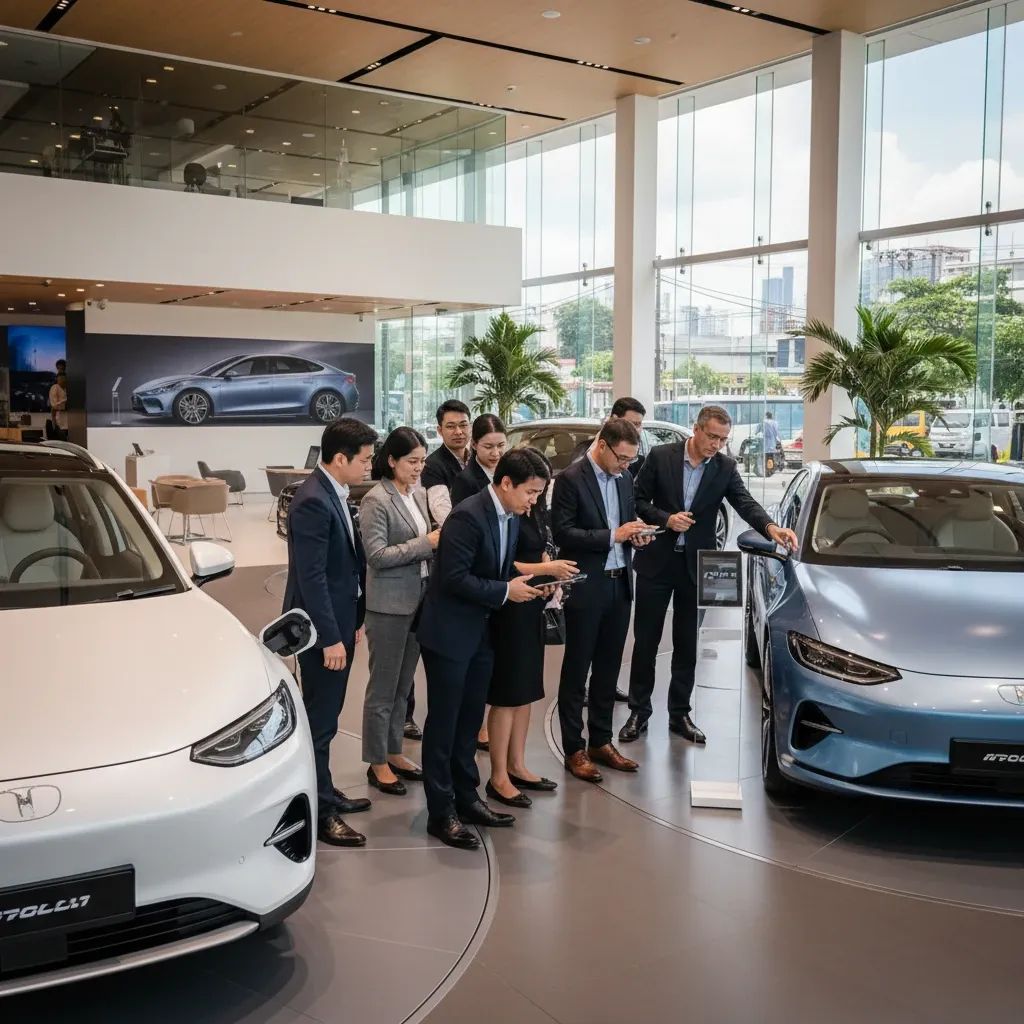
Viriyah Insurance, Thailand's dominant electric vehicle insurer with a 40% market share, is preparing to increase premiums on EV policies this year—a move that reflects deepening losses across an industry struggling to price one of the kingdom's fastest-growing vehicle segments. The company's combined ratio loss exceeds 10%, meaning it pays out more in claims and expenses than it collects in premiums, a gap that has become unsustainable as accident rates and repair bills climb far beyond initial forecasts.
Why This Matters:
• EV premiums already cost 20% more than conventional car insurance—expect further increases targeting specific high-risk models.
• Repair bills for electric vehicles run 50% higher than petrol cars, with battery replacements alone costing ฿200,000 to ฿600,000.
• Loss ratios hit 84.3% for EVs versus 61% for internal combustion vehicles, forcing insurers to recalibrate pricing across the board.
• Thailand's broader motor insurance market will see 2-3% premium hikes in 2026, driven partly by the EV surge.
The Loss Leader Problem
Viriyah generated approximately ฿2.8 billion in EV premiums during 2025, insuring tens of thousands of vehicles as Chinese manufacturers flooded the Thai market with competitively priced models. Yet that revenue growth masks a fundamental problem: the segment operates at a persistent loss. Managing director Amorn Thongthew confirmed the company is moving toward model-by-model pricing, abandoning the one-size-fits-all approach that initially attracted buyers but failed to account for wildly varying risk profiles among brands and vehicle types.
The strategy mirrors broader industry trends. Tokio Marine Safety Insurance temporarily suspended standard EV premium schedules entirely, opting to quote new policies case-by-case after realizing conventional actuarial tables underpriced the exposure. Some insurers have quietly stopped covering certain EV models altogether, citing logistical nightmares around parts availability, brand-exclusive repair centers, and technician shortages.
What Drives the Red Ink
Three factors converge to make electric vehicles uniquely expensive to insure in Thailand:
Accident frequency. Data from the Thai General Insurance Association (TGIA) and Thai Insurance Research and Development Co (TIRD) shows EVs recorded a 74.8% accident frequency rate in 2024, nearly 1.6 times the 47.2% seen among petrol vehicles. The reasons remain debated—instant torque, heavier curb weights, and a surge of first-time buyers unfamiliar with EV handling dynamics all play a role—but the result is unambiguous: more crashes translate directly into higher loss ratios.
Claim severity. The average loss per EV claim reached ฿30,071, compared to ฿19,876 for internal combustion vehicles. Battery packs, often accounting for 30-50% of a vehicle's total value, must frequently be replaced in full even after minor damage due to safety protocols around thermal runaway risks. Advanced driver-assistance systems require expensive recalibration after collisions, and the scarcity of trained technicians pushes labor rates higher. Repair costs overall run 50% above conventional vehicles, yet early EV premiums rose only 15-20%—a mismatch that guaranteed losses from day one.
Infrastructure gaps. Thailand's EV repair ecosystem remains immature. Authorized service centers cluster in Bangkok and provincial capitals, leaving upcountry owners dependent on slow parts shipments or expensive towing. Specialized diagnostic equipment and high-voltage safety training are not yet standard at independent garages, forcing insurers to route claims through brand dealerships that charge premium rates. Supply chain disruptions—often tied to geopolitical tensions affecting Chinese component exports—further inflate costs and delay repairs, sometimes making write-offs more economical than fixing vehicles.
Regional Parallels
Thailand is not alone. Across Southeast Asia, insurers are repricing EV coverage amid similar pressures. In Malaysia, the motor insurance combined ratio hit 102.2% in the first half of 2025, with EV claims contributing to underwriting losses despite semi-regulated premium frameworks imposed by Bank Negara Malaysia. Malaysian insurers now emphasize tailored products, including standalone battery coverage and access to specialized repair networks, as loss ratios climbed from 63.2% in 2020 to 68.6% by 2024.
Indonesia's Financial Services Authority (OJK) took the opposite approach, issuing guidance allowing insurers to price EV premiums below fossil-fuel vehicles to encourage adoption. Yet individual providers like Oona Insurance still build in battery protection riders, acknowledging that average accident repair costs reach IDR 15 million and flood damage poses catastrophic risks to lithium-ion cells. The Indonesian General Insurance Association (AAUI) formed a working committee to study EV-specific underwriting, recognizing that conventional risk models fail to capture battery degradation, charger-fire hazards, and the torque profiles unique to electric drivetrains.
In Vietnam, insurers deploy risk-based pricing tied to onboard diagnostics, rewarding safe-driving history with discounts while flagging high-risk behaviors. Loss-adjustment costs have risen in tandem with EV adoption, prompting industry collaboration to share blacklists of suspect repair workshops and curb fraudulent claims.
Impact on EV Owners and Buyers
For residents in Thailand, the premium increases translate to immediate cost-of-ownership changes. Current EV insurance already runs 20-25% higher than comparable petrol vehicles; further adjustments in 2026 will widen that gap, particularly for models flagged as high-risk by insurers like Viriyah. Buyers considering Chinese brands—which dominate Thailand's EV market thanks to aggressive pricing—should budget for higher insurance renewal quotes as loss data accumulates around specific models.
The shift to model-specific pricing also introduces new complexity. Previously, insurers applied broad EV premiums across vehicle classes; now, two similarly priced electric sedans could carry vastly different insurance costs depending on repair history, parts availability, and manufacturer service networks. Prospective buyers should request insurance quotes before committing to a purchase, as the premium delta between models can exceed ฿10,000 annually—equivalent to several months of fuel savings.
Flood-prone areas face compounded risks. Battery damage from water intrusion often results in total loss claims, and insurers are tightening coverage terms or excluding flood damage for EVs parked in high-risk zones. Owners in central plains provinces and low-lying Bangkok neighborhoods may encounter restricted coverage or surcharges when renewing policies.
Market Consolidation Ahead
Thailand's electric vehicle registrations surged 54% through November 2025, pushing EV policies to 3.83% of all first-class private passenger motor insurance—a segment that barely existed three years ago. Yet the "Gold Rush" phase, as industry analysts term it, is ending. Viriyah's premium adjustments signal a broader recalibration: insurers are prioritizing long-term sustainability over market share, implementing stricter underwriting discipline and refining risk segmentation.
The TGIA projects overall motor insurance premium increases of 2-3% in 2026, with the expanding EV fleet exerting upward pressure on industry averages. As more insurers adopt Viriyah's model-specific approach, buyers will face a bifurcated market: competitively priced coverage for EVs with proven reliability and manageable repair costs, versus expensive or hard-to-obtain policies for models that rack up frequent or severe claims.
For now, the insurance industry's message is clear: electric vehicles are not cheaper to insure, and the gap is widening. Buyers lured by low sticker prices and government incentives must factor rising insurance costs into total ownership calculations—a reality that could slow adoption rates if premium hikes outpace the fuel savings that make EVs attractive in the first place.


