
Why This Matters
• Penalties are severe and enforced: Cocaine smuggling into Thailand carries mandatory sentences up to 15 years imprisonment and fines of ฿1.5 million. There is no plea bargaining; conviction is final and swift.
• Networks span continents: Between October 2025 and June 2026, Thailand Customs seized narcotics in 214 cases worth ฿692 million, with West African and Brazilian organized groups now recruiting couriers from Turkey, Ethiopia, and India to evade detection.
• Hidden routes dominate: While high-profile airport arrests capture headlines, 76.6% of drug seizures involve postal and parcel services—a harder-to-police channel that poses the greater institutional challenge for enforcement.
• Enforcement is tightening: Multi-agency task forces at Suvarnabhumi now deploy K-9 units, advanced scanning, and international intelligence-sharing, creating real consequences for trafficking operations.
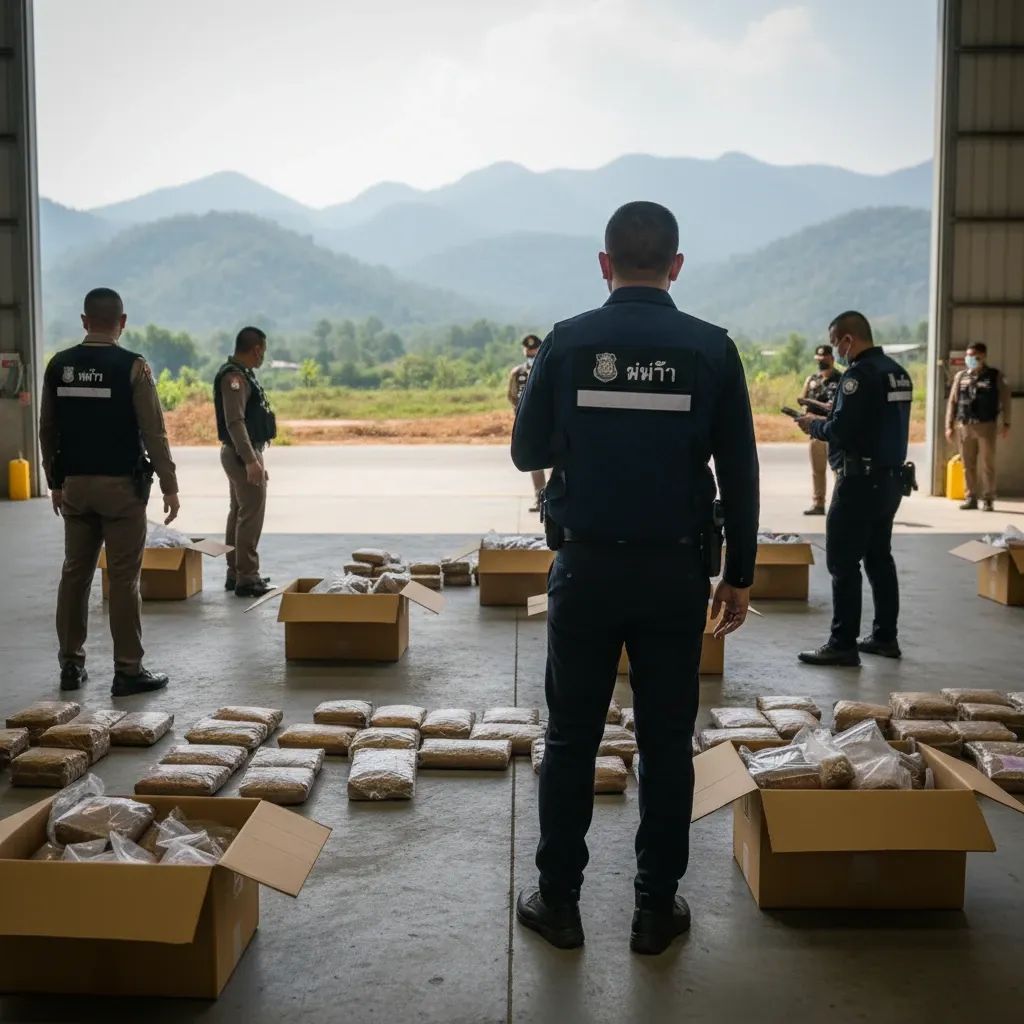
A Turkish national was arrested on June 25, 2026, at Suvarnabhumi Airport after authorities discovered 12 kilograms of cocaine concealed inside coffee bags and chocolate packaging, a haul valued at approximately ฿36 million. The case offers a revealing snapshot of how transnational smuggling networks operate, the methods they employ, and the enforcement response Thailand has mobilized.
The suspect, traveling from São Paulo, Brazil, was detained by the Thailand Customs Department's Investigation and Suppression Bureau in coordination with the Airport Interdiction Task Force (AITF)—a multi-agency operation combining resources from police narcotics units, immigration, airport authorities, and the Thailand Office of the Narcotics Control Board. Within hours, he was handed to the Narcotics Suppression Bureau for prosecution. Investigators immediately began tracing the supply chain: the Brazilian origin point, any handlers in Thailand waiting to receive the shipment, and financial intermediaries who funded the operation.
A Shift in Courier Recruitment Reflects Trafficker Adaptation
What distinguishes this arrest from previous cocaine busts is the suspect's nationality. Until 2022, Brazil-to-Thailand cocaine routes followed a predictable pattern: Brazilian nationals swallowing capsules or traveling with false-bottomed suitcases. Over the past four years, trafficking networks have systematically diversified their recruitment base—now enlisting couriers from Turkey, Ethiopia, India, and West Africa.
This rotation serves a deliberate purpose. Border agents and airline staff develop behavioral profiles of high-risk passengers over time. By rotating courier nationalities, criminal organizations reduce the likelihood that mules trigger secondary screening based on established threat patterns. A Turkish businessman flying from Brazil attracts less suspicion than a repeat Brazilian courier would.
The pattern became statistically evident in 2023, when West African criminal networks—operating in coordination with South American suppliers—were implicated in moving 48.4 kilograms of cocaine through Thailand across 41 cases. More than half of those busts involved West African nationals or shipments routed through West African logistics hubs. This geographic expansion reflects how trafficking mirrors legitimate supply-chain optimization: as enforcement tightens one route, networks quickly establish alternatives.
Multiple seizures trace this diversification. In February 2022, three Brazilian nationals were arrested at Suvarnabhumi with 15.5 kilograms hidden in false-bottom luggage—a ฿46.5 million bust. That same year, an Ethiopian national was apprehended with 2.2 kilograms. By 2024, Indian nationals began appearing in seizure records. The June 2026 Turkish arrest fits precisely into this expanding recruitment pattern.
The Parcel Problem: Where Real Volume Hides
The Turkish passenger's arrest, dramatic as it is, represents only a fraction of Thailand's cocaine smuggling challenge. Between October 2025 and June 2026, the Thailand Customs Department documented that 76.6% of all drug seizures involved postal and express parcel services—a disparity that reveals a fundamental enforcement asymmetry.
Passenger screening at major airports like Suvarnabhumi has become comparatively rigorous. X-ray machines, K-9 units, behavioral analysis, and international intelligence-sharing create genuine interdiction. Yet the parcel supply chain remains harder to police at scale. A single passenger might carry 10–15 kilograms before arousing suspicion. A parcel network, by contrast, can sustain dozens of small shipments weekly, each below a statistically likely detection threshold. If enforcement intercepts 5%, the economics remain favorable for trafficking organizations.
Recent interceptions underscore the sophistication. In March 2024, Thai authorities seized 5.36 kilograms of cocaine concealed inside the hollow steel core of a clothes-drying rack shipped from the United States. Investigation traced the network back to 2020—meaning years of undetected operations before a single bust. Other intercepts have found cocaine packed inside protein powder tins, deodorant roll-ons, and vacuum-sealed pouches originating from the United Kingdom.
The parcel advantage extends beyond volume. Recruitment is easier—warehouse workers and shipping clerks are harder to flip than a desperate courier, which paradoxically makes parcel networks more resilient to disruption through individual arrests. A mule can be replaced within days. A logistics coordinator who arranged dozens of shipments over years represents irreplaceable institutional knowledge.
The Enforcement Response: Coordination and Technology
Thailand's law enforcement apparatus has responded to this challenge with genuine operational sophistication. The multi-agency task force coordinating at Suvarnabhumi includes the Thailand Customs Department, the Narcotics Suppression Bureau, the Office of the Narcotics Control Board, the Royal Thai Police, immigration authorities, and Airports of Thailand Public Company Limited (AOT). This vertical integration allows intelligence to flow rapidly between agencies and decisions to be executed without bureaucratic delay.
Technology augments human judgment. K-9 detection units remain among the most reliable screening tools—dogs cannot be fooled by packaging or concealment methods that defeat machines. The airport has expanded its fleet. Advanced X-ray equipment now scans for density anomalies consistent with cocaine, heroin, and methamphetamine. Intelligence analysts cross-reference passenger manifests, flight routes, and behavioral data to identify statistical outliers.
International cooperation accelerates the process. The Thailand Customs Department maintains regular information-sharing agreements with the U.S. Drug Enforcement Administration (DEA), the Australian Border Force (ABF), the UN Office on Drugs and Crime (UNODC), and South Korean customs authorities. When a suspicious parcel originates in the United States, Thai agencies can query their American counterparts about the shipper's history within hours. When a passenger traveling from Brazil is flagged by Brazilian authorities, Thai immigration receives alerts before the aircraft lands.
The Turkish passenger's case illustrates this coordination. He was identified during routine screening, his luggage was X-rayed, K-9 units confirmed suspicion, officers executed a controlled search, and the evidence was documented according to Thai legal procedures. The entire process—from landing to arrest—occurred in under three hours. Investigators immediately accessed flight manifests, booking information, and historical data to identify associates and trace the supply chain backward to Brazil.
The Emerging Synthetic Challenge
While cocaine seizures command public attention, crystal methamphetamine ("ice") remains the highest-volume narcotic apprehended by Thai authorities. Ice dominates in case count, total weight, and street value. The ฿692 million logged from October 2025 through June 2026 reflects ice's overwhelming prevalence in Thailand's narcotics market.
More troubling is the rising incidence of newer psychotropic substances—specifically Zopiclone (a sedative-hypnotic) and etomidate (a short-acting anesthetic). Both are legitimate pharmaceuticals in medical settings. Yet they are increasingly smuggled for recreational use or resale in Bangkok's club circuits and hospitality venues. The challenge this creates is regulatory lag: customs protocols and K-9 training protocols focus primarily on traditional narcotics. Emerging compounds can evade detection frameworks until agencies update their watchlists.
The Thailand Customs Department has responded by expanding its partnerships with international monitoring bodies, including UNODC, to track emerging threats and update detection protocols quarterly.
What This Means for People Living in Thailand
For residents and travelers, the practical implications demand awareness. First, drug laws in Thailand are among the world's harshest. Thai courts do not recognize plea bargaining; conviction typically results in mandatory minimum sentences. For expats, conviction triggers immediate deportation proceedings, and consular assistance from embassies is limited to providing attorney referrals. Legal defense is expensive, outcomes are uncertain, and incarceration occurs in facilities with conditions that would be unacceptable in most Western countries.
Second, heightened enforcement creates longer processing times at major airports. Passengers arriving from Brazil, Colombia, Peru, West Africa, and Southeast Asia should anticipate secondary baggage inspections, K-9 screening, and questioning. This is not discrimination but statistical risk management. The overwhelming majority of cocaine seized at Thai entry points originates from those regions.
For foreign residents involved in logistics, freight forwarding, or international commerce, enforcement intensity carries serious corporate liability. If a business unknowingly becomes complicit in a smuggling shipment—even passively as a transit handler—directors and the company face asset seizures and criminal prosecution. Robust compliance protocols, staff vetting, and suspicious-activity reporting are not optional bureaucratic exercises but legal necessities.
For the general population, authorities have established anonymous tip lines. The Narcotics Suppression Bureau and local police stations accept confidential reports about suspected drug activity. While prevention relies primarily on enforcement, public cooperation accelerates identification of local distribution networks and vulnerable supply-chain points.
For investors and business operators, the stability provided by effective narcotics enforcement has measurable economic value. Countries plagued by unchecked trafficking experience capital flight, insurance premium increases, and difficulty attracting foreign investment. Thailand's demonstrated commitment to interdiction—visible in multi-agency task forces, technology deployment, and international partnerships—signals institutional commitment to rule of law and economic stability.
Investigating Beyond the Individual Arrest
Phantong Loykulnanta, director-general of the Thailand Customs Department, has emphasized that enforcement strategy now prioritizes dismantling entire transnational criminal networks rather than prosecuting individual couriers in isolation. Each arrest triggers expanded investigations aimed at identifying financiers, logistics coordinators, safe-house operators, and downstream distributors within Thailand.
The Turkish passenger's case exemplifies this approach. Investigators will attempt to identify his handler in Bangkok, trace the money flow that funded his purchase in Brazil, determine the intended recipients, and map the distribution network that would have received the cocaine for onward sales. These secondary investigations often yield larger prosecutions and asset forfeitures than the primary passenger arrest itself.
This network-focused strategy reflects maturation in Thai law enforcement. Arresting 100 couriers generates publicity but minimal impact on trafficking volumes. Dismantling a single transnational syndicate—by identifying and prosecuting its financial and logistics backbone—can disrupt supply for months or years. The June 2026 Turkish arrest is not an endpoint but an investigative entry point.
The Paradox of Effective Interdiction in a Transit Nation
Thailand faces a structural reality common to all transit countries: enforcement can be genuinely effective at interdiction, yet trafficking volumes remain substantial. The ฿692 million in narcotics seized in nine months represents real success and represents a genuine operational achievement. Yet it also suggests that total trafficking volume is orders of magnitude higher—possibly ฿5–10 billion annually across all substances and routes.
Traffickers respond to enforcement pressure through innovation, not capitulation. When passenger screening tightened, networks shifted to parcels. When West African routes faced scrutiny, Turkish and Ethiopian couriers were recruited. When direct flights became risky, multi-leg itineraries through intermediate hubs became standard. When cocaine dominance on the street diminished, newer synthetics gained market share.
From a policy standpoint, Thailand's commitment to interdiction is genuine and professionally executed. The challenge is inherent: as long as cocaine is valuable in Asian markets and Brazil has supply, some volume will transit Thailand. Law enforcement can reduce it, delay it, and raise its cost. But eradication remains implausible under current economic incentives.
For residents, this reality suggests informed vigilance rather than either complacency or alarm. The presence of ongoing enforcement—visible at airports, parcel facilities, and maritime entry points—indicates governmental seriousness and institutional capacity. But it also confirms that narcotics activity remains an embedded feature of life in Bangkok and other major cities. Awareness, avoidance of personal involvement, and cooperation with authorities represent rational adaptive responses rather than overreaction to an anomalous threat.


