Why This Matters
• Persistent vulnerability: Despite security upgrades, coordinated militant cells continue to exploit gaps in protection for fuel infrastructure, raising questions about the adequacy of current defense protocols across the deep south.
• Economic pressure building: The first two months of 2026 recorded 30 bombing and shooting incidents—a pace suggesting potential escalation compared to 2025's annual total of 150 incidents—signaling rising operational tempo for residents and businesses dependent on uninterrupted services.
• Travel and commerce disrupted: The targeting of petrol stations, trucks, and highways creates real cascading effects: potential fuel shortages, delayed goods movement, and restrictions on freedom of movement for ordinary Thais living in border provinces.
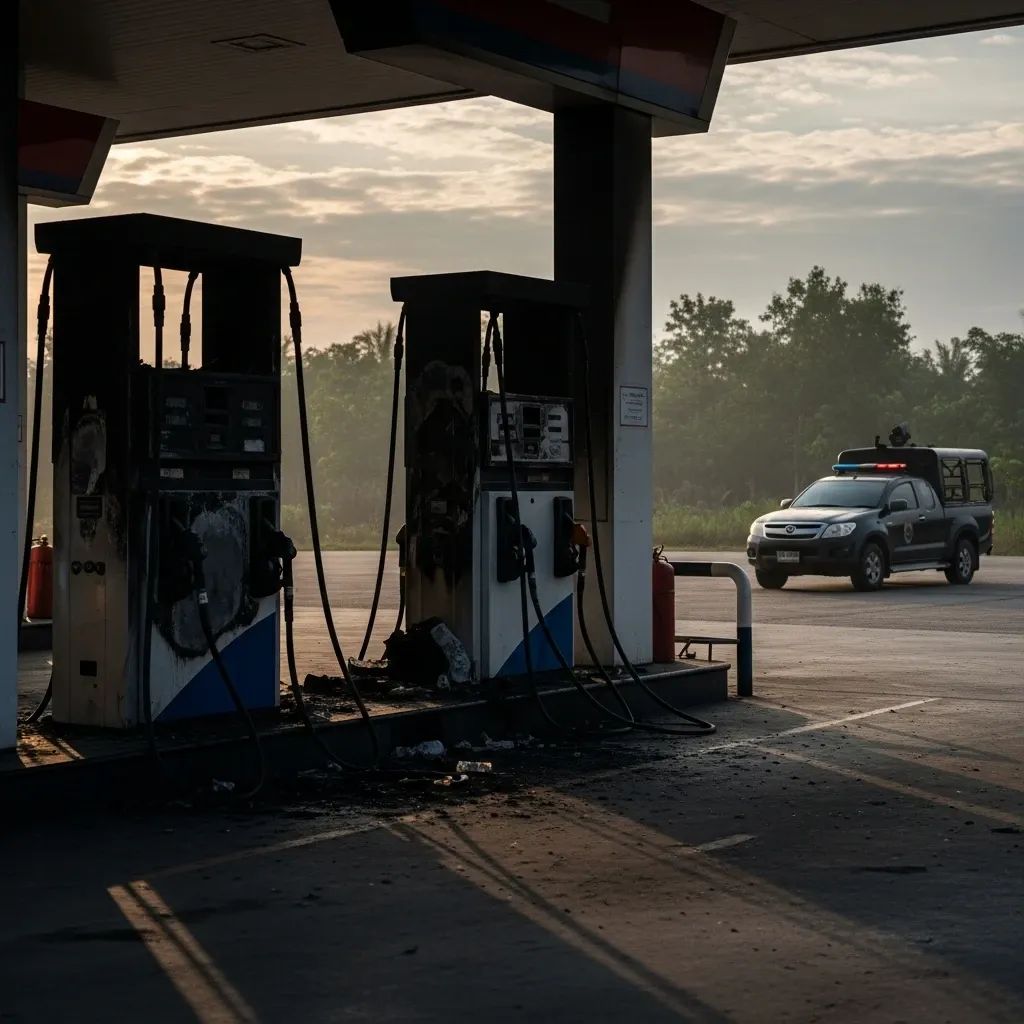
On the evening of June 28, a 20-minute window of coordinated violence shattered three petrol stations across Yala and Pattani provinces. By 11:08 p.m., the first explosion tore through a Thailand-operated PT fueling station on Highway 15 in Sateng Nok sub-district, Yala's Muang district. Twenty minutes later, identical attacks consumed two additional PT branches in Pattani—one in Sai Buri district, another in Yaring district. One civilian lay injured; multiple facilities lay charred; the pattern unmistakable.
What makes this event tactically significant is not the violence itself—the deep south endures such attacks regularly—but the operational sophistication and the shift in militant targeting logic that it reveals.
The Attack Pattern and Operational Signature
Witness statements paint a consistent picture across all three sites. Armed teams, roughly six men per group, arrived on motorcycles dressed in black. They fired warning shots skyward to evacuate the premises, then moved methodically to install improvised explosive devices directly at fuel pump heads before vanishing. The explosions, staggered by minutes, created fuel-fed blazes visible for kilometers. Firefighting units from both provinces converged on the burning sites. Explosive Ordnance Disposal teams and forensic officers cordoned the locations at dawn, collecting shrapnel and analyzing blast mechanics to map the coordination network.
The synchronization within a 20-minute window, the geographic spread across two provinces, and the technical execution all point to a command structure capable of orchestrating multi-provincial operations. The operational signature resembles previous attacks attributed to the Barisan Revolusi Nasional (BRN), a separatist organization that has historically avoided public claim-taking but leaves recognizable tactical patterns at major incidents.
A precedent exists. In January 2026, authorities recorded 11 coordinated petrol station bombings across Yala, Narathiwat, and Pattani, resulting in four injuries. That operation led to the death of Nasrulaeh Sama, identified as a cell commander. Yet the June incidents demonstrate that decapitating leadership has not degraded operational capacity—the network has either regenerated or operated through distributed command structures that survived the loss.
June's Escalating Spiral
The triple bombing caps an alarming month. On June 8, more than 10 insurgents attacked a biomass power plant and attempted to ambush a teacher protection convoy in Pattani, wounding security personnel and civilians. June 9 brought a roadside bomb near a school in Yala, injuring a police officer and one civilian.
By June 19, two separate bombings targeted Thailand Royal Police patrols. The first, detonated at 8:10 a.m. on Ban Pulo Sani-Ban Sakham Road in Yala's Than To district, injured six Border Patrol Police officers from a teacher protection unit—two critically. A second device struck 3 hours and 20 minutes later in Kwanyi village, Mayo district, Pattani, as a police special operations unit returned from checkpoint duty.
On June 26, arsonists torched a 10-wheel truck on Highway 410, the Yala-Betong artery, forcing partial road closures in Bannang Sata district. June 27 brought the shooting death of a Volunteer Defense Corps member in Yaring district, Pattani, as he drove home after dropping his child at school—a deliberate targeting of part-time civilian security auxiliaries.
By June 28, the violence had cycled back to economic infrastructure.
Strategic Shift: Economic Over Military
The trajectory across June reveals a tactical reorientation. Rather than focusing exclusively on confronting military and police—traditional hardened targets—militant cells are increasingly prioritizing economic chokepoints: fuel depots, transport arteries, power generation facilities. This strategy maximizes disruption to civilian life while minimizing the risk of direct engagement with prepared security forces.
For residents of Yala, Pattani, Narathiwat, and affected areas of Songkhla, the implications are significant. Fuel supply concerns persist despite the Thailand Ministry of Energy activating contingency reserves and transport protocols. Localized shortages remain possible if attacks continue. Road commerce has contracted; businesses account for the risk of vehicle ambushes and delayed shipments. The psychological toll—never certain whether nighttime travel will be interrupted by a roadblock or worse—imposes a hidden tax on ordinary economic activity.
The Larger Statistical Picture
Statistics contextualize the escalating pattern. In 2025, the deep south recorded 150 total insurgency-related incidents, resulting in 48 fatalities (38 security personnel, 10 civilians) and 165 injuries. The first two months of 2026 have already tallied 30 bombing and shooting incidents, producing 22 injuries and 2 deaths—a pace that would yield approximately 180 incidents annually if sustained, suggesting acceleration rather than stabilization.
This upward trend contradicts the narrative of overall security improvement relative to the 2004–2007 peak, when violence was far more intense. Officials and analysts frame the 2026 uptick as tactical adaptation: insurgents may have adopted lower-lethality infrastructure attacks to avoid triggering the same military response threshold that large-casualty incidents provoke, while achieving political and economic messaging through disruption.
Government Response and Its Limitations
The Thailand Cabinet has ordered accelerated investigations and protective reinforcement around critical infrastructure. The government extended the State of Emergency decree in affected areas, granting authorities expanded powers for searches, curfews, and detention. Military and police forces deployed additional personnel to patrol economic zones, government facilities, and community centers, emphasizing integrated operations combining civilian administration, police intelligence, and military force.
Yet the continued success of multi-site attacks despite these measures suggests significant operational gaps. Surveillance networks remain incomplete; rapid response protocols still rely on response times measured in minutes, giving agile militant teams sufficient window to execute and flee. Coordination between security layers—civilian police, military, Border Patrol Police, volunteer defense units—is nominally unified under the Internal Security Operations Command Region 4 Forward (ISOC R4F) but operates with turf complexity and information-sharing friction that insurgents have learned to exploit.
A positive note: no fatalities resulted from the June 28 bombings, and the single civilian injury suggests either luck or improved evacuation protocols. Firefighting response was rapid enough to prevent secondary explosions. Forensic collection proceeded methodically. These operational details matter because they indicate that some defensive elements—early warning, evacuation procedures, fire suppression—are functioning.
The Root Problem Remains Unresolved
What government operations cannot address is the underlying political conflict: the separatist demand for autonomy or independence rooted in ethnic Malay identity, religious grievance, and historical marginalization from Thai Buddhist-dominated governance. The Thailand Prime Minister Anutin Charnvirakul attributes recent violence to insurgent efforts to destabilize the region ahead of local elections and undermine the government's "Understand, Reach, Develop" peace framework.
Yet peace negotiations between Bangkok and BRN representatives have stalled repeatedly over core issues: amnesty for past actions, the scope of local Islamic jurisprudence, and the structure of any future autonomy arrangement. Substantive political progress has not materialized. Until it does, the security environment will remain one where ordinary infrastructure becomes a battleground by night, and residents navigate a calculus of risk that no government patrol or surveillance camera can fully mitigate.
The charred pump islands in Yala and Pattani now join a growing list of economic targets hit in 2026. They are not accidents or random violence. They are the physical manifestation of a deliberate strategy: keep the region destabilized, demonstrate that central authority cannot guarantee protection or predictability, and maintain pressure on the Thai state to negotiate seriously. Whether that pressure succeeds in producing political movement, or simply hardens Thailand's security posture further, remains the central question shaping life in the deep south.