
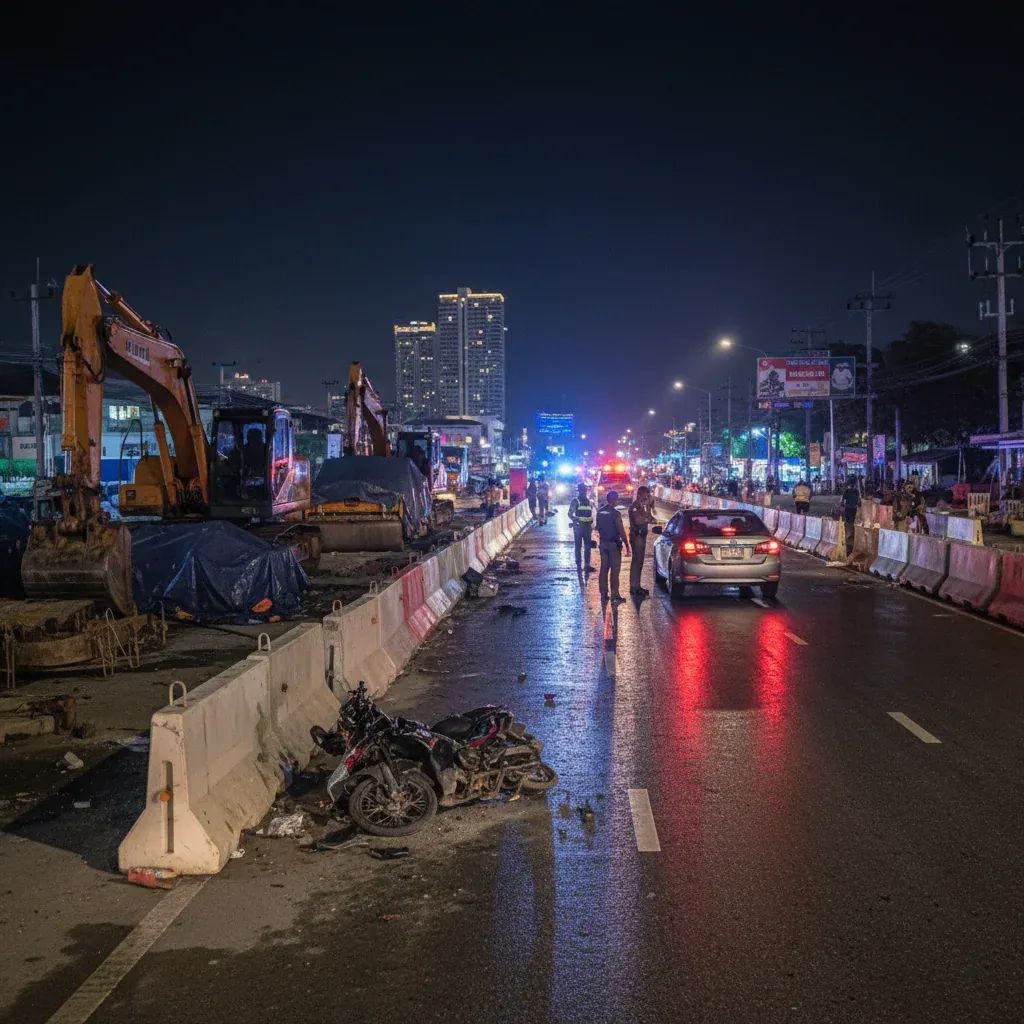
The State Railway of Thailand has suspended operations at the Doi Luang tunnel construction site following a fatal scaffolding collapse on June 20, 2026, that killed two workers and injured two others. The suspension allows for a 15-day investigation into whether inadequate safety protocols or geological forces triggered the tragedy. The incident exposes critical gaps in Thailand's railway infrastructure development as the country races to complete its Den Chai-Chiang Rai-Chiang Khong double-track line by 2028.
Why This Matters
• Construction timeline remains intact: Despite the suspension, SRT officials maintain the broader railway project will still open in 2028, though enhanced safety reviews may affect schedules.
• Geological reassessment underway: Heavy rainfall over the past 2-3 years has saturated rock formations under Doi Luang mountain, prompting questions about whether temporary support structures met international standards.
• Legal accountability looming: Thailand's Transport Ministry has pledged prosecution if negligence or safety violations contributed to the collapse, signaling a potential shift in enforcement rigor.
What Happened Inside the Tunnel
The collapse occurred during waterproofing installation work in an exposed section of the tunnel that had not yet received its permanent concrete lining. Preliminary findings from SRT investigators indicate that falling rocks from the tunnel wall triggered the scaffolding failure, with continuous heavy rainfall identified as a primary environmental factor. Water accumulation within rock layers beneath Doi Luang is believed to have weakened temporary support structures, leading to a localized failure.
Unlike the completed sections of the tunnel where permanent concrete lining is installed, the affected area was still under construction with provisional supports. Engineers conducting the initial assessment have emphasized that the main tunnel structure remains stable, a crucial distinction that officials hope will prevent broader project delays.
The Transport Ministry has characterized the incident as a possible "geological force majeure"—an unforeseeable natural event—though investigators are simultaneously examining whether technical errors or negligence played a role. Deputy Transport Minister Phattrapong Phattraprasit has ordered all high-risk infrastructure projects nationwide to intensify safety protocols while the probe continues.
Safety Standards Under Scrutiny
Thailand's railway construction safety framework has come under renewed examination following this incident and a similar tragedy at the Pak Chong tunnel in Nakhon Ratchasima in August 2024, where 3 workers died in a landslide-induced collapse. While the Roadmap for Thai Railway Standardization Development aims to align national practices with international benchmarks by integrating standards from the International Union of Railways (UIC) and European Union Technical Specifications for Interoperability, implementation gaps persist.
The Occupational Safety, Health, and Environment Act requires risk assessments and qualified safety officers across construction sites, and the Transport Ministry emphasizes adherence to ISO 45001 standards for occupational health. However, industry experts note that many Thai railway projects still rely on borrowing foreign standards without fully integrating them into local regulatory enforcement.
Enforcement Gaps in Thai Construction
International frameworks like the UIC's IRS 70779-9 and the EU's TSI SRT provide comprehensive safety protocols covering prevention, mitigation, evacuation, and rescue procedures throughout a tunnel's lifecycle. These systems mandate rigorous geological assessments, continuous monitoring, and robust temporary support designs—precisely the areas now under review at Doi Luang.
Critics point to persistent challenges in Thailand's broader construction sector, including lax enforcement, shortages of independent safety assessors, and occasional pressure to prioritize cost efficiency over precautionary measures. The fact that two major tunnel collapses have occurred within 10 months, both attributed to rainfall-related geological instability, suggests that hydrological risk assessment protocols may require significant strengthening.
New Protocols and Geological Reassessment
In response to the June 20, 2026 collapse, SRT has mandated several immediate changes:
Rock mass assessments must now precede any drilling or concrete injection work, a requirement that investigators say may not have been consistently applied in the exposed tunnel sections. Geological specialists are conducting detailed evaluations of rock conditions throughout the Doi Luang site, with particular attention to how water saturation affects temporary support systems.
The contractor has been ordered to implement enhanced worker safety measures and introduce reinforced temporary supports in all unlined sections. SRT has also expanded surveillance systems and established stricter inspection protocols across all ongoing railway infrastructure projects, not just those in Chiang Rai.
The 15-day fact-finding committee established by the Transport Ministry is examining engineering practices, construction procedures, geological conditions, and operational protocols. If investigators determine that safety violations occurred, the government has pledged to pursue legal action to the fullest extent, a commitment that represents a departure from past practices where accountability in construction incidents has sometimes been opaque.
Impact on the Northern Railway Corridor
The Doi Luang tunnel is a critical component of the Den Chai-Chiang Rai-Chiang Khong double-track railway, a 323-kilometer project designed to connect Thailand's northern provinces with trade routes extending into Laos and southern China. The line is expected to transform freight logistics and passenger mobility in the region, reducing travel times and expanding economic connectivity for provinces that have historically been underserved by rail infrastructure.
Despite the suspension, SRT maintains that the 2028 completion target remains achievable, though enhanced safety reviews and potential design modifications could introduce delays. The tunnel itself, once finished, will be one of the longest railway tunnels in Thailand, requiring sophisticated engineering to navigate the mountainous terrain of Chiang Rai province.
Chiang Rai sits in a region with medium seismic hazard, as demonstrated by the magnitude 6.2 earthquake in 2014 that originated from the Pha Yao fault zone. However, investigators have clarified that the June 2026 collapse appears linked to hydrological factors rather than seismic activity, underscoring the need for construction protocols that account for Thailand's tropical rainfall patterns and monsoon-driven soil saturation.
What This Means for Residents
For residents and businesses in northern Thailand anticipating the railway's economic benefits, the suspension highlights both the complexity of large-scale infrastructure development and the government's willingness to halt projects when safety concerns arise. While the initial two-day stoppage allowed for immediate safety assessments, construction remains suspended during the full 15-day investigation period, with resumption contingent on the findings.
Travelers and logistics operators relying on improved northern connectivity should monitor official announcements from SRT regarding any revised completion schedules. The 2028 opening date remains official, but the introduction of more stringent geological assessments and safety protocols could shift that timeline if additional structural reinforcements prove necessary. Residents can stay updated through SRT's official website and press releases from the Transport Ministry, which will announce investigation findings and any impact on the project timeline.
For workers in Thailand's construction sector—both Thai nationals and expatriates—the incident signals a shift toward more rigorous enforcement of safety standards, particularly on high-risk projects involving tunneling, deep excavation, or work in geologically unstable areas. The Transport Ministry's emphasis on ISO compliance and independent oversight suggests that contractors may face increased scrutiny and documentation requirements moving forward. Workers should be aware of their rights under the Occupational Safety, Health, and Environment Act, which includes the right to report unsafe conditions without fear of retaliation and access to safety committees on construction sites.
Whether you live near the tunnel construction area or work in northern Thailand's construction sector, it's important to note that similar hydrological risks may affect other ongoing projects in the region. Residents concerned about construction safety near their communities can contact local government offices or the Transport Ministry's safety hotline to inquire about risk assessments at nearby sites.
The broader lesson for infrastructure development in Thailand centers on the relationship between environmental conditions and engineering practices. As climate patterns shift and heavy rainfall becomes more unpredictable, construction methodologies must evolve to account for hydrological risks that may not have been prominent in earlier projects. The decision to suspend work at Doi Luang, despite pressure to maintain schedules, reflects a recognition that long-term project success depends on addressing these challenges transparently rather than deferring them until structural failures occur.


