
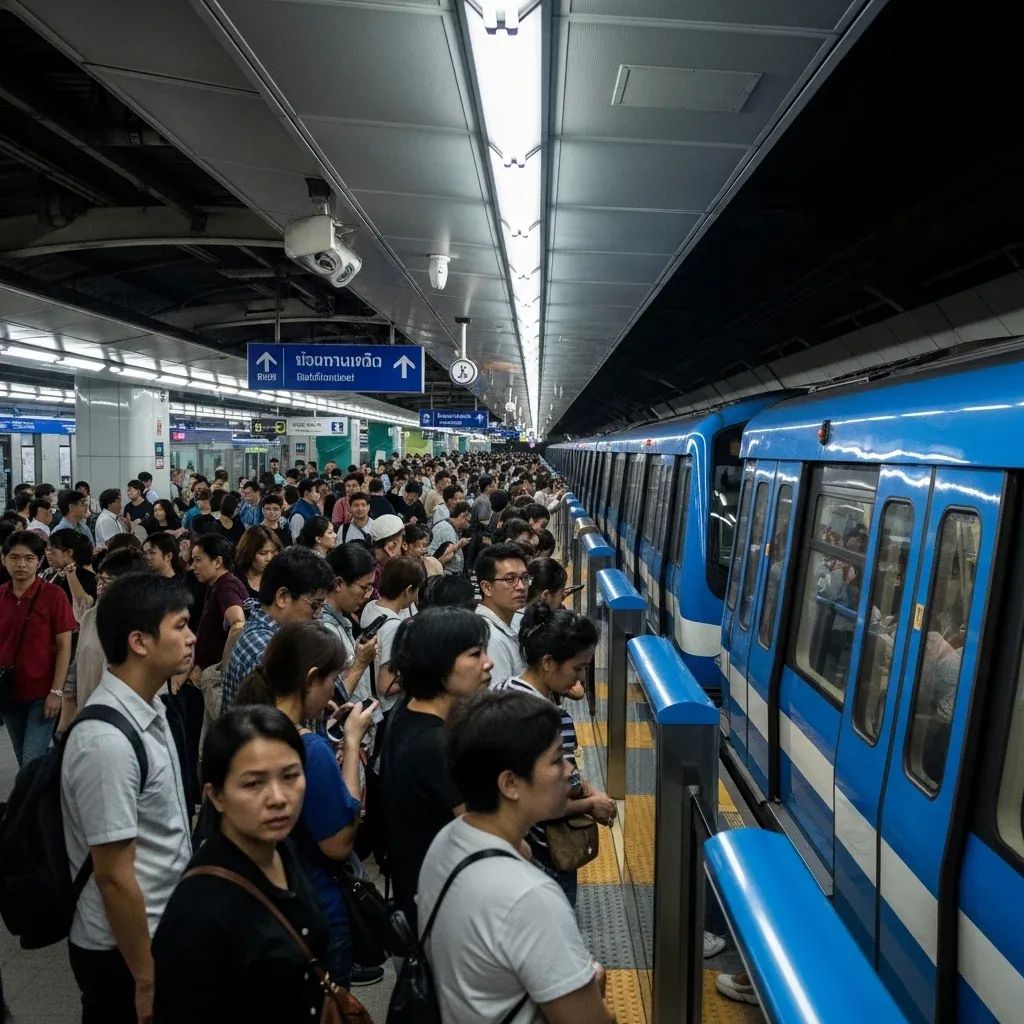
Why Daily Commuters Got a Break on Bangkok's Busiest Underground Line
The Mass Rapid Transit Authority of Thailand has reduced fares across the MRT Blue Line beginning July 3, implementing the first decrease since 2024. The maximum single-trip cost drops to ฿44 from ฿45, with reductions cascading through longer-distance journeys, though short-hop travelers within the capital will see no change whatsoever.
What You'll Actually Save
• Long-distance commuters save ฿1-2 per journey: Workers traveling 6 or more stations daily—particularly those heading from outer districts into Silom or Sukhumvit business zones—will accumulate modest but real monthly savings, roughly ฿20-40 depending on routing and frequency.
• Expanded free child travel: The height threshold for children who ride free increases to 120 centimetres, essentially pushing the cutoff upward by approximately three years in developmental age, benefiting elementary-school commuters.
• Implementation timeline is tight: The system has five weeks to reprogram fare gates across 37 stations; most contactless payment systems (Rabbit, MangMoom) will auto-adjust, but token and cash users should verify pricing before purchase.
Quick Fare Comparison (6+ Station Journeys)
• From Bang Khae to Chit Lom (11 stations): ฿42 → ฿41
• Maximum fare (longest trips): ฿45 → ฿44
• 1-5 station trips: No change (฿17-฿39)
Why the Fares Dropped
This wasn't a political decision. The concession agreement governing the Blue Line mandates a biennial fare review tied directly to the Consumer Price Index (CPI). During the calculation cycle covering inflation trends through early 2026, the CPI showed a decrease during the review period. The formula automatically triggered downward adjustments—a mechanical outcome reflecting Thailand's economic conditions and a rarity in Asian transit pricing.
The granularity matters here. The base fare of ฿17 for single-station travel remains unchanged from 2024. Passengers making trips of 2-5 stations experience identical pricing. Only the distance-heavy segment—those traveling 6 stations or beyond—receives relief.
Who Benefits, Who Doesn't
Approximately 453,000 daily riders use the Blue Line, but the benefit distribution is uneven. Regular commuters from peripheral neighborhoods—Tha Phra, Petchburi, outer Sukhumvit—traveling toward downtown office clusters capture the full savings. Urban-core travelers making quick intercity hops gain nothing.
For the operator, Bangkok Expressway and Metro Plc (BEM), the change creates modest revenue pressure in the short term. However, the company expects ridership growth among price-sensitive users to offset much of the impact.
How Thailand Compares to Other Asian Cities
Thailand's approach uses a formulaic, transparent mechanism similar to Hong Kong's MTR, which also employs a CPI-linked system. However, Hong Kong includes an affordability safeguard that caps fare increases if they would consume too much of household income—a protection Thailand's system currently lacks.
Singapore's MRT, by contrast, operates under government control with annual reviews that typically produce upward adjustments reflecting maintenance and wage costs. Fares there trend consistently higher unless government directly intervenes. Kuala Lumpur's LRT maintains lower absolute fares but uses cruder distance categories, offering less precision.
What Happens Next: Practical Information for Commuters
The July 3 cutover requires BEM to reprogram fare gate terminals across the 37-station network. For Rabbit and MangMoom cardholders—the dominant payment method—the transition is automatic; backend systems calculate new rates without action needed. Occasional riders purchasing tokens or single-trip passes should verify prices at vending machines.
Enforcement protocols remain unchanged. Station staff retain authority to measure children's height and request disability credentials at entry gates. The change applies prospectively only; passengers who used the system on July 2 at old rates receive no compensation.
Families With Children See Extra Savings
The height threshold expansion to 120 centimetres—up from 90cm—effectively extends free travel to children entering elementary school, aligning with international pediatric fare standards. Families with multiple school-age children should see monthly transport savings of ฿200-400.
Disability exemptions persist unchanged: cardholders ride free with official government-issued identification. Seniors aged 60 and above continue receiving 50% discounts. A rounding convention applies to fractional baht amounts; the system rounds upward to the nearest whole baht.
The Next Review: What Could Change
The mechanics guarantee a follow-up review. The subsequent mandatory review cycle arrives in mid-2028, again tethered to CPI performance over the preceding 24 months. Should inflation resurge, the formula could reverse direction, pushing fares back upward. For now, Bangkok commuters enjoy a rare downward adjustment in an otherwise steady cost-of-living climb, though the savings remain modest enough to likely blend into household budgets.


