
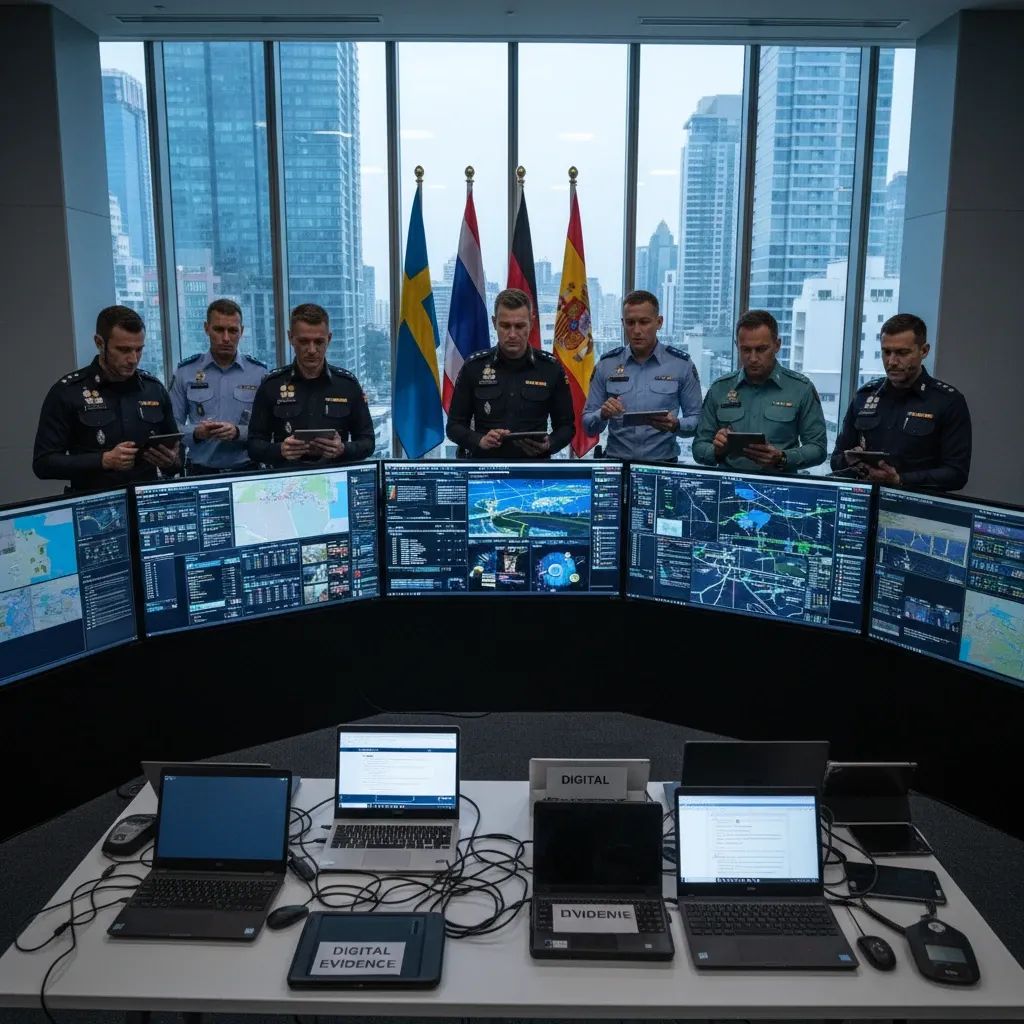
The Thailand Central Investigation Bureau has detained 3 Swedish nationals accused of orchestrating a darknet narcotics empire that allegedly controlled a significant portion of Europe's online drug trade. The arrests, executed in luxury villas across Bangkok and Prachuap Khiri Khan province on March 4, mark the culmination of a multi-year international investigation into platforms that moved an estimated €250M in illicit transactions.
Why This Matters:
• Law enforcement footprint expands: Thailand is increasingly used as a staging ground for international cybercrime, raising scrutiny on visa enforcement and property rentals to foreign nationals.
• Legal exposure for landlords: Property owners renting to foreigners may face heightened due diligence requirements if tenants are later linked to criminal networks.
• Coordinated cross-border action: Simultaneous raids in 9 Thailand locations and 18 European sites demonstrate the reach of international policing into Thai territory.
The Accused and Their Alleged Operation
Robert Mikael Lind (47), Daniel Lee (39), and John Arya Ghavamzadeh (33) were apprehended at rented pool villas, where investigators say they managed backend operations for Archetyp Market and Mupparna.net—two of the darknet's most prolific narcotics platforms. According to Thai police, 119 items of evidence were seized, including laptops, tablets, mobile phones, storage devices, internet routers, credit cards, and operational documents, all now undergoing forensic examination.
Authorities allege the trio used Thailand as a remote command center, leveraging the country's advanced digital infrastructure and relative anonymity to coordinate drug shipments across Europe and into Australia. Daniel Lee was classified under Thailand's Immigration Act as a prohibited person, deemed potentially dangerous to national security and wanted by foreign authorities for drug trafficking.
How the Darknet Markets Operated
Archetyp Market, which ran for over 5 years before being dismantled in June 2025 during Operation Deep Sentinel, amassed more than 600,000 registered users and over 17,000 product listings, according to law enforcement reports. Unlike other darknet markets, Archetyp specialized exclusively in narcotics, banning weapons, stolen data, and fraud tools. Notably, it openly permitted listings for fentanyl and other dangerous synthetic opioids, a rarity among major platforms.
Transactions were conducted solely in Monero (XMR), a privacy-focused cryptocurrency that complicates financial tracing. The platform employed escrow services, PGP-encrypted messaging, and two-factor authentication, operating on an invitation-only or administrator-approval model to maintain operational security. Drugs were typically shipped via postal networks using stealth packaging, with the marketplace acting as the logistics bridge between vendors and buyers.
Mupparna.net, established in 2019, positioned itself as a direct-to-consumer dealer, claiming to source products straight from suppliers to eliminate intermediaries. The site accepted credit cards, Bitcoin, and Monero, and promised delivery within 2-4 business days. It also operated a customer loyalty program offering free products based on purchase value.
International Coordination and Asset Seizures
The March 4 operation, dubbed Operation Pandora, was a joint effort involving Thai, Swedish, German, Spanish, and Australian law enforcement, along with Europol and Eurojust. In addition to the 3 arrests in Thailand, parallel raids across Europe netted 13 total arrests and the seizure of assets worth over €4M (approximately 100M baht). European police had previously confiscated more than 1,000 kg of drugs linked to the network.
The investigation originated with Swedish authorities' Operation Candy, launched in November 2023, which used forensic analysis of seized mobile phones to trace a criminal network spanning Europe, Asia, and Australia. The Thai leg of the operation was triggered by assistance requests from Swedish and Australian police, who identified the suspects as key figures in the network's Asia-based operations.
What This Means for Residents
For foreigners living in Thailand, the arrests underscore the Thailand Ministry of Justice's commitment to cooperating with international warrants and extradition requests. These arrests signal a hardening stance in how Thai authorities view visa holders engaged in remote work from luxury properties—a demographic that now includes both legitimate digital nomads and, increasingly, individuals using Thailand's infrastructure for criminal enterprises.
Current framework: Under Thai extradition law, the process is legally feasible under bilateral agreements, particularly when the alleged offense is punishable by imprisonment of at least one year under the requesting nation's law. However, the process can be protracted due to international legal procedures and the requirement for Thai judicial approval.
Property rental implications: Legal experts suggest this case could eventually prompt regulatory scrutiny of high-value rental markets in areas like Hua Hin and central Bangkok. While Thai law does not currently require landlords to screen tenants for international criminal records, property owners increasingly face reputational and legal risks if their properties are identified as bases for criminal operations.
For Thai nationals and long-term expats, the operation indicates that Thailand's Central Investigation Bureau is actively expanding its cybercrime and financial intelligence capabilities. The bureau is reportedly investigating complex international money laundering networks that utilize digital currencies, a trend that may eventually affect regulatory frameworks around cryptocurrency exchanges and peer-to-peer trading platforms operating in Thailand.
The Broader Darknet Crackdown
Archetyp's original infrastructure was dismantled in June 2025 during Operation Deep Sentinel, led by German authorities—nine months before the Thailand arrests. That operation targeted the platform's servers in the Netherlands and led to the arrest of a 30-year-old German administrator in Barcelona, along with a moderator and several high-volume vendors. According to law enforcement, approximately €7.8M in assets were seized.
A separate arrest in August 2025 saw a 37-year-old Swedish national, known online as "Toby," detained in a luxury villa in Chon Buri province on an Interpol Red Notice. Toby is accused of serving as a global moderator for Archetyp, facilitating illegal drug sales across Scandinavia and Europe. Swedish authorities are currently seeking his extradition.
Thailand's Role as a Regional Enforcement Hub
The arrests reflect a broader trend: Thailand is increasingly positioned as a regional hub for international law enforcement cooperation. The country's geographic proximity to Southeast Asian drug production routes, combined with its advanced telecommunications infrastructure and visa policies attractive to foreign nationals, make it both a target and a partner for transnational policing efforts.
In March 2026 alone, Thai police announced broader national operations targeting drug networks, resulting in thousands of arrests and the seizure of large quantities of illicit substances and financial assets. The Central Bureau of Investigation has signaled its intent to deepen its focus on cybercrime, digital currencies, and cross-border financial flows, aligning Thailand's enforcement priorities with those of Europol and other international agencies.
For residents, these arrests demonstrate Thailand's decreasing tolerance for foreign nationals using the country as a base for illegal online activity—whether cybercrime, fraud, or narcotics distribution. Those involved in legitimate remote work or digital businesses should be aware they may face increased scrutiny, particularly if they operate in sectors involving cryptocurrency, encrypted communications, or cross-border financial services.


