
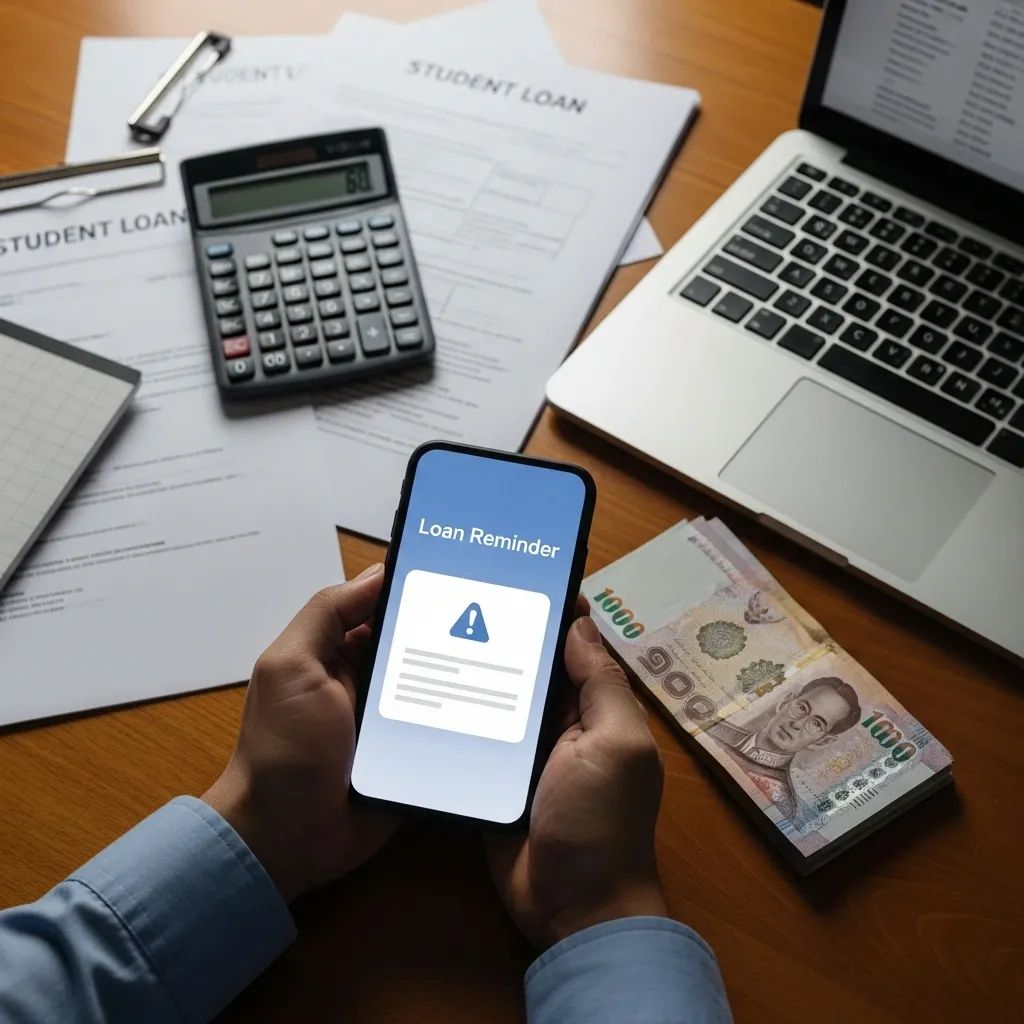
Phones across Thailand have begun lighting up with fresh reminders: more than 100,000 graduates who fell behind on their Student Loan Fund (SLF) bills now have only weeks left to settle or renegotiate before the state steps in. For many, the countdown feels like the last bridge between an unpleasant phone call and a court-ordered asset seizure.
Quick snapshot
• Court verdicts already final for 100,000+ borrowers dating back to 2016.
• SLF will start issuing enforcement writs if no action is taken this month.
• Revised law slashes penalties to 0.5% and interest to 1%, and opens a 15-year repayment runway.
• Borrowers can restructure online through SLF Connect, the fund’s website, or provincial enforcement offices.
Why December became D-Day
When the SLF began filing lawsuits in 2016, officials assumed most defendants would pay up once a judgment landed. Nine years later, more than one-third of those cases remain unresolved. The fund has already mailed and phoned defaulters repeatedly; the next step—allowed under Section 274 of the Civil Procedure Code—is to attach bank accounts, garnish salaries, or seize property. Deputy government spokeswoman Airin Phanrit says the goal is recovery rather than punishment, but she stresses that the loans were "funded by taxpayers and need to return to the classroom for future cohorts."
Borrowers who act before the enforcement clock runs out can still choose between (1) paying the full arrears shown in the SLF Connect app, or (2) signing a debt-restructuring agreement that resets all outstanding figures under the new, borrower-friendly rules.
A different math under the new law
Few realised how dramatically the Student Loan Fund Act (No. 2) 2023 would tilt the numbers in their favour:
Interest capped at 1% per year.
Penalty charges slashed from 18% to just 0.5%.
Repayments are now funnelled to principal first, followed by interest and penalties—accelerating the visible dent in the balance.
The payback window stretches to 15 years, provided the last instalment lands before a borrower turns 65.
Once a restructuring pact is signed, the guarantor walks free from liability.
Roughly 720,000 borrowers have already taken the offer, and almost 800,000 used the online portal—evidence, officials say, that the carrot works better than the stick.
Who is still in the danger zone?
Fresh SLF data as of 31 October 2025 paints a sharper picture:
• Total loan accounts: 7.3 M.
• In repayment: 3.68 M (51%).
• Fully settled: 2.06 M (28%).
• Default rate: down to 64% from previous highs but still towering.
• Age group most in trouble: 30-39 (1.13 M accounts), followed by 40-49 and 20-29.
• Top five provinces for delinquency: Bangkok, Nakhon Ratchasima, Nakhon Si Thammarat, Khon Kaen, Chiang Mai.
The SLF has already begun deducting wages directly: 490,000 people in April and 251,000 in May saw extra money siphoned from monthly pay packets. Anyone who signs a new agreement has those automated deductions recalculated downward in the following pay cycle.
How to escape enforcement in five clicks (or a short trip)
Borrowers now have more channels than ever:
• SLF Connect app – shows personalised payoff or restructuring amounts, generates QR codes for instant e-payments.
• www.studentloan.or.th – e-contract signing via ThaiD identity verification; available 24/7.
• Provincial enforcement offices – still welcome walk-ins, particularly for those whose wages or property are already under attachment.
• Mobile clinics – SLF teams pop up at district halls from Songkhla to Chiang Rai on weekends; schedules are updated on Facebook.
• Call centre 1359 – extended hours through December, including Sundays.
Remember: once a writ is issued, any fees for court officers, lawyers, and storage of seized goods will be added to the bill—costs a restructuring contract can eliminate in minutes.
Bigger stakes: Will tomorrow’s students lose out?
Economists from Thammasat University and think-tanks such as TDRI warn that chronic non-payment is already squeezing SLF’s liquidity, limiting its ability to bankroll new freshmen. One modelling exercise suggests that, unless repayments pick up, as many as 180,000 potential borrowers a year could be locked out of higher education—an especially painful prospect for families on the minimum wage in up-country districts.
Critics also caution that aggressive enforcement could scar credit histories, pushing young Thais deeper into the informal loan market. Yet supporters counter that a softer stance would punish conscientious payers and undermine faith in public finance.
What policymakers are toying with next
• Injecting an annual budget subsidy to shore up SLF liquidity so loan approvals match demand.
• Pegging repayments to income tax filings—similar to Australia’s HECS—so graduates pay more when they earn more.
• Allowing a one-time credit bureau amnesty for borrowers who regularise within a deadline, helping them qualify for mortgages later.
• Re-evaluating whether Thailand should, in the long run, move toward tuition-free undergraduate education.
The takeaway for borrowers today
Time, in short, is what the fund is offering—and what it will soon withdraw. Defaulting graduates who log in, verify their ID, and accept the new terms could clear their balance at fraction of the old cost and shelter their guarantors. Those who ignore the notices face an altogether different countdown, where the next ring of the phone may belong to a court officer rather than an SLF call centre.
Either way, the calendar will keep inching forward. For former students juggling rent, rising groceries, and the relentless Bangkok traffic, pausing long enough to click “restructure” might be the easiest new habit to pick up before the year turns.


