
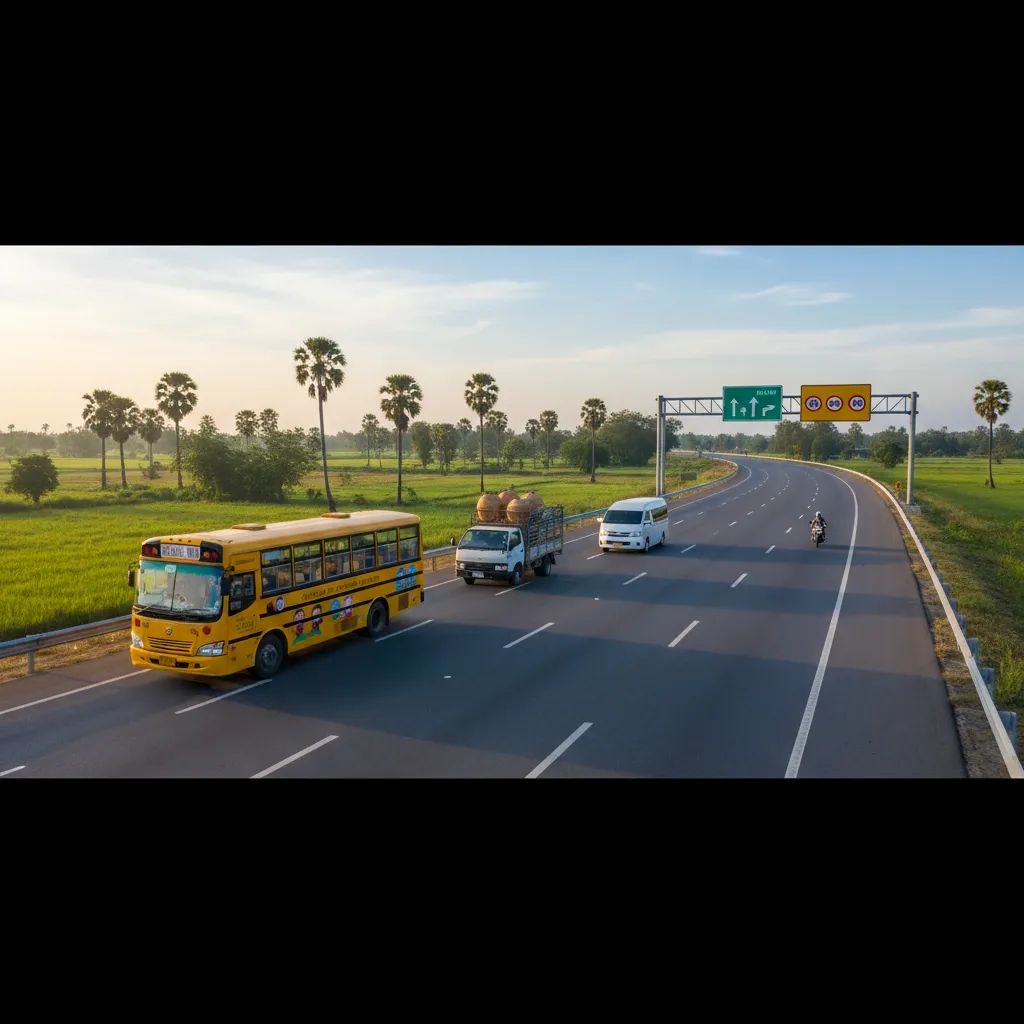
An employee shuttle bus slammed into a school transport vehicle carrying students in Prachin Buri province on June 15, 2026, sending 24 children to multiple hospitals across the region. The collision, which occurred at 7:00 AM during peak commute hours on Route 3079 in Si Maha Phot district, has reignited nationwide concerns about student transport safety standards and morning traffic management protocols.
Why This Matters
• 24 students injured: 5 classified as yellow-level (moderate injuries requiring hospitalization) and 19 as green-level (minor injuries with observation needed), with most suffering abrasions, bruising, and shock.
• No fatalities reported: All students have been accounted for; several have already been discharged from hospitals.
• Bus company assumes liability: The employer shuttle operator pledged to cover all medical expenses.
• Investigation ongoing: Thailand Royal Police are collecting evidence to determine fault and pursue charges.
The Collision at Ban Khok Mai Daeng
The six-wheel school truck was transporting students ranging from kindergarten through upper secondary levels from Sri Maha Phot School and Wat Mai Krong Thong School. Witnesses reported the vehicle was turning right from a residential side street onto the main highway when the employee shuttle—traveling straight at an estimated 60–70 kilometers per hour—struck the rear with significant force.
The impact caused severe damage to the school vehicle's rear section. Students were thrown from their seats, and witnesses reported confusion at the scene with distressed students requiring immediate assistance. The shuttle bus, reportedly transporting workers for a manufacturing company, was unable to brake in time despite the driver's claim that two pickup trucks had already exited the village moments before the school truck emerged.
Emergency responders from the Sawang Bamphen Tham Sathan Prachin Buri rescue unit, traffic police, and local authorities arrived within minutes. Injured students were distributed across four area hospitals: 10 to Sri Maha Phot Hospital (1 yellow, 9 green), 8 to Chularat 304 Inter Hospital (2 yellow, 6 green, with 6 later released), 4 to Kasemrad Prachin Buri Hospital (all green, all released), and 2 to Chao Phraya Abhaibhubejhr Hospital (both yellow-level).
What This Means for Parents and Schools
This incident highlights persistent vulnerabilities in Thailand's student transport infrastructure. Despite existing regulations requiring school vehicles to display orange reflective signage, carry fire extinguishers and emergency hammers, and employ drivers aged 25-plus with at least three years of licensed experience, enforcement remains inconsistent. Many operators run unlicensed or modified vehicles that fail to meet safety codes, and roadside pickup zones near schools often lack clear demarcation or traffic control.
For families relying on private school shuttles, the Thailand Department of Land Transport maintains a public database at schoolbussafety.dlt.go.th where parents can verify vehicle registration and compliance status. Parents can enter their child's school name or the vehicle license plate number to view safety inspection records and verify current insurance coverage. The database also tracks GPS-enabled vehicles that monitor driver behavior in real time—a technology the government has promoted but not mandated.
Parents should confirm their child's transport provider holds valid permits and adheres to the "3E" safety framework: Education (teaching children escape procedures), Enforcement (strict adherence to capacity limits and route protocols), and Engineering (alarm systems that prevent children being forgotten in parked vehicles).
Rising Accident Rates and Current Safety Concerns
This Prachin Buri incident occurs amid a broader pattern of concerning transport accidents in Thailand. In 2024, the country recorded 40 school transport accidents resulting in 10 child fatalities, including a devastating tour bus fire on October 1, 2024, that killed 23 people—20 students and 3 teachers. During the first two months of 2025 alone, six incidents injured 60–70 students. The June 2026 crash underscores that these vulnerabilities persist despite ongoing regulatory efforts.
Thailand's public bus accident data from 2024 shows 208 incidents, with the Thailand Traffic Police attributing 81.1% to driver error—primarily speeding, tailgating, drowsy driving, and failure to yield. The trend has alarmed transport regulators, who note that unlicensed modifications (such as unauthorized CNG tank installations or capacity expansions) compound risk.
The morning rush remains the most dangerous window for student transport. Between 6:30–8:30 AM, congestion around schools creates pinch points where private vehicles, commercial trucks, and school shuttles compete for limited road space. Many institutions lack dedicated drop-off lanes, forcing parents to idle in traffic or double-park, which obstructs sightlines and slows reaction times for approaching drivers.
Government Response and "3 Prepare, 1 Avoid" Campaign
In response to mounting pressure, the Thailand Ministry of Education and Ministry of Transport have coordinated nationwide inspections focusing on brake systems, tire condition, and driver credentials. The Bangkok Metropolitan Police Bureau launched a "3 Prepare, 1 Avoid" public awareness drive urging parents to:
Prepare belongings: Check school bags the night before to minimize curbside delays.
Prepare the child: Have students ready to exit immediately when the vehicle stops safely.
Prepare pickup arrangements: Establish clear meeting points following the rule "child waits for car, car does not wait for child."
Avoid parking violations: No engine-off idling, no exiting the vehicle, and no double-parking that blocks traffic flow.
Prachuap Khiri Khan province has piloted an integrated model at Prachuap Wittayalai School, where uniformed traffic volunteers equipped with reflective vests and light batons manage drop-off zones during peak hours. The program includes raised pedestrian islands, non-slip crosswalk surfaces, and speed-limit signage posted 200 meters before school entrances. Local authorities plan to expand the model province-wide by the end of 2026.
Legal Accountability and Next Steps
The Sri Maha Phot Police Station superintendent confirmed investigators are interviewing both drivers and analyzing dash-cam footage from nearby vehicles. The school truck driver stated he was yielding for other vehicles when struck; the shuttle driver maintains he was traveling within the legal limit and could not anticipate the truck entering the roadway.
Under Thailand's Road Traffic Act, drivers involved in accidents causing injury face penalties ranging from fines to imprisonment depending on negligence findings. The bus company's pledge to cover medical costs does not shield the driver from criminal liability if investigators determine reckless conduct.
For residents in high-traffic districts, this incident underscores the importance of community vigilance during school hours. Drivers approaching residential zones between 6:30–8:00 AM should reduce speed to 40 km/h or below, anticipate sudden stops, and maintain at least a three-second following distance—particularly when passing marked school vehicles with flashing amber lights.
Systemic Challenges Remain
While the Thailand Cabinet has allocated funding for GPS installation subsidies and launched a national vehicle compliance registry, structural gaps persist. Thousands of school shuttles operate without proper licensing, especially in rural provinces where oversight capacity is limited. The Department of Land Transport reported that only a small fraction of registered school vehicles meet updated fire-retardant interior material standards introduced in 2024.
Cultural factors also play a role. Many families prefer informal neighborhood carpools or converted pickup trucks over certified services due to cost, despite the legal prohibition on modified flatbeds for student transport. Enforcement officers face pushback when impounding noncompliant vehicles, particularly in areas where no affordable alternative exists.
The path forward requires simultaneous investment in infrastructure (dedicated school zones, improved signage), regulation (stricter licensing and unannounced inspections), and education (driver training programs emphasizing defensive techniques around school routes). Until these measures converge, mornings on Thailand's provincial highways will remain fraught with preventable risk.
Parents seeking more information on transport safety standards or wishing to report noncompliant vehicles can contact the Department of Land Transport hotline at 1584 or file complaints through the ministry's mobile application.


