
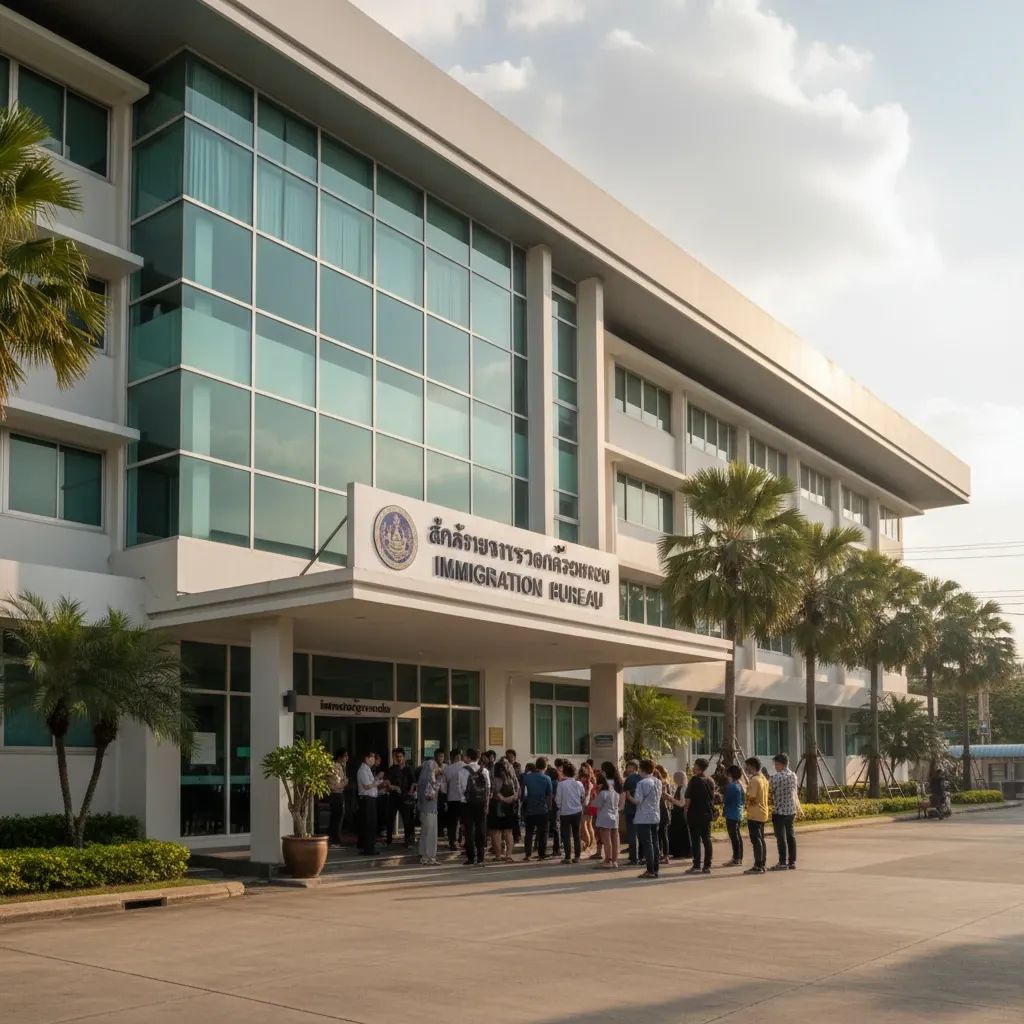
A quiet evening at an urban condominium complex turned into a deportation case after neighbors alerted police to what they perceived as threatening behavior from one resident. What began as a community safety call on February 19 unraveled a far more serious legal violation: the 37-year-old Nigerian national had no authorization whatsoever to remain in Thailand. His visa had expired months earlier, and he was apprehended at Manor condominium in Nonthaburi under Section 81 of the Immigration Act.
Why This Matters for Your Security and Legal Standing
• Your complaint triggers immigration audits: When you report disruptive behavior to police, authorities automatically cross-reference that person's visa status. A noise complaint can escalate into deportation proceedings for the subject.
• Every day unpermitted is a financial and legal penalty: Daily overstay fines reach 500 THB; arrest multiplies consequences with re-entry bans spanning 5 to 10 years.
• Voluntary disclosure beats forced removal: Turning yourself in to immigration authorities results in dramatically shorter re-entry bans than being caught and arrested.
How the Evening Unfolded in Bang Kraso
Officers from Rattanathibet Police Station responded around 7:00 p.m. on February 19 after Manor condominium residents submitted multiple complaints to authorities. The person in question, identified as Mr. E. C. (also named Emmanuel Chukwuebuka in related records), had been exhibiting what residents described as alarming conduct—sustained noise disturbances, verbal aggression, and threatening demeanor that produced genuine anxiety among neighboring residents.
When Rattanathibet Police arrived at the building, routine questioning turned into an immigration investigation. Officers conducted a standard status check on the suspect's travel documents. His passport revealed the critical fact: his permission to remain in Thailand had expired. There was no valid visa extension, no border-run documentation, no legitimate legal standing. Under Section 81 of the Immigration Act B.E. 2522 (1979), remaining in the kingdom without authorization constitutes a direct violation. Arrest followed immediately.
Mr. E. C. now faces formal charges as a foreign national residing unlawfully in Thailand. The exact duration of his overstay and whether additional charges regarding public disturbance or threatening behavior might be pursued remain undisclosed by authorities. He remains in police custody pending formal processing through the justice system.
Immigration Enforcement Has Intensified Significantly
This incident reflects a broader trend in Thailand's immigration enforcement. Under Section 81 of the Immigration Act, visa overstays have always carried the consequence of deportation, but enforcement intensity has increased markedly. Immigration authorities have prioritized proactive enforcement operations at airports, land borders, and within cities in addition to reactive investigations.
Recent enforcement activity demonstrates this escalation. Between January 2025 and February 2026, immigration authorities denied entry to approximately 2,900 foreign nationals at Thai airports, primarily for attempting to re-enter on repeated visa-exempt entries without sufficient time in their home countries. A single Bangkok-based operation in August 2025 resulted in 328 detentions. The Thailand Immigration Bureau has prioritized two specific populations: perpetual travelers and remote workers who exploit visa exemptions to remain indefinitely, and organized crime networks—including scammers—operating from Thai soil.
In January 2026 alone, Nonthaburi authorities arrested 11 Nigerian men as part of 13 foreign suspects dismantled for operating a coordinated romance-scam enterprise. Nearly all individuals in that network also held expired visas, suggesting a pattern: criminal enterprises attract individuals willing to ignore immigration regulations.
What Happens Now if You Discover Your Visa Has Lapsed
For foreign nationals already living in Thailand, the practical question is urgent: What should you do if your permission to stay has actually expired, unbeknownst to you?
Voluntary surrender produces measurably better outcomes than arrest. This is not academic theory but a direct comparison embedded in immigration penalty law. If you report yourself to any Immigration Office and admit to overstaying:
• Overstay lasting 90 days to one year results in a 1-year re-entry ban.
• An overstay of 1 to 3 years carries a 3-year re-entry ban.
• Overstays between 3 and 5 years impose a 5-year re-entry ban.
• Any overstay exceeding 5 years triggers a 10-year re-entry ban.
Arrest, by contrast, produces automatic—not negotiable—blacklisting under stricter thresholds. If arrested for any overstay exceeding one year, you receive a 5-year automatic ban. Over three years, you face a 10-year automatic ban. You also spend weeks or months in an Immigration Detention Centre (IDC) awaiting flight arrangements, which you must fund yourself. Passports are held by flight stewards and returned only upon arrival in your home country.
The operational mathematics are clear: voluntarily walking into an immigration office is financially and temporally superior to waiting for apprehension.
Daily Financial Exposure You May Not Have Calculated
Most foreign nationals do not immediately grasp the ongoing financial accumulation while overstaying. The Thailand Immigration Bureau imposes a daily fine of 500 Thai Baht per day, capped at 20,000 THB regardless of overstay length. This means:
• A 40-day overstay costs the full 20,000 THB maximum.
• A 90-day overstay also costs 20,000 THB—not more.
• A 2-year overstay still results in a 20,000 THB fine (though criminal deportation procedures and re-entry bans far exceed this penalty).
Children under 15 are exempt from fines but still receive overstay notations in their passports, which complicates international travel applications later. The fine is separate from deportation costs, legal fees, and any additional penalties for secondary offenses (such as unauthorized employment).
How Immigration Checks Now Operate in Daily Life
The Thailand Immigration Bureau has deployed several systematic tools to identify and flag individuals with questionable status. Understanding these mechanisms helps explain why a noise complaint can cascade into an immigration investigation.
Thailand Digital Arrival Card (TDAC), mandatory since May 1, 2025, tracks all entries and exits with greater precision than the old paper forms. Every border crossing is timestamped and electronically recorded. Attempts to game the system—such as frequent land-border "visa runs"—are immediately visible to border officers reviewing your pattern.
Enhanced scrutiny at high-risk borders means certain checkpoints operate under zero-tolerance policies. Mae Sot, the porous border with Myanmar, now automatically denies entry to any individual flagged previously for visa violations or romantic scams. Once denied at Mae Sot, subsequent entries become significantly more difficult.
Visa-exempt extensions are no longer routine. The Thailand Immigration Bureau now reviews each extension request individually. Officers require proof of onward travel bookings, hotel reservations, and a substantive reason for staying longer. Extensions for visa-exempt entries are capped at two per calendar year. Land-border entries are typically not eligible for extensions at all, forcing individuals to either depart or transition to a formal visa category.
Inter-agency data sharing between the Thailand Immigration Bureau and the Thailand Royal Police means any police contact—a traffic stop, a noise complaint investigation, a routine street check—can trigger an immigration status query. This is standard procedure.
The Nonthaburi Context: Safety, Community Dynamics, and Reporting
Nonthaburi province ranks as the #81 safest location in Thailand for solo travelers, and foreign nationals living in secured condominiums report consistent feelings of security. Most mid-to-high-end residential buildings feature 24-hour on-site guards and CCTV systems covering common areas and entry points. Serious burglaries remain uncommon in gated facilities, though petty theft—stolen bicycles, unattended bags—occurs sporadically.
Yet the Manor condominium case introduces a social complexity residents should understand. When you file a formal complaint with police about a neighbor's disruptive conduct, that complaint enters an official police report. If the subject holds questionable immigration status, what began as a quality-of-life issue can escalate into an immigration investigation. For Thai residents living in mixed-nationality buildings, this dynamic carries practical significance.
Report observable, factual behaviors. Document the specific times noise occurred, duration, frequency, and nature (music, voices, objects dropping, etc.). Avoid subjective characterizations such as "frightening," "menacing," or "dangerous" unless you can link those to specific concrete actions. Objective language keeps the complaint focused on the actual disturbance.
Property managers and juristic committees increasingly coordinate with local authorities on tenant documentation. Maintaining current tenant registries, verifying visa status during move-ins, and coordinating with local police substations now functions as essential property management. Some condominiums now require copies of passport identification pages and visa stamps during the lease-signing process. This reflects legal risk management practices.
Practical Checklist: Protecting Your Legal Status
Set expiration alerts with substantial lead time. Calendar notifications should trigger at least three weeks before your authorized stay expires. This window allows time to apply for extensions, arrange travel, or prepare departure logistics. Immigration offices now individually review each extension; vague reasons or incomplete paperwork result in denial. Early submission—at least one week prior to expiration—improves approval odds.
Carry identification documentation constantly. Keep a digital copy of your passport identification page and current Thai visa on your phone, accessible offline. Physical copies should be stored in your residence. Immigration police conduct routine spot checks in commercial zones, at traffic checkpoints, and during random street verification. Inability to produce documentation on demand can result in temporary detention until status is verified through centralized systems—a process that requires 2 to 4 hours minimum.
Understand your burden of proof. Under Section 81 of the Immigration Act, the burden lies entirely with you to demonstrate valid permission to reside in Thailand. Courts uniformly uphold deportation orders; judicial appeal processes are lengthy and rarely overturn immigration decisions.
Plan extensions as a formal application process, not a casual errand. Gather accommodation proof, travel documentation, and explicit reasons for extension. Applications submitted hastily or with missing components are denied, forcing you to either depart or attempt reapplication after a border run—which may itself be denied if your re-entry pattern appears suspicious.
If you discover you have overstayed, visit an immigration office immediately. Do not delay, do not attempt to leave the country and re-enter, and do not wait to see if anyone notices. Voluntary disclosure is the singular best strategy available once a violation has occurred.
Understanding Current Immigration Enforcement
The Thailand Immigration Bureau has prioritized enforcement of existing immigration law with greater intensity in 2025 and 2026. Deportation for visa overstays is not a new consequence—it has been the legal reality under Section 81 of the Immigration Act for decades. What has changed is the consistency and frequency of enforcement operations targeting violators.
Foreign nationals should understand:
• Enforcement operations have increased frequency in urban centers, tourist destinations (Phuket, Koh Samui, Pattaya), and areas known for criminal activity.
• Border denials are faster and more granular—decisions made efficiently based on travel history and databases.
• Re-entry bans are imposed according to established law—penalties are determined by overstay length, as outlined in immigration statutes.
• Inter-agency coordination is standard practice—immigration authorities routinely access police records and other government data.
For Thai citizens living alongside foreign nationals, the takeaway is straightforward: quality-of-life complaints about a neighbor's conduct are legitimate, and police follow standard procedures in responding. The individual apprehended for noise disturbance faces legal consequences under existing law because he had no valid authorization to remain in Thailand.
The only defensible strategy is maintaining lawful immigration status continuously. Everything else—delay, hope, assumption that enforcement is selective—leads to deportation, years of re-entry prohibition, and international complications that reverberate through future travel applications across other nations.


