
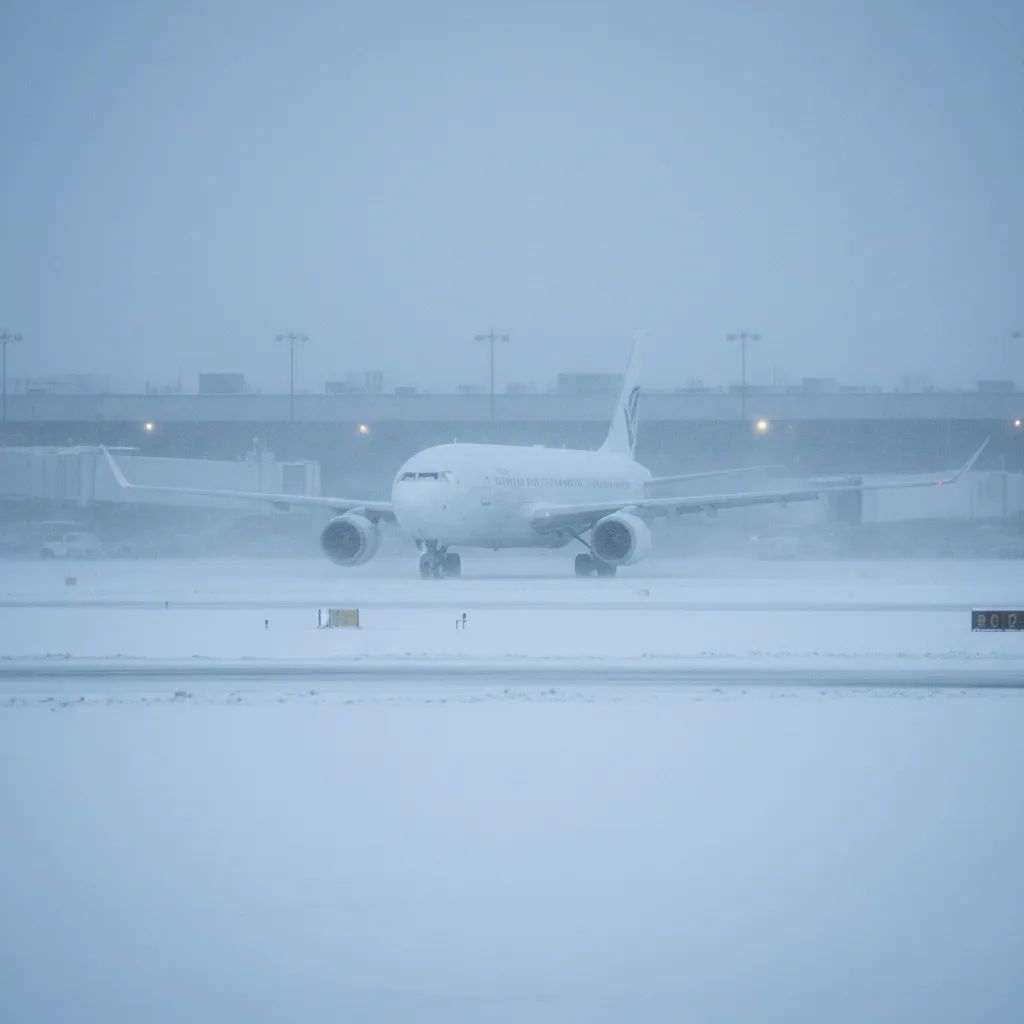
Thailand-based travelers and expats planning trips to the United States should expect continued flight disruptions through at least the end of February following a massive blizzard that has paralyzed air travel along the U.S. East Coast. Over 10,000 flights have been canceled nationwide from Saturday through Tuesday, with major carriers still scrambling to restore operations as the storm system clears.
Why This Matters
• Return flights and connections: Travelers currently in Thailand with tickets to or through New York, Boston, or Philadelphia face extended delays through at least February 26.
• Peak cancellation day: Monday saw more than 5,700 flight cancellations, the highest single-day total, with nearly 98% of departures from LaGuardia grounded.
• Economic ripple: Preliminary estimates place the storm's cost between $5B-$115B, though experts dispute the upper range, marking it as potentially the first billion-dollar weather disaster of 2026.
• Travel waivers: Major airlines have extended fee waivers through early March, allowing travelers to reschedule without penalty.
Regional Paralysis Strands Millions
The blizzard, informally dubbed Winter Storm Hernando, dumped 2-3 feet of snow across the Northeastern United States from February 22-24, transforming one of the world's busiest air corridors into a frozen standstill. By Tuesday evening U.S. time (February 25 Bangkok time), operations at key hubs remained severely compromised, though some carriers began planning limited resumptions.
New York City's two primary airports bore the brunt of the chaos. LaGuardia Airport (LGA) and John F. Kennedy International Airport (JFK) effectively ceased functioning on Monday, with cancellation rates hitting 98% and 91% respectively. Delta Air Lines suspended all operations at both facilities, along with Boston Logan and Newark Liberty International, extending the suspension through Tuesday morning.
Boston Logan International Airport (BOS) mirrored the devastation, with 92% of outgoing flights scrapped on Monday. Philadelphia International Airport (PHL) canceled over 80% of departures, while Newark Liberty International Airport (EWR) saw approximately half its schedule wiped out. Smaller facilities fared even worse—Atlantic City International and Martha's Vineyard airports remained shuttered as of Monday evening, part of roughly a dozen airports unable to reopen.
Impact on Thailand-Based Travelers
For residents of Thailand with connections through these transit points, the disruption extends far beyond simple delays. The U.S. East Coast corridor serves as a critical gateway for travelers from Southeast Asia, particularly those flying through Tokyo, Hong Kong, or directly via carriers like Thai Airways, United Airlines, and ANA. With rebooking queues stretching into the hundreds of thousands and hotel capacity strained near affected airports, travelers face potential delays of 3-5 days before normal routing can resume.
Airlines including American Airlines, United Airlines, JetBlue Airways, and Spirit Airlines issued proactive cancellations beginning Saturday and have offered waivers for rebooking. Major carriers serving Thailand-US routes—Thai Airways, United, and ANA—have updated their rebooking policies on their websites. Some carriers extended flexible options through February 26 or even March 4, allowing passengers to reschedule without change fees. For Thailand-based travelers holding tickets through affected airports, checking flight status remotely before departing for Suvarnabhumi or Don Mueang airports is essential to avoid wasted trips.
The financial sting extends to accommodation and ground transportation. With snowfall totals reaching 37.9 inches in Providence, Rhode Island—the city's largest storm on record—and 19.7 inches in New York's Central Park (the city's ninth-biggest snowstorm in history), ground transport options remain limited. Travel bans implemented across seven states—New Jersey, New York, Pennsylvania, Delaware, Connecticut, Rhode Island, and Massachusetts—brought normal movement to a halt for over 40 million people.
Economic Shockwaves Beyond Aviation
The blizzard's economic fallout reaches far beyond canceled flights. States of emergency across seven jurisdictions triggered widespread travel bans and business closures, effectively freezing commerce across one of the world's most economically productive regions. Nearly 647,000 customers lost power by Monday morning, with Massachusetts and New Jersey bearing the worst outages at 214,000 and 128,000 customers respectively.
The power grid failures created cascading disruptions through supply chains and business operations. Economists noted that when crucial transportation hubs and electrical infrastructure fail simultaneously, the ripple effects extend to retail, hospitality, and manufacturing sectors. Public transit systems collapsed—the Long Island Rail Road fully suspended service, New York City subways experienced severe delays, and bus and rail operations in New Jersey and Rhode Island ground to a halt. Amtrak adjusted and canceled routes throughout the corridor.
Private weather firm AccuWeather provided a preliminary damage estimate between $105B-$115B, though other experts dismissed this figure as excessively high and lacking methodological detail. However, there is broad consensus that the storm represents a multi-billion dollar weather disaster, with insurance sector losses expected to include wind damage, structural stress from snow and ice accumulation, fallen trees, and freezing-related water damage from power outages.
Insurance analysts warn of potential underinsurance problems due to recent increases in construction and rebuilding costs, which could leave policyholders facing significant out-of-pocket expenses. The ultimate financial impact will depend on geographic concentration of losses, policy deductibles, and coverage penetration rates across the affected region.
Historical Context and Storm Severity
While Winter Storm Hernando ranks as a significant meteorological event, it falls short of the most catastrophic blizzards in U.S. history. The Great Blizzard of 1888 remains the benchmark, with snowfall ranging from 10-58 inches and snowdrifts exceeding 50 feet, resulting in approximately 400 fatalities and damages equivalent to roughly $900M in current dollars.
The Storm of the Century in 1993 impacted the entire eastern third of the United States, closing all major East Coast airports and claiming 318 lives. The Blizzard of 1978 in New England caused over 100 deaths and nearly 5,000 injuries, with Boston receiving 26.7 inches and wind gusts reaching 92 mph.
The 2026 storm's distinguishing features include its concentration in the Northeast megalopolis and the unprecedented disruption to modern air travel infrastructure. Wind gusts reached 98 mph in Wellfleet, Massachusetts, approaching hurricane strength and contributing to the massive power outages. Providence's record-breaking 37.9 inches surpassed all previous measurements for that city, though regional totals remained below historic benchmarks.
Safety Protocols and Expert Recommendations
Meteorologists and emergency management officials issued stringent warnings throughout the storm's duration. The National Weather Service characterized conditions as "extremely treacherous" and "nearly impossible" for travel, with blizzard conditions and sharply reduced visibility persisting through Tuesday.
New York Governor Kathy Hochul declared a travel ban for commercial vehicles and tractor trailers on major interstates. While some bans have been lifted, hazardous travel advisories remained in effect across the region. Coastal flooding and erosion affected areas from Delaware to Cape Cod, with hurricane-strength wind gusts creating additional hazards in immediate coastal regions.
NWS meteorologist Owen Shieh warned residents about the "deceptively heavy" snow, advising extreme caution when shoveling and recommending frequent breaks to avoid overexertion. The combination of wet, heavy snow and sustained high winds created ideal conditions for downed trees and prolonged power outages, with restoration efforts hampered by continuing adverse conditions.
Planning Ahead for Thailand Residents
For Thailand-based travelers with upcoming U.S. itineraries, the storm highlights the vulnerability of winter travel through Northeastern hubs. Alternative routing through southern gateways—such as Miami (served by Thai Airways and United), Atlanta (Delta hub with connections to Asian carriers), or Dallas (American Airlines hub)—may offer more reliable connections during winter months, though these often add 2-4 hours of flight time and increase ticket costs by 10-20%. Check with your carrier for availability on these routes from Bangkok.
Travel insurance policies covering weather-related disruptions become particularly valuable during this season. Standard coverage typically includes accommodation expenses and meal allowances during extended delays, though policies vary significantly in coverage limits. Travelers should verify their policy specifics before departure, particularly regarding weather-related cancellation provisions.
The storm also underscores the importance of maintaining flexible travel schedules when routing through northern U.S. airports between December and March. Building in 24-48 hour buffers before critical commitments—business meetings, cruise departures, or onward international flights—can prevent cascade failures when weather disrupts initial legs of complex itineraries.
Airlines' extended waiver periods through early March provide an opportunity for travelers to reschedule without financial penalty. For those holding non-refundable tickets through affected airports, contacting carriers proactively to explore rebooking options before original departure dates may secure better alternative routing than waiting until travel day.


