
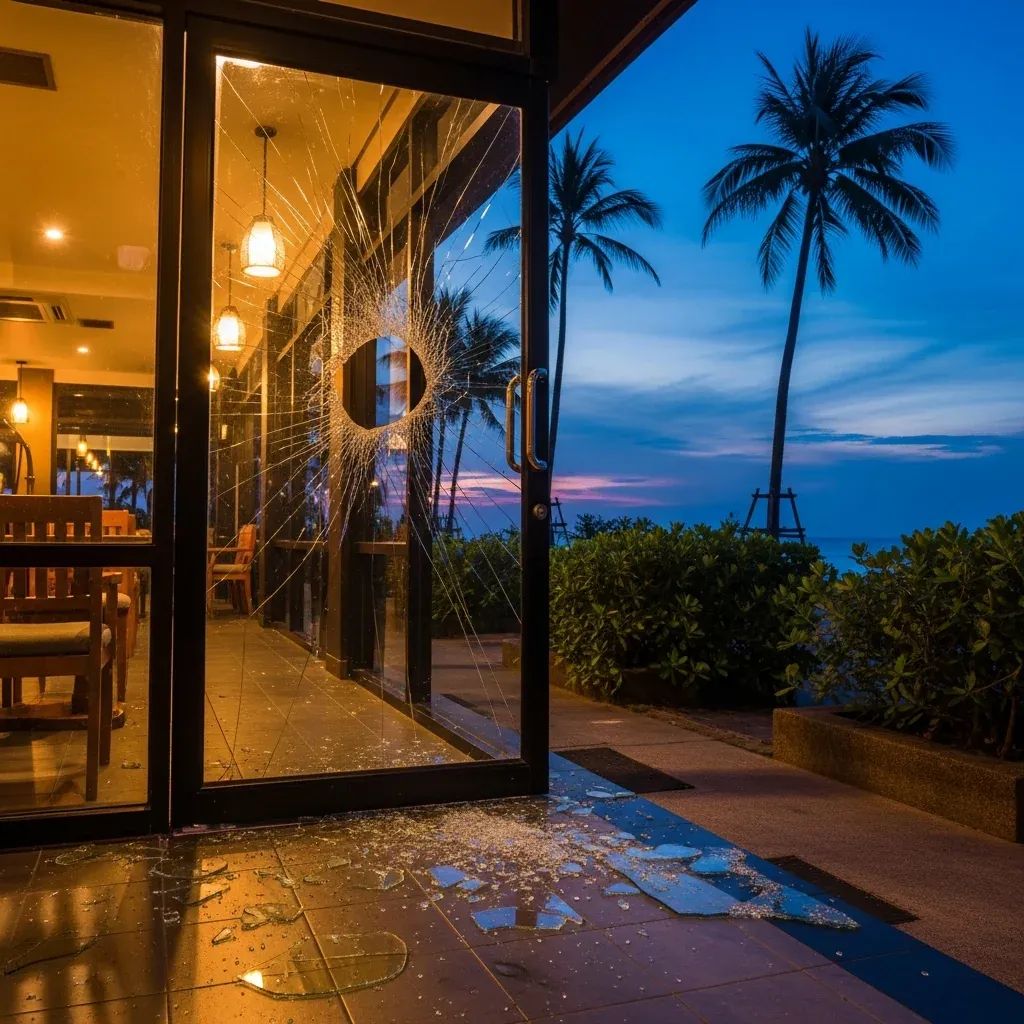
A holiday evening meant for Pad Thai and sea breezes at Karon Beach turned fatal when an Australian traveller sprinted into a restaurant’s glass entrance, suffering a catastrophic leg wound that doctors could not stem. The case has reignited questions about building‐safety enforcement, mental-health support for visitors and the economic image of Phuket as Thailand’s blue-chip tourism hub.
Key talking points for residents and business owners
• The victim, a solo male tourist, bled to death after colliding with a non-laminated glass panel on 11 December.
• Police say CCTV shows behaviour resembling severe disorientation moments before impact; toxicology is pending.
• Phuket’s restaurant operators are legally obliged to install tempered or laminated safety glass under 2023 regulations, yet loopholes remain.
• Businesses could face both civil compensation and criminal negligence charges if non-compliant fittings are confirmed.
What unfolded inside the Karon eatery
Witnesses told investigators that the Australian tourist walked in alone shortly after 22:30, nodding repeatedly and appearing lost. Other diners shifted tables as the man’s erratic movements intensified. When two waiters tried to offer help, he suddenly sprinted, shoulder-first, into the transparent front door. The glass door shattered; a shard sliced his right thigh, severing a major artery. Staff applied towels as improvised tourniquets while paramedics raced from Chalong Hospital, 8 km away, but the massive blood loss proved fatal within an hour.
The mystery behind the behaviour
Police from Karon station stress that no clear motive or trigger has been identified. Investigators are combing through:
• CCTV footage from adjoining shops for the tourist’s route before entering the restaurant
• Hotel check-in records and immigration data to reconstruct his day
• Medical files, if any, supplied by the Australian embassy
Early interviews yielded no sign of confrontation, alcohol service, or theft. Officers have requested a toxicology screen to determine whether prescription drugs, alcohol, or narcotics may explain the tourist’s disorientation. Results are expected within 2 weeks.
Thailand’s glass-safety rulebook in spotlight
After several high-profile glass accidents nationwide, the Interior Ministry updated a rule in February 2024 requiring tempered or laminated safety glass for doors and partitions in restaurants classified as public buildings. The standards mirror TISI 1222-2560 for laminated panels and TISI 965-2560 for tempered glass, which prevent large, razor-sharp shards. Preliminary checks suggest the Karon outlet used standard float glass, cheaper but prone to lethal breakage. Should that be confirmed, the owner faces:
• Civil suits from the victim’s family under Section 420 of the Civil and Commercial Code
• Potential charges of criminal negligence causing death, carrying up to 10 years’ imprisonment and/or a ฿200,000 fine
Why Phuket cannot ignore liability gaps
The island welcomed 9.2 M visitors in the first 11 months of 2025, roughly 70% of pre-pandemic traffic. Incidents like this ripple across social media faster than Tourism Authority marketing campaigns. Travel insurers already list “unsafe building fixtures” as an exclusion risk in parts of Southeast Asia, prompting analysts to warn that repeat episodes could nudge premiums upward for Thai-bound travellers.
Local restaurateur consortium PBA estimates that upgrading every legacy door in the Karon‐Kata corridor to safety standards would cost ฿18,000-฿35,000 per panel, a fraction—operators argue—of a single wrongful-death payout. Yet compliance checks remain spotty; municipal officials acknowledge they rely on complaint-driven inspections rather than routine audits.
Next steps: from ad-hoc fixes to systemic safety
Phuket’s provincial hall has called an emergency meeting with construction-materials suppliers, tourism police and the Australian consular office. Proposed measures include:
A 60-day amnesty for eateries to self-report and replace substandard glass without fines.
A multilingual QR code poster in restaurants outlining emergency hotlines and first-aid tips for patrons.
Joint night patrols of tourist police and municipal engineers to spot glaring hazards during peak season.
While the tragedy of one visitor cannot be undone, officials insist sweeping improvements can restore confidence in an industry that fuels more than 80 % of Phuket’s GDP. For residents, the episode is a sobering reminder that tourism prosperity hinges not only on sunny forecasts but on the transparent safety of seemingly ordinary fixtures like a restaurant door.


