
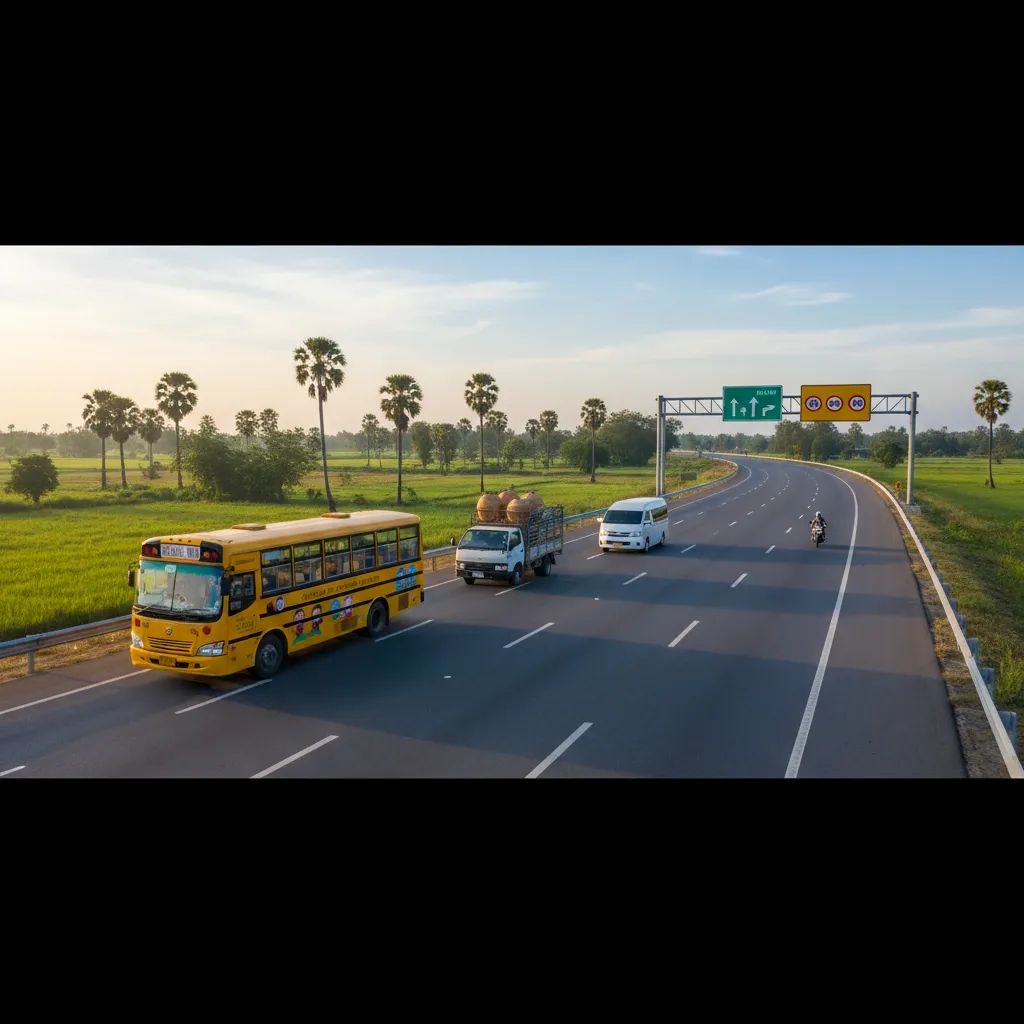
A routine school morning in rural Suphan Buri province turned tragic when a school van and a songthaew carrying students collided head-on, the impact violent enough to pin two children inside twisted metal. By the time rescue crews completed their work with hydraulic cutters, 25 young passengers—boys and girls ranging from age 7 to 17—were injured and scattered across Bang Pla Ma Hospital. The crash exposes a systemic vulnerability in how Thailand's poorest rural families move their children to class, a system held together more by habit and economics than by regulation.
Why This Matters for Your Family
• Children remain unsecured in vehicles: The fact that students were thrown from their seats signals a widespread absence of functional seatbelts—a violation that remains common in provincial school transport operations
• Overcrowding persists unchecked: The songthaew was carrying approximately 30 students, likely well beyond its safe capacity, yet operates with minimal oversight
• Rural roads lack basic infrastructure: Highway 340's narrow shoulders and informal parking create collision multiplier effects—the parked trailer was a preventable third victim in this crash
The Incident: Where Safety Systems Failed
The collision unfolded around 8 a.m. on Wednesday near kilometre markers 45–46 of Highway 340, the primary corridor linking Suphan Buri to Bang Bua Thong. A six-wheeled songthaew driven by 30-year-old Thanawat was transporting roughly 30 students when it pulled from a side street onto the highway's main lane. Simultaneously, 72-year-old Rangsan was operating a school van carrying 14 children in the opposite direction. The two vehicles collided mid-lane.
The impact possessed enough force to send the heavier songthaew careening sideways into a parked trailer truck sitting on the roadway's shoulder—a location where long-haul drivers routinely rest between shifts without warning lights or hazard protocols. The school van crumpled inward, trapping two students whose rescue required the insertion of hydraulic cutting equipment.
Of the 25 injured children, thirteen were male and twelve female. Most sustained cuts, lacerations, and head trauma classified as minor by Bang Pla Ma Hospital staff. However, two of the trapped students required extended evaluation for potential internal injuries, and families were advised to monitor all survivors for delayed concussion symptoms over the following weeks—a standard protocol that assumes parents have the literacy and access to recognize neurological warning signs.
The Competing Versions of Events
Who caused the collision remains disputed. Songthaew passengers told traffic investigators that Rangsan's van appeared to be traveling at elevated speed before impact. The van driver countered that Thanawat's songthaew "suddenly pulled out" from the side street without adequate warning, leaving insufficient time for braking.
Neither vehicle had its speed measured by electronic enforcement. Thailand Highway Police do not routinely deploy cameras or radar on provincial secondary routes, relying instead on manual investigations after the fact. This evidentiary gap reflects a broader reality: Thailand's road enforcement infrastructure concentrates on urban expressways and major national highways. Routes like Highway 340, despite serving thousands of commuters daily, operate under assumptions of driver responsibility that crash statistics consistently disprove.
Songthaews: The Regulatory Gray Zone
The songthaew operated by Thanawat typifies a transport category that exists in legal limbo across Thailand's countryside. These six-wheeled modified pickup trucks are registered as private vehicles yet function as commercial carriers for students, laborers, and rural commuters. They cost roughly one-third the price of a proper minibus, making them irresistible to schools with constrained budgets and to operators seeking profit margins.
Officially, Thailand's Land Transport Department oversees these vehicles and should mandate periodic safety inspections, seatbelt installation, and passenger capacity limits. In practice, systematic enforcement remains challenging due to limited regulatory resources. Thousands of informal school transport operators nationwide conduct business with minimal state oversight.
The songthaew carrying 30 students that morning likely exceeded its legally registered capacity by 50%, yet operated without triggering regulatory intervention. That overcrowding directly contributed to the entrapment scenario—more bodies compressed into a smaller frame means fewer pathways for emergency exit and a higher likelihood of crush injuries during deceleration.
What Residents Need to Know Right Now
If your child commutes by school transport—whether through a contracted operator or a shared songthaew arrangement—this incident reveals three areas where your intervention can matter immediately.
Demand Documentation of Vehicle Capacity: Under the 2024 school transport guidelines, operators must display and provide proof of the maximum passenger limit. If your school cannot produce a certificate showing the vehicle's safety inspection and approved capacity, contact the district education office rather than accepting verbal assurances. Overcrowding is the single most predictable factor in fatal school transport crashes.
Verify Seatbelt Functionality: The fact that children were thrown from seats indicates that restraint systems either do not exist or are not in use. During school pickup or drop-off, observe whether children are actually using seatbelts and whether those belts remain accessible during the journey. Request that your school conduct a surprise seatbelt audit by an independent party, not by the operator itself.
Report Violations Anonymously: The Thailand Land Transport Department maintains a hotline (1584) and a mobile application specifically designed to report overcrowded or speeding school vehicles. Schools and operators know these channels exist but often underestimate parent follow-through. A documented report creates a paper trail that accumulates toward enforcement action.
The Cascade Effect: January's Accident Wave Meets February's Negligence
In January 2026, Thailand experienced school vehicle accidents that resulted in one fatality and 122 injuries. This toll prompted the Ministry of Education to issue a directive in early February requiring all schools to complete audits of their transport contractors by March 15.
The audit occurred just days before the songthaew and school van collided on Highway 340.
The audit mandate itself reveals the sluggish nature of regulatory response in Thailand's education system. Rather than deploy inspectors or establish minimum standards, the ministry defaulted to asking schools themselves to evaluate their own contractors—an approach equivalent to asking restaurants to self-certify their own food safety rather than conducting health department inspections. Most schools, particularly in rural areas where this collision occurred, lack the technical expertise to evaluate mechanical safety or driver training credentials.
Proposed Reforms That Have Stalled
Several substantive reforms have circulated through Thailand's bureaucratic channels but have not yet become enforceable law.
GPS Tracking Mandates would require all vehicles carrying more than 10 students to install real-time location and speed monitoring systems. Schools could observe whether drivers exceed speed limits or deviate from established routes. Insurers argue this would reduce claims by 25% within five years. Yet the proposal has stalled because Thailand's informal transport operators argue that GPS equipment costs ฿3,000–5,000 per vehicle, a sum equivalent to a month's profit for many operators. They contend that mandatory GPS would force 30% of the informal sector out of business.
Star Ratings for Schools (SR4S) represents a different approach. ThaiRAP, in partnership with the Children and Youth Council of Bangkok, launched pilot training in February, teaching students and educators to identify high-risk road infrastructure near school campuses. The program maps roadside hazards—sharp curves, poor lighting, inadequate shoulders—that correlate with student transport accidents. A database of these risk zones could guide route planning. However, only 45 students received formal training so far, and expansion funding has not been allocated.
Insurance Minimums proposals would raise mandatory coverage from the current ฿1M per vehicle to ฿5M. This would protect families with claims exceeding the typical damages from minor injuries but would increase operator costs significantly. Industry resistance remains fierce, and no legislative language has advanced past the committee stage.
A coalition opposition party has drafted a proposal for a centralized School Transport Safety Authority, modeled on state-level systems in Australia and Singapore. Rather than splitting oversight among the Ministry of Education, the Land Transport Department, and provincial police, this new entity would establish unified standards, conduct inspections, and enforce penalties. The proposal has stalled in committee since November 2025, largely due to lobbying by private transport operators who fear standardized costs would eliminate smaller competitors.
The Liability Tipping Point: Schools Now Own the Risk
Schools themselves are facing a new financial reality. A Thailand Supreme Court ruling in 2025 held schools jointly liable for transport contractor misconduct if the schools failed to conduct adequate due diligence. One Bangkok-area private school faced a significant judgment after a contracted van driver caused a crash that injured students.
That precedent has triggered increased pressure on school transport insurance premiums. Smaller rural schools, already operating on tight budgets, are caught between the cost of compliance and the cost of negligence. Some schools have responded by reducing extracurricular activities that require transportation, thereby limiting students' educational opportunities as a side effect of safety regulation.
Infrastructure: The Missing Third Party
The parked trailer truck that completed the collision triangle reflects a persistent but largely invisible hazard on Thailand's provincial highways. Drivers routinely park on narrow shoulders to rest, repair vehicles, or load cargo. On a two-lane route like Highway 340, a parked vehicle reduces the available lanes by 50% during peak hours, forcing oncoming traffic to cross the centerline—a maneuver that transforms a sideswipe into a head-on collision.
The Road Safety Master Plan (2022–2027) includes provisions to widen breakdown lanes and improve shoulder design on high-risk routes. Progress has been glacial. Infrastructure improvements remain incomplete on many routes including Highway 340. Funding shortfalls have delayed projects significantly.
A parallel proposal to establish dedicated rest areas every 30 kilometres on major provincial routes—thereby removing parked vehicles from active traffic lanes—exists in draft form but has not been enacted.
Practical Protective Actions for Schools and Parents
While legislative reform inches forward at the pace of Thai bureaucracy, immediate protective measures exist and can be implemented by individual schools and parent groups.
Many schools in Bangkok have begun deploying volunteer parent monitors at morning pickup points. These monitors observe whether children are using seatbelts, count passengers against the vehicle's stated capacity, and take photographs of any violations. The presence of monitoring—even informal monitoring—has proven sufficient to deter some operator misconduct.
Some schools have enrolled in the Ministry of Education's Vocational-Transport Volunteer Program, which coordinates supervised shuttle services during peak periods. These services operate at cost and prioritize safety over profit, though availability remains limited outside urban areas.
Parents can also request that schools participate in the emerging Star Ratings for Schools program, even if formal training has not yet reached their district. Schools can contact ThaiRAP directly to conduct a road risk assessment around their campus. The data generated informs route planning and provides a basis for requesting infrastructure improvements from provincial authorities.
The Economic Reality Underlying the System
The crash ultimately reflects a choice Thailand has made implicitly but never confronted explicitly. Public school bus systems exist in wealthier countries because governments fund them as part of educational infrastructure. Thailand does not. Sixty percent of rural families rely on informal transport because alternatives do not exist in their communities. A songthaew seat costs families ฿80–150 monthly; a regulated minibus would cost three times that amount, pricing working-class families out entirely.
Schools contract with informal operators because they lack budgets to purchase and maintain buses themselves. Operators run songthaews rather than formal minibuses because the profit margins allow them to survive on routes with low population density. Children ride unsecured because seatbelt installation and maintenance adds to operator costs.
Each participant in this system—family, school, operator—makes individually rational decisions that collectively create catastrophic risk.
The Outlook: Speed Without Direction
The Road Safety Master Plan sets a target to reduce school transport incidents by 50% by 2027. Current trajectory data suggest Thailand will fall short of that goal unless enforcement budgets increase significantly within the next twelve months. There is no indication of such an increase in the 2026 fiscal allocation.
The 25 injured students at Bang Pla Ma Hospital represent not merely a traffic statistic but an indictment of a system operating beyond its designed capacity. Reform proposals exist, technical solutions are available, and the political will to act occasionally surfaces—yet implementation remains perpetually deferred. The songthaew operated without GPS, the school van driver was not required to maintain medical certification despite his age, the trailer remained parked on an unimproved shoulder, and 30 students occupied a vehicle designed for fewer passengers.
Until Thailand reconciles the economic necessity of cheap transport with the safety imperatives of child protection, incidents like this morning's collision will remain predictable, preventable, and costly consequences of a system stretched beyond its intended limits.


