
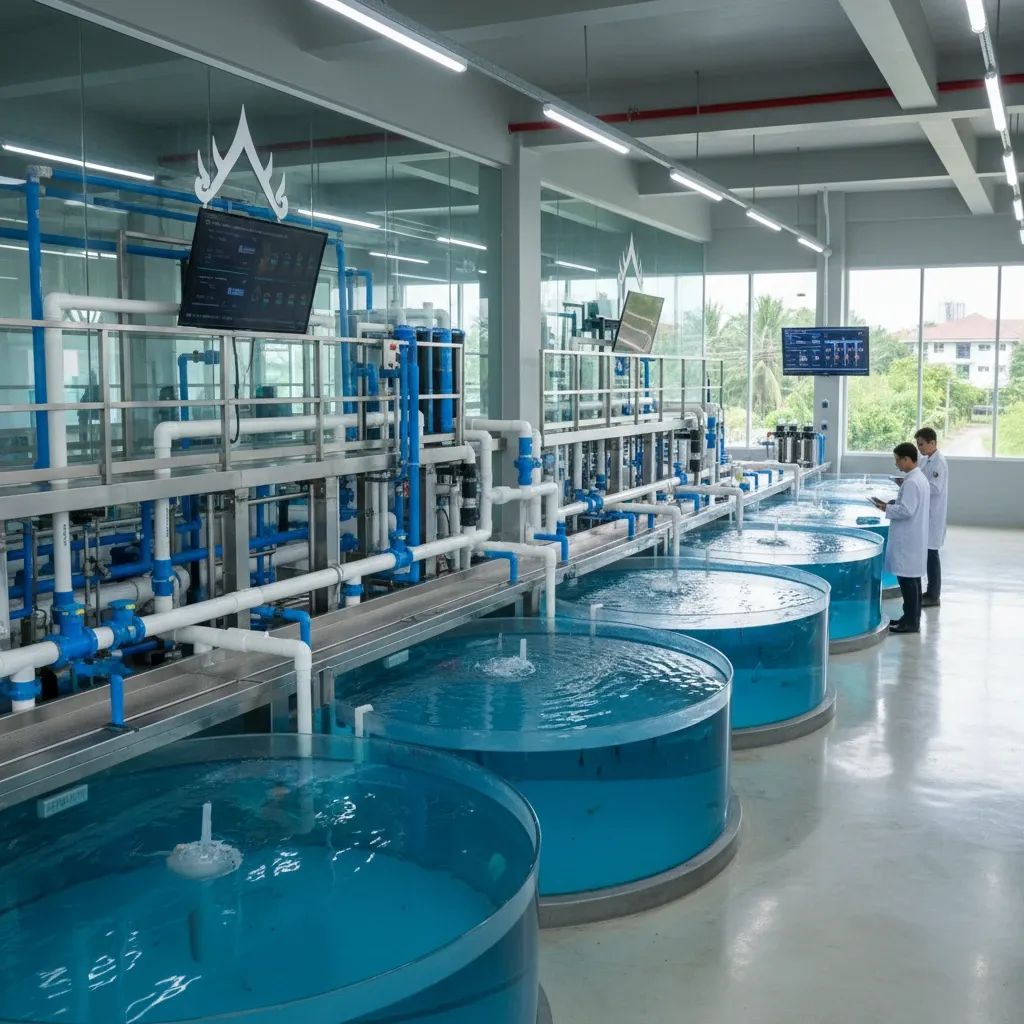
Kasetsart University has launched the Kingdom's first controlled-environment Atlantic salmon project, a bid to crack the economics of producing cold-water fish in the tropics and eventually displace billions of baht in annual imports.
Quick Facts for Residents
When will Thai salmon be available? Late 2027 or early 2028—if the trial succeeds.
How much cheaper? Locally farmed salmon could cost 10–20% less than current airfreighted imports.
Why does this matter? Thailand spends ฿7–8 billion annually on imported salmon. Homegrown production could reduce prices, create jobs, and boost food security.
Why This Matters
• Import substitution: Thailand imports ฿7B–8B worth of salmon per year, ranking 5th globally in import volume.
• Cold-chain breakthrough: The pilot uses waste cryogenic energy from PTT LNG terminals to chill water, potentially making land-based aquaculture viable.
• High-value protein: Success would anchor a new domestic industry in premium seafood, currently dominated by Norway, Chile, and Scotland.
• Research timeline: The project began this month with 20,000 fertilized eggs from Chile; early survival and growth data expected within six months.
The Cold-Water Challenge in a Tropical Country
Atlantic salmon thrive between 8°C and 14°C and experience stress above 16°C; mortality spikes when water exceeds 20°C. The Gulf of Thailand, by contrast, averages 26.5°C to 31.4°C year-round—conditions incompatible with traditional open-net pen farming. Even in established salmon regions like Norway and Scotland, rising sea temperatures are triggering disease outbreaks and thermal die-offs, shrinking viable farming zones by an estimated 10% to 40% by 2050.
Kasetsart's Faculty of Fisheries is sidestepping the climate problem entirely by deploying a Recirculating Aquaculture System (RAS) on land. RAS technology creates a closed-loop environment where temperature, dissolved oxygen, salinity, and waste filtration are monitored in real time. The key innovation here is free refrigeration: PTT's regasification plants superheat liquefied natural gas back to pipeline form, producing large volumes of waste cold. That byproduct—previously discarded—now chills the salmon tanks to mimic sub-Arctic waters.
What This Means for Residents
If the trial succeeds, Thailand could eventually produce market-size salmon domestically, reducing reliance on airfreighted imports and stabilizing retail prices. The current import bill of ฿7B–8B annually reflects strong consumer demand—fueled by sushi chains, hotel buffets, and upscale grocers—but leaves the Kingdom vulnerable to exchange-rate swings and supply-chain disruptions.
A functioning domestic industry would also create specialized aquaculture jobs and open export opportunities within Southeast Asia, where cold-water fish farming is virtually nonexistent. The technology itself—integrating industrial waste heat (or cold) into food production—could be replicated for other high-value species or urban farming projects throughout the region.
How the System Works
The Faculty of Fisheries imported 20,000 fertilized Atlantic salmon eggs from Chile in early May and is now incubating them in temperature-controlled hatchery tanks. Researchers will track hatch rates, larval survival, feed conversion, and disease incidence through each life stage—from alevin to smolt to harvest-weight fish.
Water circulates continuously through mechanical filters, biofilters (which convert toxic ammonia to less-harmful nitrate), and oxygenation units. The chilled water enters the tanks at a steady 12°C to 14°C, while waste is siphoned off and treated before the cleaned water loops back. This closed system uses less than 10% of the water volume required by flow-through farms and shields the stock from pathogens common in open waters.
The partnership with PTT LNG provides a subsidy-equivalent cost advantage: cooling represents one of the largest operating expenses in tropical RAS projects. By tapping waste cold, the university cuts energy overhead and demonstrates a scalable model for industrial symbiosis.
Precedents in Warm Climates
Thailand is not inventing the concept from scratch. A Florida-based company is constructing what it bills as the world's largest land-based salmon farm in a subtropical zone, using RAS to maintain Arctic-like conditions year-round. In Lesotho—a landlocked African nation with warm days but highland elevation—another RAS facility is producing Atlantic salmon for regional export.
Both examples prove that cold-water species can be reared in non-traditional geographies, provided operators master the engineering and absorb the electricity costs. Kasetsart's edge lies in its access to free refrigeration, which addresses the single biggest financial barrier.
Can This Be Profitable?
Operating a land-based salmon farm in the tropics still requires significant upfront investment and careful cost management: facility construction, biosecurity protocols, feed, skilled labor, and backup power. Even with free cooling, electricity for pumps, filters, and oxygenation remains a major expense.
The research team at Kasetsart will measure how efficiently feed converts to fish weight—a key cost driver. Tropical RAS farms typically produce fish at around ฿150–210 per kilogram (US$5–7), which stays competitive with airfreighted imports once you factor in flight costs, spoilage, and tariffs. Norwegian and Chilean cage farms run closer to ฿75–120 per kilogram (US$2.50–$4.00), but they benefit from natural cold water and established supply chains.
Another challenge: The Kingdom has no native Atlantic salmon population, so eggs and breeding fish must be imported under strict veterinary quarantine. Long-term success will require either continuous imports or development of a domestic hatchery capable of selective breeding.
Environmental and Regulatory Considerations
Closed systems dramatically reduce the ecological footprint compared to open-net pens, which discharge uneaten feed, fecal matter, and veterinary chemicals directly into coastal waters. In Thailand, where marine pollution and habitat degradation are already pressing concerns, RAS offers a zero-discharge alternative: solids are captured, water is recycled, and nutrients can be repurposed as fertilizer.
Regulators at the Department of Fisheries have not yet published sector-specific guidelines for land-based salmon farming, but existing aquaculture permits and environmental impact assessments will apply. The Kasetsart trial will generate the data policymakers need to draft standards for water use, biosecurity, and emergency protocols—especially important given the risk of non-native species escape in the event of flooding or tank failure.
Timeline and Next Steps
The 20,000 eggs will hatch within weeks; by mid-2026, researchers expect to have juvenile salmon large enough for growth trials and disease challenges. Full grow-out to market size—typically 4 to 5 kilograms—takes 18 to 24 months in a RAS environment, meaning the first harvestable cohort could reach tables in late 2027 or early 2028.
Interim findings on survival rates, feed formulas, and operating costs will be published incrementally, allowing private investors and other universities to assess commercial viability. If the economics pencil out, PTT LNG may expand the partnership to larger-scale production, leveraging additional regasification capacity at its Map Ta Phut and other terminals.
What This Technology Opens Up
The Kasetsart project validates a key principle: industrial byproducts can anchor new food systems. The approach—using waste cold from LNG terminals—is replicable across Southeast Asia and could eventually support other premium species production in tropical regions.
For Thailand, already among the world's top seafood exporters in shrimp, tuna, and canned fish, adding a cold-water species diversifies the export portfolio and positions the Kingdom as a regional leader in advanced aquaculture. The knowledge gained here—RAS design, water chemistry management, feed logistics—directly supports future ventures in ornamental fish and specialized protein production.
What Residents Should Watch
• Retail availability: If the trial succeeds, expect locally farmed salmon labels in supermarkets by 2028, potentially at a 10–20% discount to imported product.
• Investment opportunities: Aquaculture technology startups and equipment suppliers may emerge as the sector scales.
• Regulatory clarity: The Department of Fisheries will likely publish RAS-specific rules within the next 12 months, defining water-use permits, biosecurity standards, and zoning.
• Energy policy: The model depends on access to cheap or free cooling; any policy encouraging industrial waste-heat recovery will amplify the sector's growth.
The pilot at Kasetsart University is still in its infancy, but the stakes are high: prove that tropical aquaculture can profitably rear cold-water species, and Thailand unlocks a new revenue stream, reduces import dependence, and demonstrates climate-adaptive food innovation at scale.


