
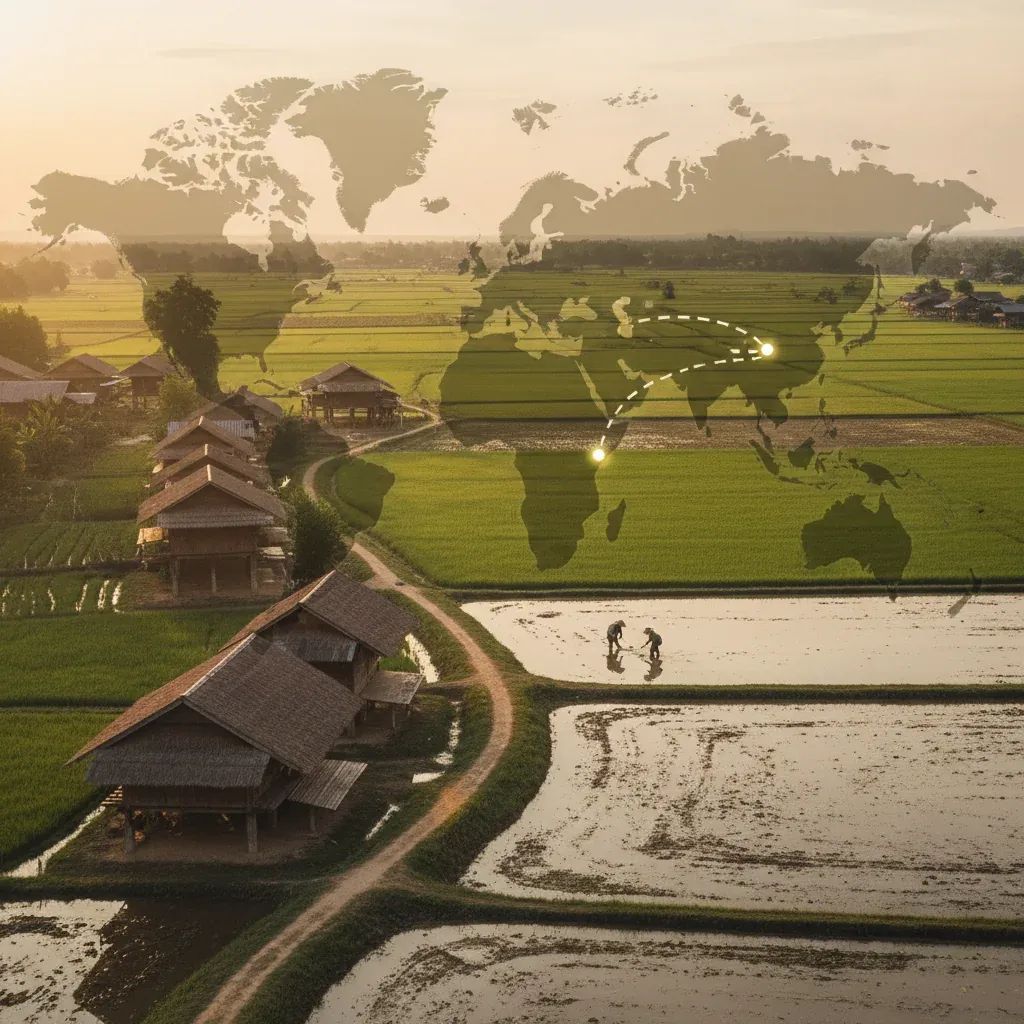
Why Thailand's Rural Economy Drives Women to Cross-Border Marriages
The Thai bride phenomenon in South Korea reflects broader economic realities rather than romantic preference. Last year, South Korean authorities recorded 21,000 international marriages, representing a 0.3% decline from 2024. Yet within this overall trend, a significant pattern persists: Thai women now comprise 12.5% of all foreign wives entering South Korean households—placing Thailand among the top three source nationalities for five consecutive years. For observers of Thailand's rural economy, this statistic suggests something fundamental about domestic opportunity.
Why This Matters
• Thai women account for 12.5% of international marriages involving South Korean men, maintaining a position among the top three nationalities for five consecutive years
• The overall marriage rate in South Korea rose 8.1% in 2025 to 240,300 cases, the strongest year since 2018, yet masks regional disparities and demographic pressures
• Rural economic conditions in Thailand create structural incentives for cross-border marriage as economic strategy rather than romantic choice
The Economics of Rural Thailand and Cross-Border Marriage
Understanding why Thai women enter marriages with Korean men requires examining Thailand's rural economic landscape. Agricultural provinces face limited employment opportunities beyond farming, which generates uncertain returns. Young women seeking income often face constrained choices: factory work in industrial zones near Bangkok, tourism-related employment, or family obligations that demand financial contributions to aging parents.
The cultural expectation that daughters provide financial support to aging parents—described as the "dutiful daughter" tradition—combines with limited domestic wages to create economic pressure. Marriage brokers operating in areas like Pattaya, Bangkok, and Udon Thani position cross-border marriage as an economic solution, presenting Korean opportunities as pathways to increased income capacity.
South Korea's Demographic Context and Rural Marriage Patterns
South Korea's 2025 marriage increase to 240,300 cases reflects demographic shifts rather than changing attitudes toward marriage itself. The country faces well-documented demographic challenges, including aging populations and regional variations in marriage patterns. In rural areas, significant demographic imbalances create situations where men in agricultural regions face limited marriage prospects within Korea itself.
Young Korean women with university degrees and professional opportunities typically migrate to major urban centers like Seoul, Busan, and Daegu. This pattern leaves rural and agricultural areas with distinct demographic compositions. Traditional Korean family structures, rooted in Confucian hierarchies, assign wives responsibilities including care for parents-in-law and household management—expectations that create additional barriers to rural marriages with Korean women.
The Brokerage System and Information Asymmetry
Marriage brokers facilitate introductions between parties through limited communication channels. The video-based courtship process, conducted across language barriers and geographic distance, creates significant information asymmetries. Women and men typically share minimal common language and may lack detailed understanding of each other's actual circumstances, expectations, and family situations.
This structural limitation means that individuals entering these marriages often possess incomplete information about family dynamics, household expectations, and daily life realities in their spouse's region.
Remittances and Economic Impact on Thai Families
For Thai families in rural provinces, income generated through these cross-border marriages constitutes a significant economic resource. Remittances flowing from Korean spouses to Thai family networks contribute to household economics in ways that domestic employment opportunities often cannot match.
This economic reality creates complex incentive structures. Families benefit from remittance income, yet women entering these marriages face potential vulnerability through economic dependence on marital continuation.
Geographic and Social Integration Factors
Outcomes for Thai women in South Korea vary significantly based on location. Urban centers like Seoul and Incheon contain established Thai communities, religious institutions, and social networks that facilitate cultural continuity and social connection. Rural areas lack these support structures, potentially limiting a woman's ability to maintain cultural identity or access community assistance.
Language barriers in rural settings can restrict independent access to information, services, or social connection beyond the immediate family unit.
Children and Multicultural Family Contexts
Children born to Thai-Korean couples navigate bicultural identity development within South Korean social systems. Social integration, educational experiences, and peer acceptance vary based on location, family circumstances, and community attitudes toward multicultural families.
Structural Economic Patterns
The continuation of Thai-Korean cross-border marriages reflects enduring economic disparities and structural factors. For Thailand, these marriages represent a response to limited domestic economic opportunity in rural provinces. The pattern persists because underlying economic conditions—limited agricultural returns, constrained employment options in rural areas, and cultural obligations toward family financial support—remain fundamentally unchanged.
Addressing the drivers of cross-border marriage would require substantive economic development in Thai rural provinces and expanded employment opportunities that provide viable alternatives to emigration-based economic strategies.


