
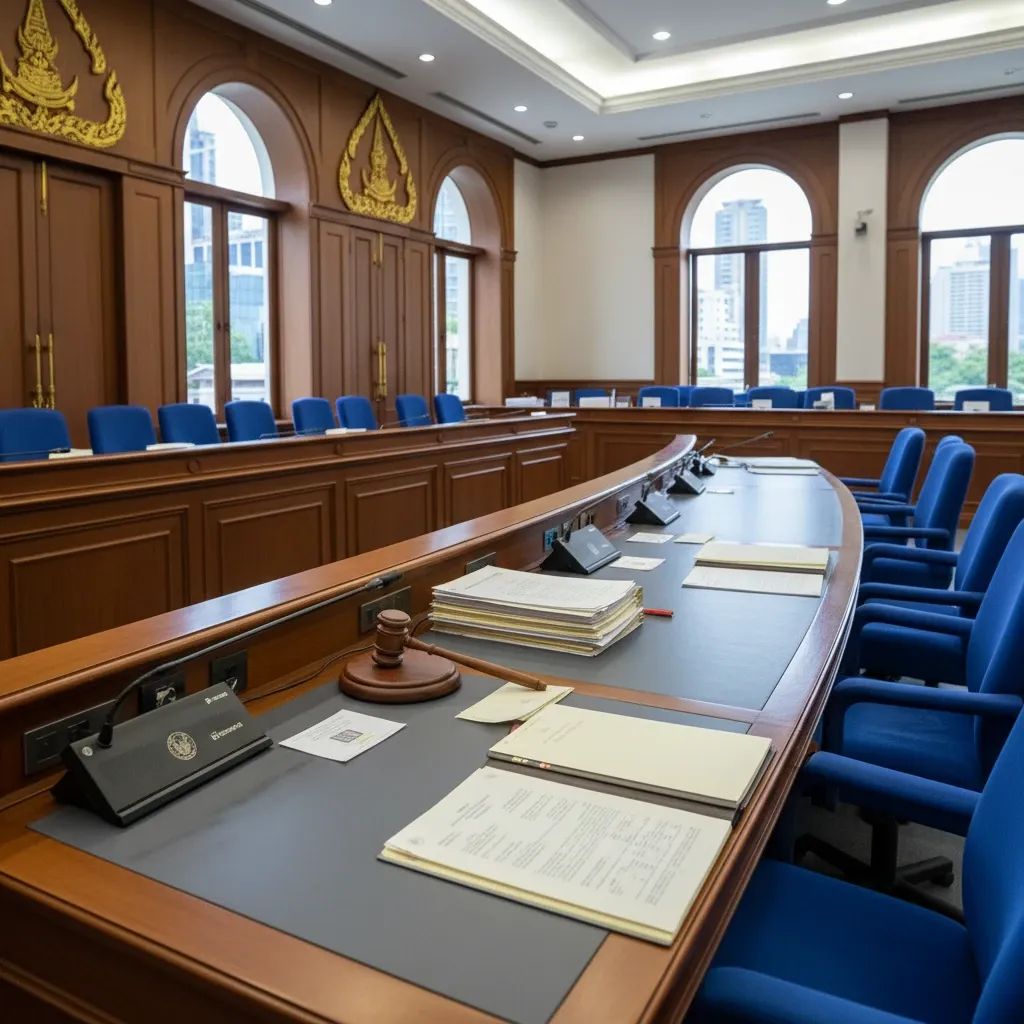
The Thailand Supreme Court has taken a move that could reshape the opposition's political trajectory for an entire generation. On April 24, 2026, the court accepted an ethics petition targeting 44 current and former lawmakers from the progressive movement, threatening career-ending consequences if convictions follow.
Why This Matters
• Lifetime political bans at stake—anyone convicted loses the right to hold office permanently and cannot vote for 10 years, effectively ending careers.
• Ten sitting legislators now restricted from speaking publicly about their actions, creating a self-imposed communications blackout on one of Thailand's most contentious policy debates.
• First hearing scheduled for June 30, 2026—the court will examine whether proposing legislative changes on sensitive topics amounts to attempted overthrow of the constitutional order. A verdict timeline has not been established.
• This marks another threshold moment for Thailand's progressive opposition, already fractured by four prior judicial dissolutions since 2018.
How We Arrived at This Crossroads
The narrative begins not with the Thailand National Anti-Corruption Commission filing its petition last month, but rather with a bill drafted five years earlier. On March 25, 2021, the 44 lawmakers—then serving under the Move Forward Party banner—jointly proposed amendments to Section 112 of the Criminal Code, Thailand's lèse-majesté statute. The bill sought two specific changes: reducing penalties for royal defamation offenses and restricting who could file complaints to the Bureau of the Royal Household alone.
For advocates of reform, these changes represented common-sense adjustments to a law widely seen as a tool for political suppression. Current penalties range from 3 to 15 years imprisonment per charge, meaning a single speech or article could theoretically result in decades of potential jail time. The 44 lawmakers argued—through parliamentary channels—that reform would protect genuine royal dignity while narrowing avenues for abuse.
Section 112 enforcement has historically affected foreigners in Thailand. Foreign journalists, academics, and even tourists have faced accusations or investigations for comments deemed disrespectful to the monarchy. The broad interpretation of what constitutes an offense has created a chilling effect on free speech among expat communities. For residents considering long-term stays, understanding Section 112's reach is essential—casual social media posts or academic discussions have occasionally triggered legal scrutiny.
The NACC viewed the proposal differently. In its filing, the commission characterized the amendment attempt as "serious ethical violations" and framed it as an effort to undermine the constitutional monarchy itself. By this interpretation, proposing legislative reform on a royal-related statute crosses a constitutional red line that separates legitimate parliamentary debate from sedition.
The Thailand Supreme Court's Criminal Division for Holders of Political Positions did not order the 10 sitting members—including party leader Natthaphong Ruengpanyawut—to step down. Instead, it imposed a gag order. These legislators may continue parliamentary work but face strict restrictions: no public comments, no media appearances, no advocacy related to the accusations. The silence is intentional and strategic.
The Real-World Impact for Those Living Here
For expatriates, investors, and long-term residents tracking Thailand's stability, this case signals something beyond parliament theater. A guilty verdict would eliminate the People's Party's senior leadership. The party currently holds 118 seats in parliament following February's election—already a significant drop from the 151 seats its predecessor won just three years prior.
If convictions follow, the party loses not just individual members but institutional cohesion. The remaining legislators would scramble to reorganize under new leadership, accelerating a pattern already familiar to observers: party dissolution, rapid rebranding, electoral decline. This would mark the fourth major restructuring of Thailand's progressive movement since 2018.
The business implications matter. Foreign investors track political durability. When opposition parties face recurring judicial threats, regulatory predictability declines. Companies considering long-term operations or expansion hesitate. Thailand's chambers of commerce have noted this dynamic—repeated court interventions in electoral outcomes complicate the investment calculus.
Beyond economics, there are governance and policy continuity concerns. If the senior leadership faces convictions or removal, budget negotiations, trade policy, tax reform initiatives, and business regulation oversight would shift to less experienced hands. Foreign firms operating in Thailand depend on continuity in parliamentary relationships and policy direction. Legislative gridlock stemming from leadership instability could delay approvals for projects, visa policy reforms, and foreign investment frameworks that affect the expatriate business community.
The case also carries implications for Thailand's international reputation. Western governments and international business bodies monitor judicial independence. If courts are perceived as weaponizing legal processes against opposition, confidence in Thailand's institutional stability declines. This affects credit ratings, foreign direct investment flows, and Thailand's ability to negotiate favorable trade agreements—outcomes that ripple through to foreign residents and business operators.
If proposing statutory amendments on sensitive topics becomes grounds for ethics violations, what remains of parliamentary deliberation? The 10 sitting members cannot even defend their position publicly. This creates a peculiar dynamic: they are accused, restricted from responding, yet must continue voting on national policy. It is a form of legal restriction that raises questions about whether meaningful debate on contentious issues remains possible within Thailand's political system.
A Movement Perpetually Under Judicial Siege
Understanding this moment requires stepping back to trace how the progressive camp arrived here. The chronology reveals a pattern.
The Future Forward Party, founded in 2018, pioneered a new political lane: youth-focused, anti-military, pro-monarchy reform. It grew rapidly until February 2020, when the Thailand Constitutional Court dissolved it over a founder's loan to the party—a technical violation that seemed minor until deployed. The party died, but the movement survived.
The displaced members reorganized as the Move Forward Party in late 2020. It captured popular imagination and won the most seats in the May 2023 general election with 14 million party-list votes. Yet the military-appointed Senate blocked it from forming a government, and within months, the Constitutional Court dissolved it too—this time explicitly for its campaign pledge to amend Section 112. The court ruled the amendment promise itself amounted to an unconstitutional challenge to the monarchy.
Within 48 hours of that August 7, 2024, dissolution ruling, the remaining 143 Move Forward MPs executed a pivot. They defected to the Thinkakhao Chaovilai Party and rebranded it as the People's Party on August 9, 2024. Natthaphong Ruengpanyawut became leader. The party technically survived, but the signal was unmistakable: the progressive movement was now in crisis-management mode.
February's election exposed the toll. Despite polling well, the People's Party won only 118 seats with 10.4 million party-list votes. The decline stemmed partly from strategic caution. The party deliberately muted its Section 112 reform messaging and sidelined military restructuring—issues that had mobilized its base but risked inviting another dissolution. Critics accused the party of sacrificing its "ideological core" to survive.
Meanwhile, the Bhumjaithai Party emerged triumphant with 192 seats. Conservative and nationalist sentiment—fueled by border tensions with Cambodia—benefited the party. The progressive movement's strategic retreat did not clear the field; it ceded ground.
The Strategic Dilemma the Party Now Faces
Political analysts note that the People's Party cannot win by either strategy available to it. A vigorous defense of the 2021 amendment proposal risks appearing to challenge royal prerogatives, handing the NACC ammunition. Distancing itself from the proposal alienates the young, urban voters who drove its predecessors' success—voters who specifically mobilized around legal reform and military accountability.
Party officials have rejected the NACC's framing. They insist proposing legislative reforms through parliament is a constitutional right and that their intentions never involved challenging the democratic system. According to the party's statements, the case represents what they characterize as selective legal weaponization of political opponents—though analysts debate whether this terminology accurately describes the court's actions.
Yet their hands are partially tied. The 10 sitting members cannot articulate this defense in the media or among constituents. Their forced silence invites the interpretation that accusations carry weight. For a political movement already weakened by three dissolutions and electoral decline, this is damaging regardless of eventual outcome.
What the Verdict Will Establish
The June 30 hearing will not decide whether the 44 lawmakers intended genuine reform or genuine sedition. It will establish something broader: the boundaries of permissible political debate in Thailand. Can opposition movements advocate for changes to laws touching the monarchy without risking collective prosecution? Can parliamentary amendment of controversial statutes proceed without accusations of attempted overthrow?
The Supreme Court's interpretation of "serious ethical violations" will define whether parliamentary advocacy itself can constitute misconduct. If the court upholds the petition, it sends a message that challenging specific laws—even through formal legislative channels—crosses an ethical line. If dismissed, the court signals that proposing reform, even on sensitive topics, remains protected parliamentary activity.
For residents and business operators, the ruling will clarify whether opposition parties can propose meaningful policy change without risking dissolution or prosecution of leadership. For the People's Party, the verdict will either validate its legal existence or accelerate another organizational death spiral.
The party's survival depends not on winning this case—courts control that outcome—but on whether it emerges intact enough to contest the next election. At this point, that narrow goal is itself uncertain.


