
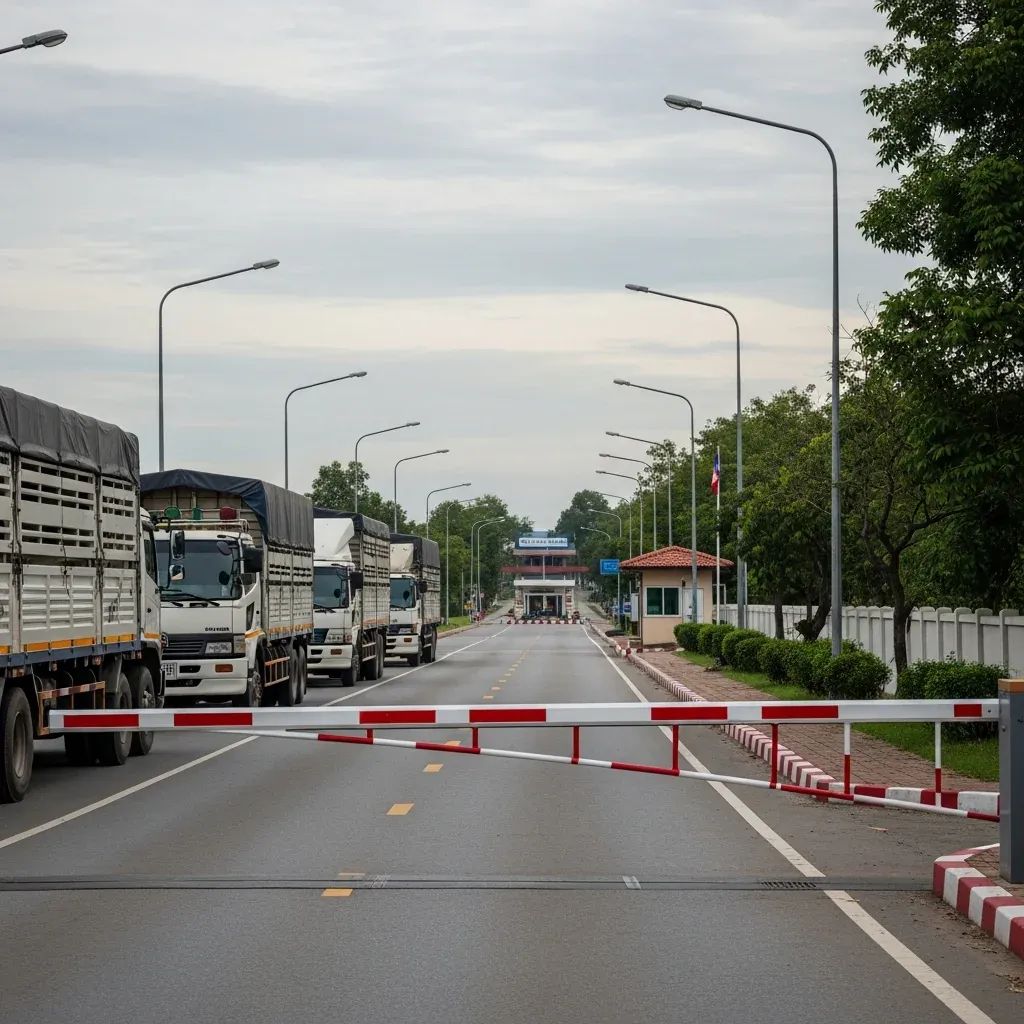
The border with Cambodia has grown quiet again, but nobody along the eastern frontier expects the calm to last. Bangkok’s caretaker ministers, the army and provincial traders are all waiting to see whether Thailand’s next cabinet will keep, tweak or scrap MOU 43, the 2000 land-boundary memorandum that Phnom Penh insists is still binding. Their decision will determine not just where soldiers stand, but whether border markets reopen and factories on both sides regain their supply chains.
Why the frontier suddenly matters to voters
The shooting that rattled villages in Sa Kaeo, Buri Ram and Oddar Meanchey during July-August 2025 stopped only after negotiators stitched together a fragile 72-hour truce. Yet Prime Minister Hun Manet and his father Hun Sen quickly reminded supporters that a ceasefire is “not a surrender”. For Thai voters heading to the 8 February 2026 poll, the episode has transformed an obscure diplomatic text—MOU 43—into a litmus test of any party’s willingness to protect sovereignty, livelihoods and cross-border trade. Senior officers at Army Region 2 warn that accepting Phnom Penh’s reading of the MOU could oblige Thai troops to pull back from ground retaken last year, something the electorate might view as squandering lives, treasure and national pride.
Decoding MOU 43: from French treaties to LiDAR maps
Few outside foreign-ministry circles remember that the memorandum is anchored in the 1904 and 1907 Siam-French treaties, obliging both neighbours to finish surveying their 798-km border. Under the document, any overlapping claims must be kept “construction-free” until the Joint Boundary Commission (JBC) locks in a definitive line. To date 45 stone markers are certified, 29 remain disputed, and a further 196 km of unmarked ridge line awaits first-ever demarcation. Over the past year Bangkok and Phnom Penh agreed—after a decade of wrangling—to deploy LiDAR overflights, drone imagery and watershed modelling to speed up the job, producing brand-new 1:25,000 maps. Cambodian technicians finally accepted the technology in 2025, a breakthrough Thai diplomats regard as “the only silver lining” of the crisis.
A crowded calendar: ceasefire today, Siem Reap talks tomorrow, election next month
Hun Sen has summoned an “urgent” special JBC session for the first week of January 2026 in Siem Reap, hoping to invoke MOU 43 to formalise troop withdrawals. Thailand’s National Security Council argues that a caretaker cabinet lacks the mandate to go, leaving the invitation in limbo until after the vote. At the same time a China-Cambodia-Thailand trilateral hosted by Wang Yi in Yunnan on 28-29 December produced a five-point plan that quietly places “reopening checkpoints” at centre stage. Beijing’s signal: restore the economic arteries or risk stranding Chinese investments worth $5 billion in Cambodian special-economic zones that rely on Thai ports and power.
The cost of locked gates: seven provinces counting losses
The shut-down of 18 official crossings since mid-2025 has bled the border economy. Commerce Ministry data show that when Aranyaprathet, Khlong Yai and Ban Pakkad closed, border trade crashed 90% almost overnight. By August 2025, monthly exports to Cambodia fell from ฿11.4 billion to ฿7 million—mainly premium whisky and mineral fuels hauled by rail. Researchers at Krungthai COMPASS peg damage at ฿14 billion per month, with provincial treasuries in Ubon Ratchathani, Surin and Trat worst hit. Small vendors in Rong Kluea market speak of losing 800 baht a day in income, while garment plants in Koh Kong report raw-material shortages that threaten 30,000 Cambodian jobs. Bangkok has rolled out subsidies, cheap-goods caravans and soft loans, yet local chambers warn that “temporary relief cannot replace trucks rolling across the border”.
Three paths before the new cabinet
Only a sworn-in government can decide Thailand’s posture. Diplomatic sources outline three broad options:
Maintain the status quo: Re-endorse MOU 43, attend the Siem Reap JBC and accept simultaneous troop pullbacks. Pro: Revives boundary mapping, pleases Beijing and ASEAN. Con: Faces domestic backlash, risks ceding recently retaken ground.
Renegotiate the terms: Table targeted amendments—for example, redefine “vacant land” or add a clause recognising LiDAR outputs. Pro: Aligns the text with realities on the ground. Con: Requires Phnom Penh’s consent, which analysts deem unlikely while Cambodia is on the back foot.
Terminate the memorandum: Withdraw under Article 65 of the Vienna Convention, then propose a new bilateral treaty. Pro: Satisfies nationalist sentiment, gives Bangkok a blank slate. Con: Halts the near-complete demarcation effort, could trigger international arbitration and unsettle investor confidence.
China’s quiet leverage—and Thailand’s strategic juggling act
Beijing, which holds nearly 50% of FDI stock in Cambodia, cannot afford prolonged checkpoint closures that strand goods destined for its domestic market. Its Yunnan initiative couples ceasefire support with nudges for faster economic normalcy, promising to bankroll infrastructure, demining and digital customs systems if both sides deliver. Thai strategists see opportunity: leverage China’s interest to secure security guarantees, infrastructure grants and perhaps a role for ASEAN observers at the JBC. The risk is appearing to outsource policy to an external power at a moment of heightened nationalism.
Satellites, drones and disputed ridges: the LiDAR breakthrough
Technicians from the Joint Technical Sub-Commission (JTSC) began flying LiDAR sorties in June 2025 over 29 disputed pillars and 196 km of virgin frontier. The laser pulses cut through dong forest canopy, producing centimetre-level elevation data that let surveyors locate the true watershed line—long the heart of disagreements near Ta Muen Thom and Preah Vihear. Experts say processing can finish within 6 months, meaning the demarcation ledger could be closed before 2027—if politics stays out of the way. The world’s LiDAR market is booming; Thai start-ups see a chance to spin off agricultural, mining and flood-defence applications from the same datasets.
What to watch in the weeks ahead
Thailand’s poll campaign is heating up, but whichever coalition captures the House will inherit a choice that blends security, economics and diplomacy. Provincial traders want checkpoints reopened before Songkran 2026. The army argues that any deal must guard territorial integrity. China is pressing for speed; Cambodia is pushing for January talks. For now the frontier stays eerily quiet—just the whirr of survey drones above and the murmur of border communities waiting to find out how much influence an old piece of paper called MOU 43 will still hold over their future.


