
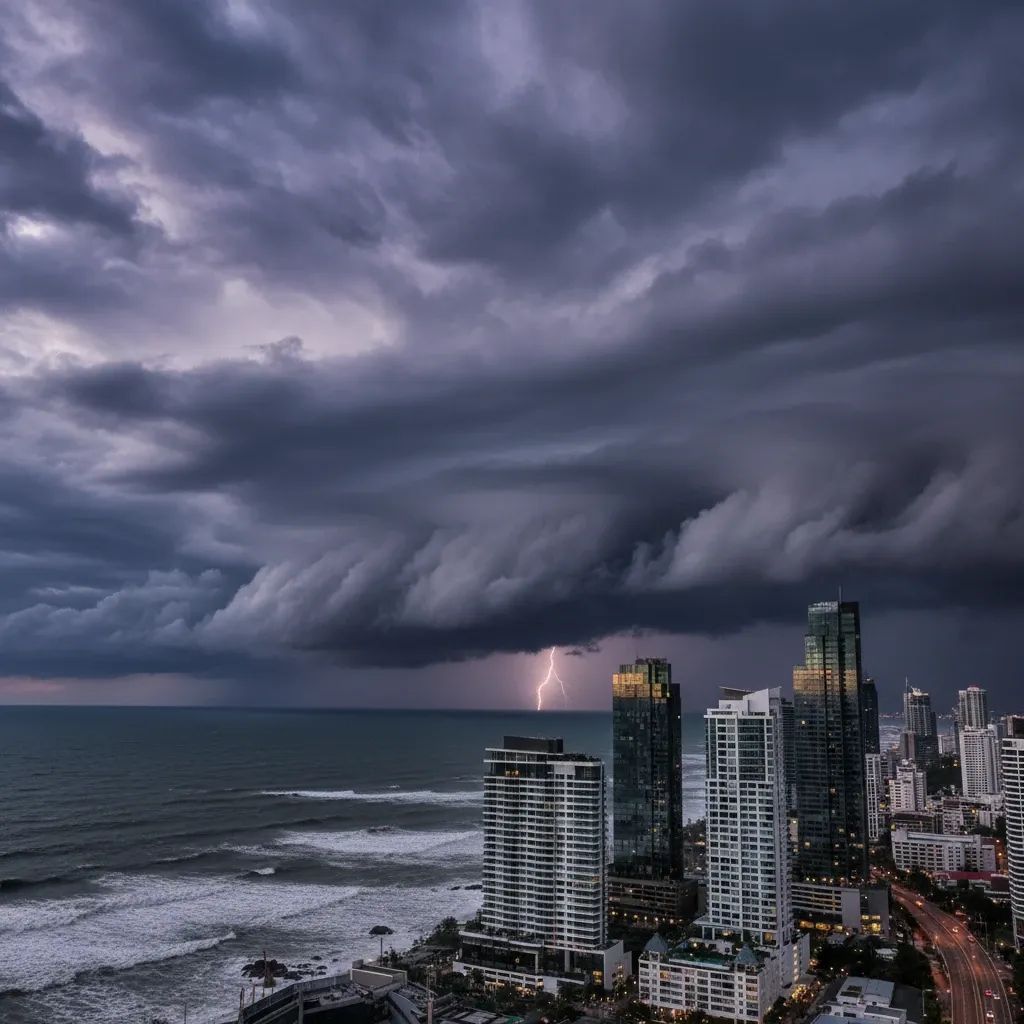
Starting May 7, 2026, Thailand faces a critical 96-hour weather window as atmospheric systems collide over Southeast Asia, bringing concentrated moisture and destabilizing wind patterns that meteorologists warn could trigger localized flooding across multiple provinces. The Thailand Meteorological Department projects heavy to extreme rainfall concentrated in the south, while thunderstorm activity intensifies across northern and central regions through May 10.
Why This Matters
• Multiple provinces under active monitoring, with southern coastal zones facing highest flash-flood probability
• Reservoir management across 22 river basins now activated; farmers and businesses in flood-prone areas should verify evacuation routes today
• Historical precedent: May rainfall has triggered Thailand's significant flooding events—the 2011 floods affected 9.1% of the country, killed 680 people, and inflicted $46.5 billion in economic losses. More recent events like the May 2025 flooding affected several provinces with localized impacts
The Atmospheric Setup Driving This Week's Risk
Unlike sudden tropical systems, this event stems from persistent weather mechanics—a high-pressure dome anchored over southern China is funneling warm, moisture-laden air southward and eastward. That moisture-rich air mass interacts with established wind corridors running north-south across the Gulf and Andaman Sea, creating a low-pressure mechanism that prevents rainfall from dispersing quickly.
The result is training effect dynamics: successive storms track along the same corridor, dropping moisture repeatedly over identical low-lying and coastal zones. The Thailand Meteorological Department has identified this as a medium-duration event—not a quick thunderstorm, but a multi-day saturation pattern.
Geographic Fracturing: Who Gets Impacted When
May 7–9 Window
The central and northeastern plateau will bear the initial surge. Bangkok's northern suburbs—Pathum Thani, Nonthaburi, and Samut Sakhon—experience the first wave of gusty afternoon thunderstorms, with wind gusts reaching 40–50 km/h in exposed areas. Northern provinces from Mae Hong Son to Chiang Rai, inland to Phetchabun, face isolated but intense downpours. The Northeast's provinces, spanning Udon Thani to Ubon Ratchathani, report scattered heavy rain with localized flash-flood risk in drainage channels and agricultural terrain.
Critically, Bangkok Metropolitan Administration has contingency plans to activate its pump-station network if needed, with adjusted capacity for expected surface runoff. Soi-level drainage systems in Thonburi and eastern districts maintain readiness.
May 10 Narrowing
As the high-pressure ridge shifts, impact zones compress. Only northern and northeastern provinces retain significant rainfall risk. Bangkok's alert status remains at standby.
Southern Provinces: The Pressure Cooker
The lower south absorbs the system's heaviest moisture load. Surat Thani, Nakhon Si Thammarat, and Phatthalung experience 150–250 mm of cumulative rainfall by May 9. The Andaman coast—Phang Nga, Phuket, and Krabi—sees similar totals, with Satun and Trang bearing wave-amplified coastal flooding risk alongside terrestrial runoff.
These zones carry intrinsic vulnerability: steep terrain feeding narrow river valleys, degraded mangrove buffers, and historical underfunding of upstream detention infrastructure. Residents in southern provinces should note that coastal plains require particular caution during May weather systems due to population density in confined areas.
Why May Remains Thailand's Concern Month
The May-to-July transition represents a climatologically sensitive period. Thailand's geographic position at 5–20 degrees north latitude sits directly in the collision zone between retreating cold-air masses from Central Asia and advancing tropical moisture. Historically, this boundary layer can produce localized flooding.
The 2011 mega-flood—one of Thailand's most significant 21st-century disasters—began with anomalous May rainfall that saturated soil across the Northeast. By July, Tropical Storm Nock-ten dumped an additional pulse, causing synchronized dam overflows and channel breaches across the Chao Phraya basin. Over 9.1% of Thailand eventually flooded; damages reached nearly 1.43 trillion baht (roughly 70% of the annual national budget at that time).
More recent memory reinforces May caution. May 2025 saw rolling waves of flooding from the 2nd through 24th, affecting Pattani, Lampang, and scattered central provinces, displacing over 1,000 residents. While less severe than 2011, it demonstrated that May rainfall warrants serious preparedness.
May 2017 proved equally instructive: northern provinces including Kamphaeng Phet and Uttaradit saw 800+ homes damaged and 2,000 families evacuated when 3-day rainfall totals exceeded 200 mm.
What Residents Must Do Now—Practical Safeguards
For Urban Residents in Bangkok and Central Plains
Monitor surface-water accumulation near sois, under bridges, and on expressway underpasses. Never attempt to cross flowing water deeper than ankle height—a risk that appears trivial but kills 10–15 Thais annually. Secure laptop batteries, medications, and crucial documents (land deeds, passport copies) in waterproof containers by May 6. The Bangkok Metropolitan Administration provides real-time updates and drainage-zone forecasts; bookmark official channels now.
For Rural and Agricultural Communities
Farmers in Chiang Rai, Phrae, and Yasothon provinces should move livestock to elevated pens by May 6 evening. The Thailand Agricultural Extension Office warns that continuous rain can compromise rice paddies in the North; inspect irrigation channels for obstruction and test drainage pumps. Stored grains in ground-level warehouses risk mold—move to raised structures if possible.
For Residents in Southern Coastal Provinces
Those in Phuket, Krabi, and Surat Thani should prepare for potential sea-level rise exacerbating riverine flooding. Fishing communities in Satun and Narathiwat historically experience compound flooding—tidal surge plus river outflow—that can submerge neighborhoods rapidly. Verify evacuation-center locations with your Tambon administrative office. The Department of Disaster Prevention and Mitigation pre-positions rescue boats and high-water vehicles in southern provinces; know your nearest staging point.
The Institutional Response: What's Being Done
Thailand's government has deployed a 22-basin water management framework involving 10,127 coordinated projects and 196.1 billion baht in investment, run across 18 agencies under 7 ministries. The Royal Irrigation Department has issued explicit pre-May directives: all reservoirs must adjust to target levels by May 5; intake gates and spillway mechanisms must clear accumulated debris; on-site machinery and rescue personnel must be combat-ready.
Provincially, disaster-prevention offices are conducting daily coordination calls with municipal administrations. In Bangkok, the BMA's Flood Control Department activates contingency protocols for Samut Prakan, Thonburi, and Phra Nakhon districts based on weather conditions.
Despite these investments, inter-agency coordination remains a focus area. The 2024 Chiang Mai floods revealed delays in evacuation orders stemming from conflicting interpretations of meteorological data between the provincial authority and the Department of Disaster Prevention and Mitigation. Residents should stay informed through official channels; personal vigilance remains essential.
Reading the Signals: Data You Can Trust
The Thailand Meteorological Department's 24-hour bulletin cycle (updated at 05:00, 11:00, 17:00, and 23:00 daily) provides the most granular regional forecasts. Access via http://www.tmd.go.th or the hotline 1182. The Department of Disaster Prevention and Mitigation releases province-level advisories separately, emphasizing evacuation zones and shelter capacity.
Real-time updates for Bangkok arrive via Thai Meteorological Department mobile alerts, SMS warnings sent to registered residents, and official channels displaying pump-station readiness, sluice-gate status, and water-level readings across monitoring points citywide.
Southern residents can access Phuket, Krabi, and Surat Thani provincial disaster offices for localized maps showing flood-risk zones, shelter locations, and access routes. These offices publish daily updates accessible via provincial Facebook pages.
Timeline and Temperature Shift
May 7, 2026 (Thursday): Scattered thunderstorms commence across the North and Northeast by 14:00. Southern provinces remain partly cloudy until evening. Wind gusts 30–45 km/h in affected zones.
May 8–9, 2026 (Friday–Saturday): Peak rainfall activity. Central and Northeast see heaviest downpours between 10:00–18:00. Southern rainfall intensifies overnight May 8–9. This window represents the critical period for evacuation if you are in a flagged flood zone; if in a high-risk area, consider moving to safety by May 8 morning.
May 10, 2026 (Sunday): Rainfall tapers; clearing begins in northern sectors. Southern provinces may retain light rain. Temperatures drop 3–5°C across the North and Northeast post-system transit—a typical post-frontal cooling pattern. Upper-elevation areas may experience morning fog.
The Larger Question: Adaptation and Infrastructure
Experts acknowledge that Thailand's hydrological infrastructure, while improved since 2011, faces ongoing challenges from climate variability. Population density in low-lying zones has increased; wetland buffers have shrunk; urban impervious surfaces accelerate runoff. The 2024 Chiang Mai incident revealed that even with modern early-warning systems, evacuation protocols can experience delays.
The broader lesson: Residents in chronically flood-prone zones—Nakhon Ratchasima's lower terraces, Chiang Mai's river corridors, southern coastal plains—should evaluate preparedness strategies. Insurance products covering monsoon flooding remain limited; personal preparedness remains the rational approach.
Final Checklist
By end of May 6:
• Non-perishable food, water (3–5 liters per household member), prescription medications for 7 days
• Flashlights, batteries, portable phone chargers
• Important documents in waterproof bag
• Verify evacuation zone and shelter address with local Tambon office
• For farmers: livestock relocated, pumps tested, drainage channels cleared
May 7–9:
• Monitor official alerts every 6 hours
• Stay off expressways during peak rainfall (typically 15:00–19:00)
• Do not approach riverbanks, canals, or swollen drainage channels
• If water begins accumulating indoors, evacuate immediately—do not wait for official orders
The next 96 hours will test the preparedness of Thailand's disaster infrastructure and provinces across all regions. Individual vigilance and adherence to official guidance remain essential.


