
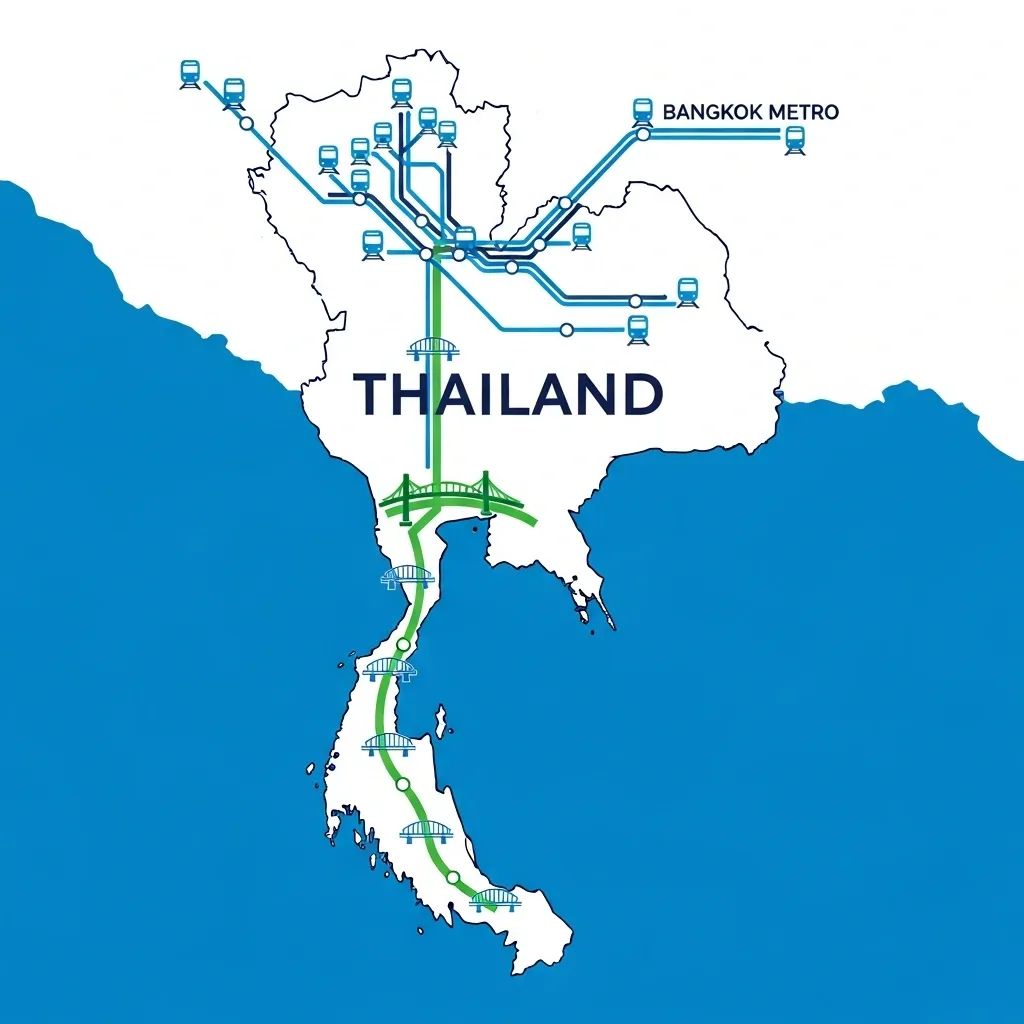
Thailand's controversial Land Bridge megaproject has triggered a swift and significant public backlash, forcing Prime Minister Anutin Charnvirakul to order a comprehensive 90-day reassessment of the ambitious infrastructure scheme. An online petition opposing the project surpassed 100,000 signatures within three days, signaling intense resistance to what would be one of Southeast Asia's largest transport corridors.
Why This Matters
• Timeline on pause: The 90-day review initiated in early May 2026 could delay or fundamentally alter the ฿1 trillion ($31 billion) project, previously slated for cabinet approval this summer.
• Local livelihoods at risk: Fishing communities in Ranong and Chumphon provinces face displacement and ecosystem disruption from deep-sea port construction and over 1,104 hectares of sea reclamation.
• Environmental stakes are high: Marine ecosystems, national parks, mangrove forests, and UNESCO-designated biosphere reserves lie directly in the project's footprint.
• Economic promises contested: While the government forecasts 280,000 jobs and ฿500 billion in annual economic value, critics question the commercial viability and warn of a potential infrastructure white elephant.
The Project and Its Promise
The Chumphon-Ranong Land Bridge aims to establish a multimodal transport corridor spanning approximately 90 kilometers across southern Thailand, connecting deep-sea ports on the Gulf of Thailand and the Andaman Sea. The vision includes a motorway, dual-gauge railway, and potentially oil and gas pipeline infrastructure designed to bypass the congested Strait of Malacca.
Proponents within the Thailand Ministry of Transport argue the corridor could slash shipping distances by roughly 1,000 kilometers, reducing voyage times by an average of four days and cutting transportation costs by approximately 15%. The initiative forms the centerpiece of the Southern Economic Corridor (SEC), a special economic zone the government hopes will propel Thailand to high-income status by 2030.
International investors from China, Japan, Germany, India, and Dubai Port World have expressed interest, attracted by preliminary financial projections showing an internal rate of return of 8.62% with a 24-year payback period. The Thailand Cabinet views the Land Bridge as a strategic hedge against geopolitical uncertainties affecting existing maritime chokepoints, particularly in light of disruptions to global shipping routes like the Strait of Hormuz crisis.
Development would unfold in phases: Phase 1/1 between 2030 and 2031 at ฿617 billion, Phase 1/2 from 2032 to 2034 costing ฿174 billion, and Phase 1/3 spanning 2035 to 2053 with an investment of ฿205 billion. Full operational capacity had been anticipated by 2039, though the current review casts doubt on this timeline.
Mounting Opposition From Multiple Fronts
The Environmental Law Foundation (EnLAW), collaborating with Greenpeace and Beach For Life Thailand, launched the petition titled "STOP SEC ACT & LAND BRIDGE: Stop special laws for special people" in early May. The campaign initially targeted 50,000 signatures but rapidly exceeded double that figure by May 8. The petition remains open until June 30, with organizers planning to submit the signatures to the cabinet and Thailand Ministry of Transport.
Fishing communities have emerged as particularly vocal critics. Somsap Jittathom, president of the Ranong Commercial Fisher Association, warns that construction of deep-sea ports and increased shipping traffic will irreversibly damage delicate marine ecosystems and obliterate traditional fishing grounds. Residents like Thom Sinsuwan from affected fishing villages express concerns that financial compensation cannot replace generations of cultural connection to the sea.
Environmental groups emphasize the threat to Mu Ko Ranong Biosphere Reserve, Laem Son National Park, and extensive mangrove ecosystems. The project calls for dredging approximately 11,000 rai of seabed and reclaiming over 6,900 rai of sea area, operations that critics say will severely disrupt marine ecosystems, alter coastal hydrodynamics, and threaten coral reefs rich in biodiversity.
The proposed expressway and railway would carve through forested areas in the Isthmus of Kra, a critical biodiversity corridor containing diverse ecosystems including mangroves, coastal wetlands, and lowland forests. Species documented in the project area—such as the oriental pied hornbill, bar-tailed godwit, and maskray—face heightened extinction risk from habitat fragmentation and deforestation.
Agricultural communities, particularly durian farmers, worry about land expropriation and inadequate resettlement arrangements. The Southern People's Council has accused the government of conducting public hearings that excluded directly affected communities and disregarded input from academic institutions, alleging the Environmental and Health Impact Assessment (EHIA) was "patched together" without reflecting local conditions.
Government's Cautious Recalibration
Responding to the intensifying opposition, Prime Minister Anutin announced on May 5 the formation of a special committee chaired by Deputy Prime Minister and Finance Minister Ekniti Nitithanprapas. The panel's mandate includes re-examining the project's feasibility, environmental risks, social repercussions, and acceptance by local communities, along with reassessing costs in light of current geopolitical tensions.
The Thailand government emphasized that previous studies, conducted several years ago, require updating to reflect the changed global economic landscape. The accelerated planning phase responds partly to geopolitical factors, particularly disruptions affecting global shipping routes.
This 90-day review represents a significant pivot from the earlier timeline, which anticipated cabinet submission in June or July 2026, with construction potentially commencing later this year and investment bidding opening in the third quarter. The reassessment suggests the government is adopting a more cautious approach given the scale of public backlash.
What This Means for Residents
For those living in Ranong and Chumphon provinces, the 90-day window represents a critical period to influence the project's fate. The review committee's findings will determine whether the government proceeds, modifies, or shelves the Land Bridge entirely. Residents concerned about displacement, environmental degradation, or economic disruption should monitor announcements from the Thailand Ministry of Transport and consider participating in public consultations if they are extended beyond the current EHIA process.
The petition mechanism has proven effective in forcing government reconsideration, suggesting that organized civic action carries weight in Thailand's infrastructure decision-making. However, a NIDA Poll conducted in early May indicated that two-thirds of Southerners support the Land Bridge project, revealing a divide between local populations who anticipate economic benefits and communities directly in the project's path who face immediate disruption.
Investors and businesses eyeing opportunities in the Southern Economic Corridor face heightened uncertainty. The 90-day review could result in substantial project modifications, altered timelines, or even cancellation, affecting investment strategies for logistics, real estate, and industrial development in southern Thailand.
Tourism operators in coastal areas should prepare for potential regulatory changes affecting marine tourism, port infrastructure, and access to national parks. The Chumphon Tourism Business Association has advocated for incorporating cruise ship and international yacht facilities into the project design, seeking to balance industrial development with tourism preservation.
Competing Visions for Southern Thailand
The Land Bridge debate ultimately reflects competing visions for southern Thailand's future. Government officials and international investors see a logistics powerhouse that diversifies trade routes and generates substantial economic value. Environmental advocates and local communities envision irreversible ecological damage to some of Thailand's most biodiverse regions.
Academic experts have questioned whether the project aligns with geopolitical realities, noting that China—a major potential user—has prioritized investments in Myanmar's Kyaukphyu deep-sea port as an alternative to the Malacca Strait. Some economists warn that traffic through the Strait of Malacca continues growing, and the Land Bridge may not attract sufficient cargo volume to justify its massive cost, potentially creating an infrastructure white elephant.
The reassessment ordered by Prime Minister Anutin provides an opportunity to address these concerns through updated feasibility studies that account for changed global conditions. Whether the review genuinely incorporates community voices and independent environmental analysis will determine its credibility among critics who have accused the government of prioritizing industrial interests over local welfare.
As the 90-day clock ticks, Thailand faces a defining infrastructure decision that will shape the economic and environmental future of its southern provinces for generations. The outcome will test whether the government can balance ambitions for regional logistics dominance with environmental stewardship and the rights of communities whose livelihoods depend on preserving the coastal ecosystems the Land Bridge would fundamentally transform.


